
What Can an IP Address Reveal? City and ISP, Not Your Address
Contents
- What an IP lookup actually shows you
- "No Home Address" Comes From the Data Companies Themselves
- Why your location shows up in the wrong city
- So How Do Investigators Find Out?
- You Get Notified When Your Information Is Handed Over (Since 2024)
- How Big Is the Scale?
- When Your IP Location Comes Out Wrong
- The Bottom Line
- Frequently Asked Questions
An IP address can tell you the country, region, and city at roughly the city level, plus the name of the ISP that owns the IP. It won't give you a home address, an apartment number, or a name. That said, "when law enforcement gets a court order and asks the ISP" is a completely different story — and the fact that these two things get mixed up is why this question keeps coming back.
Summary An IP lookup shows country, region, city (approximate), ISP, ASN, and time zone. IP databases are built on ISP registration records, so they often point to the ISP's headquarters or to the wrong city entirely. Figuring out which subscriber used a specific IP, on the other hand, is something only the ISP can do, and it's a process that requires law enforcement to obtain a court order. Ordinary people have no authority to ask an ISP directly. That said, if an investigation opens because someone files a complaint or report, law enforcement can follow that process. It means you can't find out on your own — not that the process doesn't work.
What an IP lookup actually shows you
The fields in an IP lookup result are pretty consistent.
- Country
- Region (state or province level)
- City (approximate)
- ASN (autonomous system number) and ISP name
- Time zone
Latitude and longitude sometimes show up too, and that's where the misunderstanding starts. Because coordinates appear, people read it as "there's a pin on the map, so the location has been identified."
But the coordinates in IP geolocation aren't a point — they're a circle. MaxMind publishes an accuracy_radius alongside its data, and states in its blog that "IP geolocation is not precise enough to put a pin on a map" and that "the IP is no more likely to be at the center of that circle than at any other point within it." The coordinates mean "somewhere in this circle," not "right here."
"No Home Address" Comes From the Data Companies Themselves
This isn't speculation — it's written in the official documentation of the data providers themselves.
In its geolocation accuracy documentation, MaxMind flatly states that "GeoIP geolocation data has never been precise enough to identify or find a specific household, individual, or street address." Its GeoLite2 page says "the location provided by GeoLite or GeoIP should not be used to identify a specific address or household," and that "IP geolocation is inherently imprecise, and locations in the data are often near population centers."
The accuracy numbers are public too. Country level is 99.8%, and for IPs in the United States, roughly 80% at the state level and 66% at the city level (within 50km of that city). MaxMind doesn't publish city-level accuracy by country, including for Korea.
You need to read that 66% precisely. It does not mean "a 66% chance you're in that city" — it means "a 66% chance you're within 50km of that city." To get a sense of how big 50km is: draw a circle around Seoul and both Incheon and Suwon fall inside it. That's not to say Korean numbers were calculated that way — it just means a 50km radius isn't a size that pins down a city. And that figure is for paid GeoIP. On the GeoLite2 page cited above, MaxMind notes that free GeoLite City is considerably less accurate than paid GeoIP City.
Cloudflare doesn't publish accuracy numbers at all. Its official docs only mention that the database is updated several times a week and where to report corrections. Search around and you'll see plenty of figures like "50–80% city accuracy," but when you trace them, they come from community posts or vendor blogs — not official Cloudflare numbers. That said, the Privacy Proxy docs do say the default is "city-level accuracy" and that it uses geohashes with reduced precision "to locate users at the city or region level without pinpointing their exact location."
Why your location shows up in the wrong city
This is the part most articles skip. They say "it's imprecise" and never explain why. Once you see what IP location databases are built from, it makes immediate sense.
IP blocks carry registration records, and anyone can check them with the whois command. Look up an actual KT block in Korea and you get something like this (excerpted from the full output — just the lines that matter).
inetnum:        121.160.0.0 - 121.191.255.255
netname:        KORNET-KR
descr:          Korea Telecom
country:        KR
admin-c:        IA9-KR
source:         KRNIC

person:         IP Manager
address:        Gyeonggi-do Bundang-gu, Seongnam-si Buljeong-ro 90
address:        KT Head Office
nic-hdl:        IA9-KR
source:         KRNIC
Here's the thing to notice. The block itself has no address. The block record (inetnum) only lists an admin handle (admin-c: IA9-KR), and the address is attached to a separate admin object (person) linked through that handle. And that address isn't a subscriber's home — it's KT headquarters. Look up another KT block (175.223.0.0/22) and it's registered to KT headquarters the same way.
For what it's worth, the same block shows up twice in the actual output. The block APNIC returns first has the netname KORNET, and the block mirrored by KRNIC below it is KORNET-KR. The content is effectively identical.
This registration data is the backbone of IP location databases. Various correction signals get layered on top to estimate where the IP is really used, but for blocks with weak correction, the values stay close to the registration data. That's how you end up connecting from Busan and showing up in Seongnam, or getting lumped into Seoul regardless of where you actually are. It's not a bug — the data was built that way from the start.
There's one famous case. According to The Washington Post and TIME, MaxMind rounded the coordinates of US IPs it couldn't locate to near the center of the continental US (38°N, 97°W), and as a result about 600 million IPs piled up on a single farmhouse near Potwin, Kansas, that happened to sit at those coordinates. The couple renting that house dealt with law enforcement and strangers showing up until they sued MaxMind. It's a clear look at what happens when you treat an IP location as a real street address.
How to check it yourself
If you want to try it without a tool, use whois in a terminal.
whois 121.160.0.1If whois isn't installed, you can use a regional internet registry's website instead. For Korean and Asia-Pacific blocks, enter the IP at APNIC whois; for Korean blocks, KRNIC whois shows the same registration data. If you don't know your own IP, you can type "my IP" into a search engine.
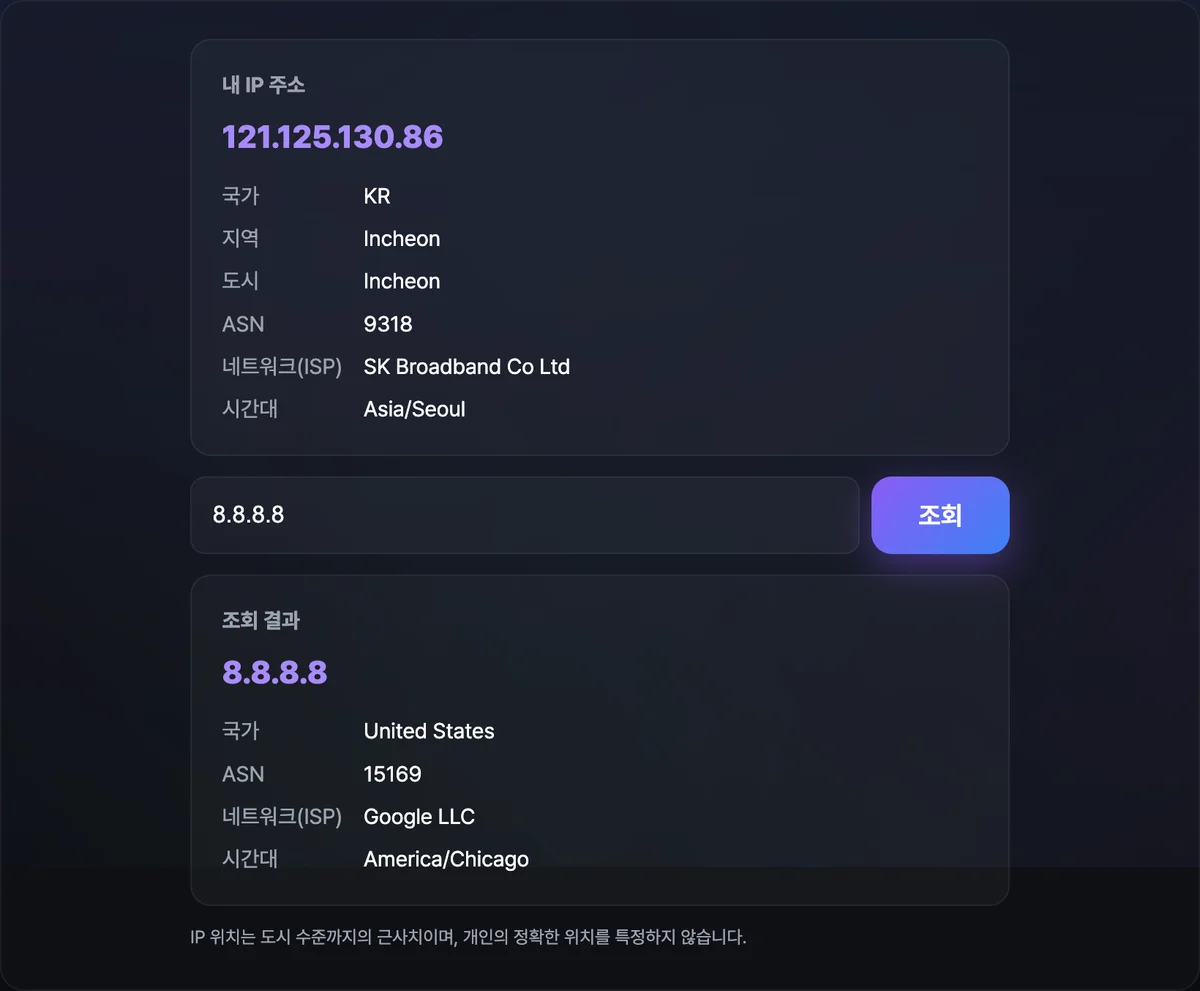
That said, whois only shows registration data — it won't give you the estimated city, ASN, or time zone all at once. And hunting down a command just to check one IP is a hassle. The tool below shows country, region, city, ASN, ISP, and time zone on a single screen, for both your own IP and any IP you enter.
See the country, region, city, ASN, ISP and time zone for your own IP or any IP you enter, all on one screen. No install needed.

So How Do Investigators Find Out?
This is where the real distinction starts. "Looking up a location from an IP" and "identifying the subscriber who used an IP" are completely separate things, done by different parties, through different procedures, under different laws.
Only the carrier that assigned an IP knows who was using it at any given moment. Lookup sites don't have that record. Neither do individuals. Neither do companies. So the question becomes: how does anyone get that record out of the carrier?
IP access records require a court order
Article 2, item 11 of the Protection of Communications Secrets Act lists the categories of communication confirmation data, and item (g) covers "tracking data on the access point that can identify the location of the information and communications device a computer communication or internet user uses to connect to the information and communications network." The log record data in item (e) falls in the same category.
Article 13(3) of the same law requires that a request for this data "must obtain permission from the competent district court or branch court by means of a written request recording the reason for the request, the connection to the relevant subscriber, and the scope of the data needed." In urgent cases you can request first and get permission afterward, but under paragraph 4, if permission is not granted, the data must be destroyed without delay.
The government says the same thing. The Ministry of Science and ICT (MSIT) explains that communication confirmation data includes internet access records and IP addresses, and that this data is provided by telecommunications carriers only when a court has granted permission under the requirements and procedures set by the Protection of Communications Secrets Act.
Subscriber identity is a different provision
Asking who the subscriber is falls under Article 83(3) of the Telecommunications Business Act. It says that when the head of a court, the prosecution, an investigative agency, or an intelligence investigative agency requests it, the carrier "may comply with the request" — that's discretion, not an obligation — and the scope of what can be provided is limited to six items.
| No. | Item |
|---|---|
| 1 | Name |
| 2 | Resident registration number |
| 3 | Address |
| 4 | Phone number |
| 5 | User ID |
| 6 | Date of subscription or termination |
This list limits what a carrier can hand over. With IP, the direction runs the other way. Log records and access-point tracking data showing who was using a given IP are communication confirmation data under items (e) and (g) of Article 2, item 11 of the Protection of Communications Secrets Act. That puts them on the Article 13 track, which requires a court order, not the Article 83 track. The two provisions ask different questions.
Article 83(3) also limits who can make the request: the head of a court, the prosecution, an investigative agency, or an intelligence investigative agency. Ordinary people have no direct access to this route. There is no way for an individual to ask a carrier "who was using this IP?" and get an answer.
That said, "an individual can't request it directly" is different from "no one can ever find out." If a criminal complaint or report opens an investigation, investigators can go through the procedure above with a court order. It just means you have no way to find out on your own — not that the procedure itself doesn't work.
You Get Notified When Your Information Is Handed Over (Since 2024)
This is the part the posts at the top of search results almost never mention, and it's actually the most useful thing to know.
In 2022, the Constitutional Court ruled Article 83(3) of the Telecommunications Business Act unconstitutional for lacking a post-notification procedure. The law was amended accordingly and Article 83-2 was added. Investigators and other agencies must notify the person in writing, or by text message or messenger app, within 30 days of receiving telecommunications user information, stating ① the main details of the query and the purpose of use, ② who received it, and ③ the date it was received.
Notification can be deferred if grounds set by law apply. But the deferral cap applies only to grounds 3 through 5 (risk of obstructing judicial proceedings, risk of infringing reputation or privacy, risk of obstructing or delaying administrative proceedings), and even then it can be extended only twice, for up to 3 months each time. Ground 1 (national and public security) and ground 2 (threat to the life or body of a victim or similar person) have no such cap, so notification can be pushed back until the ground is resolved.
Communication confirmation data is governed by Article 13-3 of the Protection of Communications Secrets Act. The rule is notification within 30 days of the disposition; if an investigation is ongoing, notification comes within 30 days after 1 year has passed from the date the data was provided (3 years for serious crimes). Under paragraph 5 of the same article, a person who receives notification can file a written request to be told the reason for the request.
In short, if your IP access records or subscriber information are provided to investigators, you are in principle notified. When that notification arrives, and how far it can be delayed, is set out ground by ground in the provisions above.
How Big Is the Scale?
These are the figures MSIT released on December 26, 2025 for the first half of 2025 (covering 107 telecommunications carriers, counted by phone number).
| Category | Phone numbers | Year-over-year |
|---|---|---|
| Telecommunications user information | 1,505,897 | +10.6% |
| Communication confirmation data | 308,292 | +5.2% |
| Communication restriction measures | 5,790 | +9.7% |
Telecommunications user information comes to 527,492 cases when counted by document.
I'm not citing these numbers to scare you. The point is that this happens at this scale through procedures set by law, and that the statistics are published every half year — that fact alone tells you what kind of procedure this is. It isn't something anyone does quietly. It's a system that gets counted and reported.
When Your IP Location Comes Out Wrong
If a lookup result doesn't match your actual location, you can request a correction.
- MaxMind: submit the IP and the correct location on the location correction request page.
- Cloudflare: the IP geolocation docs explain how to file a correction request, and note that it takes about 48 hours to take effect.
In most cases, though, there's no need to correct anything. The city coming out wrong is also a sign that the data can't pinpoint you.
The Bottom Line
An IP is "an address on the internet," not "your address in the real world." The country, region, and city an IP lookup returns are estimates based on carrier registration data, and the companies that build that data state in their own documentation that it isn't precise enough to identify a household or a street address.
Meanwhile, only the carrier knows who used a given IP. Getting that out of them requires investigators to obtain a court order, and in principle you're notified when it's provided. That route isn't open to ordinary people, because the law limits who can request it. Still, if a criminal complaint or report opens an investigation, investigators can walk that procedure. It just means you have no way to find out on your own — not that the procedure doesn't work.
So when someone says "I know your IP," you don't need to worry about your home address. At the same time, an IP isn't nothing either. The truth sits exactly between those two statements. Run a lookup yourself and you can see with your own eyes how far it actually goes.
See the country, region, city, ASN, ISP and time zone for your own IP or any IP you enter, all on one screen. No install needed.
Frequently Asked Questions
Can you find someone's home address or apartment number with just their IP?
No. MaxMind, the company that makes IP location data, states in its official documentation that "GeoIP geolocation data has never been precise enough to identify or find a specific household, individual, or street address." Even with paid data, city-level accuracy for IPs in the United States is only "a 66% chance of being within 50km of that city." Free data is less accurate than that, and city-level accuracy by country, including Korea, hasn't been made public.
What are the latitude and longitude in an IP lookup result?
Those coordinates don't mean "this exact spot." They mean "somewhere in this circle." MaxMind provides an accuracy radius along with the coordinates, and explains that an IP is no more likely to be at the center of the circle than at any other point inside it. It only looks precise because a pin shows up on a map.
My location shows up as a city I don't even live in. Why?
Because the backbone of the IP location database is the registration information for IP ranges. If you run whois on a domestic KT range, the range itself has no address; the address is attached to the object linked as that range's administrator, and that address isn't a subscriber's home — it's KT headquarters in Bundang-gu, Seongnam. For ranges with weak correction, this registration data stays close to the original value, so the location lands on the carrier's headquarters or a densely populated center. If it doesn't match your actual location, you can request a correction from MaxMind or Cloudflare.
So is it completely impossible to identify a person from an IP?
There's no way for an ordinary person to find out directly. You simply don't have the authority to ask the carrier. Law enforcement is different, though. Under the Protection of Communications Secrets Act, IP access logs count as communication confirmation data, so they can only be requested from the carrier with permission from the competent district court. Providing subscriber personal information is limited by Article 83, Paragraph 3 of the Telecommunications Business Act to the court, prosecutors, the heads of investigative agencies, and the heads of intelligence investigative agencies as requesters. If an investigation begins based on a criminal complaint or accusation, this procedure can come into play. When information is provided, the person concerned is notified within 30 days as a rule.
This article was adapted from our Korean original. Read the Korean original