
ASRS Scoring for Adult ADHD: Positive Cutoffs Explained
Contents
- You Got a Score, but You Don't Know Why
- How It Works: The WHO ASRS v1.1 Scoring Matrix and DSM-5 Criteria
- How to Read Your ASRS Result and What to Do Next
- 5 Common Misunderstandings and Mistakes When Self-Screening
- A 5-Step Workflow to Prepare Before Your Appointment
- 7 Tips for Managing Focus in Daily Life
- Final Decision Tree: What Should You Do After the Test?
- Adult ADHD & Mental Health Key Terms Cheat Sheet
- Frequently Asked Questions
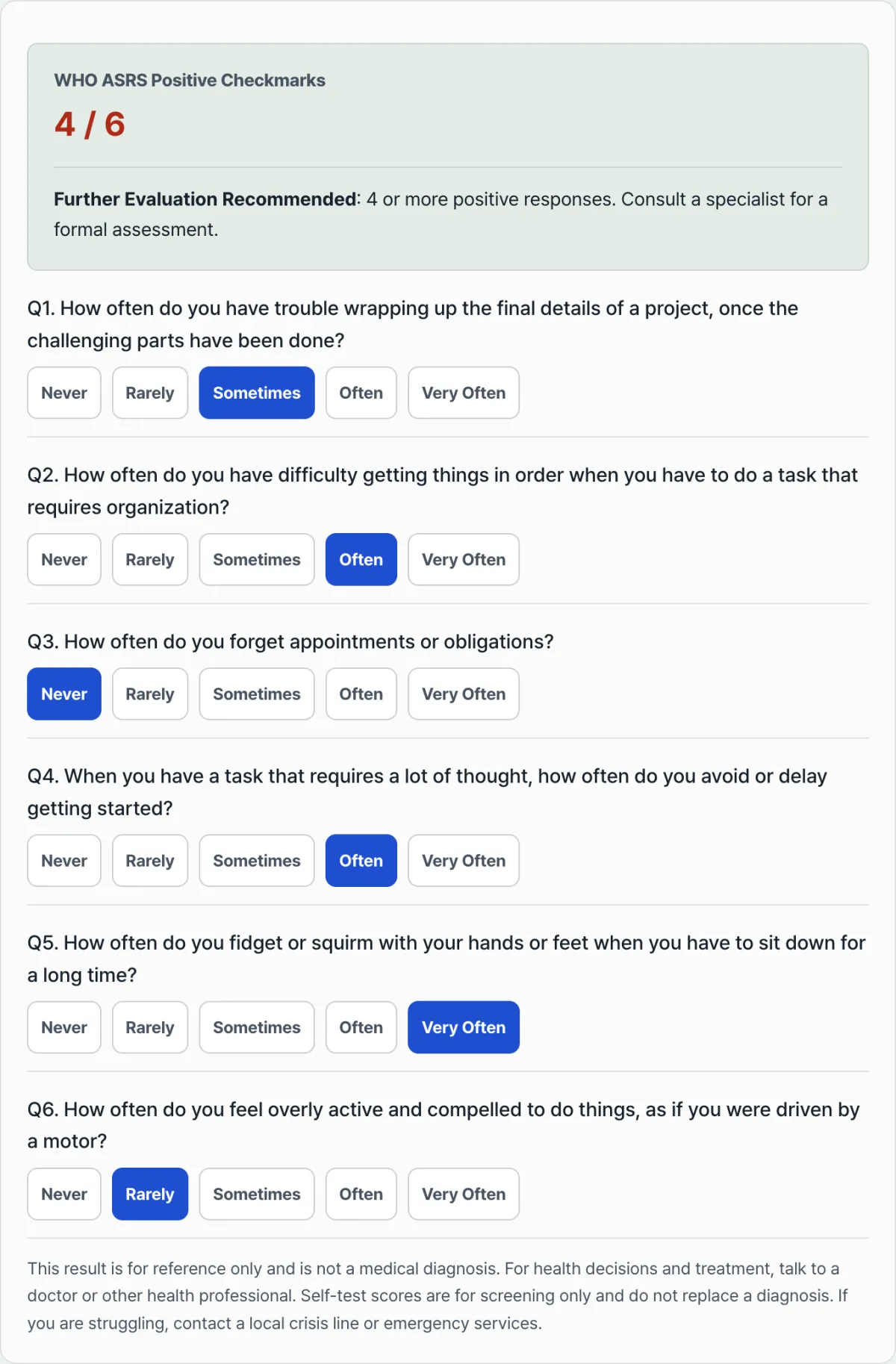
The WHO ASRS v1.1 Part A is a 6-question screener. For questions 1–3, an answer of "Sometimes" or higher counts as positive. For questions 4–6, an answer of "Often" or higher counts as positive. If four or more answers are positive, the screener recommends a further evaluation. It is not a diagnosis. It's a reference tool that helps you gauge whether you need a specialist evaluation, and you must answer all 6 questions to get a result.
If you don't know these scoring rules, a simple total score or a result message alone makes it hard to see why you got that result.
Key Takeaways ① The ASRS v1.1 Part A is a 6-question adult ADHD self-screening scale. You answer each question on a 0–4 scale (Never to Very Often). It was developed by a WHO working group and researchers. ② For questions 1–3, a score of 2 ("Sometimes") or higher counts as one "positive item." For questions 4–6, you need a score of 3 ("Often") or higher. ③ If 4 or more of the 6 items are positive, your responses are highly consistent with adult ADHD symptoms, and a further evaluation (a consultation with a specialist) is recommended. With 3 or fewer, the tool shows "Low likelihood." ④ This test is a brief screening tool. A final diagnosis must come from a comprehensive clinical evaluation by a psychiatrist.
You Got a Score, but You Don't Know Why
Many people search online for an adult ADHD self-test, answer the 6 questions, and read only the result message. Most never check which answer choices count as a positive signal.
The catch is that the cutoff depends on the question's position.
- Questions 1–3 (wrapping up tasks, organizing, remembering appointments): A score of 2 ("Sometimes") or higher counts as 1 positive.
- Questions 4–6 (putting things off, fidgeting, overactivity): You need a score of 3 ("Often") or higher to count as positive.
These cutoffs follow the shaded boxes on each question of the official ASRS scoring sheet. The per-question cutoffs differ because they were set in research that compared symptom frequency against diagnostic outcomes. No single question is meant to be read on its own.
So if you chose "Sometimes" on question 4, it does not count as positive.
Free · Takes 1 minute · Answer all 6 questions to see your ASRS positive count and result message
How It Works: The WHO ASRS v1.1 Scoring Matrix and DSM-5 Criteria
The ASRS (Adult ADHD Self-Report Scale) is a self-report scale developed by a WHO working group and researchers led by Kessler at Harvard Medical School.
1. Sensitivity and Specificity of the 6 Part A Questions
Of the 18 questions in the full ASRS, the 6 in Part A are a screening set. They were chosen because they best predicted diagnostic outcomes.
- Sensitivity (68.7%): The probability of correctly flagging adults who actually have ADHD as positive.
- Specificity (99.5%): The probability of correctly classifying people without ADHD as negative.
- Both figures come from comparing the ASRS responses of 154 people in a U.S. community sample against clinical interview results (Kessler et al., 2005, Psychological Medicine). High specificity does not mean that everyone who screens positive has ADHD. A diagnosis comes from a specialist interview.
2. Positive Cutoff by Question (Shaded Area Matrix)
| Question | What It Measures (Core Symptom) | Minimum Score for a Positive | Answers That Count as Positive |
|---|---|---|---|
| Question 1 | Trouble wrapping up a task (inattention) | 2 or higher | Sometimes / Often / Very often |
| Question 2 | Trouble getting organized (executive function) | 2 or higher | Sometimes / Often / Very often |
| Question 3 | Forgetting appointments or obligations (working memory) | 2 or higher | Sometimes / Often / Very often |
| Question 4 | Putting off tasks that require thought (avoidance) | 3 or higher | Often / Very often |
| Question 5 | Fidgeting or squirming when seated for a long time (hyperactivity) | 3 or higher | Often / Very often |
| Question 6 | Feeling overly active, as if driven by a motor (impulsivity) | 3 or higher | Often / Very often |
How to Read Your ASRS Result and What to Do Next
| Number of Positive Items | What the Tool Shows | What It Means |
|---|---|---|
| 0–3 | Low likelihood (within normal range) | You don't meet the screening cutoff. If your symptoms bother you a lot, you can still talk to a professional |
| 4–6 | Further evaluation recommended (high likelihood of a positive screen) | A psychiatrist evaluation with an interview and testing is recommended |
The official ASRS Part A cutoff has just one rule: 4 or more positives means a further evaluation is recommended. There is no official "borderline" category for 2–3 positives.
5 Common Misunderstandings and Mistakes When Self-Screening
- Mistaking your self-test result for a doctor's diagnosis: The ASRS is only a first-step screening tool. A clinician must also rule out other conditions such as depression, anxiety disorders, and thyroid disease.
- Ignoring the per-question cutoffs (2 vs. 3) and just adding up the score: Part A is read by the number of positive items, not the total score.
- Not considering whether symptoms persisted since childhood (before age 12): Adult ADHD doesn't appear suddenly in adulthood, so whether you had symptoms as a child is key.
- Confusing temporary burnout with ADHD: Trouble concentrating because of extreme work stress has a different cause than ADHD.
- Trusting unofficial online variations: Relying on internet quizzes with no verified reliability is risky.
A 5-Step Workflow to Prepare Before Your Appointment
- Step 1 (ASRS Part A test): Answer the 6 questions and check your number of positive items.
- Step 2 (Write down specific everyday problems): Note real examples that keep happening at work or school, such as being late, missing deadlines, or losing things.
- Step 3 (Find records from childhood): Gather anything that shows what you were like as a child, such as behavior comments in school records, report cards, or family members' memories.
- Step 4 (Book a psychiatrist): Visit a clinic with plenty of experience in adult ADHD.
- Step 5 (The evaluation): The diagnosis centers on a specialist interview. Depending on the case, the clinician may also refer to attention tests or questionnaires. Which tests are used depends on the clinic and your situation.
7 Tips for Managing Focus in Daily Life
- The Pomodoro technique (25 minutes of focus + 5 minutes of rest): Break work into short chunks so it's easier to start.
- Use a visual timer (Time Timer): A visual timer shows a shrinking block of color instead of numbers, so you can feel how much time is left.
- Build an "external brain": Don't try to hold every appointment and to-do in your head. Write them down right away in Notion, phone reminders, or on a whiteboard.
- Minimize visual clutter on your desk: Simplify your workspace so your phone and random items are out of sight.
- Regular aerobic exercise: Steady exercise can help with mood, sleep, and focus.
- Watch your caffeine intake: Coffee gives a short-term boost in alertness, but too much can make anxiety and impulsivity worse.
- Stick to good sleep hygiene: When you don't sleep enough, your focus drops and it gets harder to tell the cause apart from ADHD symptoms.
Final Decision Tree: What Should You Do After the Test?
- 4 or more positives ➔ Talk to a psychiatrist for a further evaluation. The more your daily life or work is affected, the less you should put it off.
- 3 or fewer positives, but you're struggling a lot ➔ Even if you don't meet the screening cutoff, you can talk to a professional if daily life is hard. Lack of sleep, depression, and anxiety can cause similar difficulties.
- 3 or fewer positives, and you're not struggling much ➔ The tool shows "Low likelihood."
Adult ADHD & Mental Health Key Terms Cheat Sheet
- ASRS (Adult ADHD Self-Report Scale): An adult ADHD self-report screening scale developed by a WHO working group and researchers.
- Executive function (frontal lobe): The brain's control tower for planning, prioritizing, inhibiting impulses, and working memory.
- Working memory: The short-term memory capacity to hold and manipulate information in the brain for a brief time.
- Dopamine: A key neurotransmitter that regulates the brain's reward circuits and sustained attention.
Frequently Asked Questions
Can adult ADHD be cured?
Adult ADHD is usually thought of as something you manage rather than cure. Many people find that medication, cognitive behavioral therapy, and other treatments ease their symptoms and daily struggles. But results and progress differ from person to person, so talk with a specialist to decide on a treatment plan.
I got 4 positive answers. Could it be depression or an anxiety disorder instead?
Yes. Chronic depression, generalized anxiety disorder, and sleep apnea can also weaken frontal lobe function and cause symptoms that look like inattention. That's why a differential diagnosis from a specialist is essential.
Does the test save my answers on a server?
No. The test runs locally in your web browser. Your personal information and answers are never sent to an outside server.
Do I get a result if I only answer a few questions?
No. You need to answer all 6 questions to see your positive count and result message. Until then, the tool only shows how many questions you've answered.
This article was adapted from our Korean original. Read the Korean original