
Wordle green, yellow, gray rules: duplicate letter logic
Contents
You've probably seen a Wordle result that doesn't add up. A letter is clearly in the answer, but Wordle marks it gray. That's not a bug. It comes from the way Wordle handles repeated letters.
Summary ① Green is always scored first, and each matching letter is immediately used up from the answer's "remaining letter pool." ② Yellow and gray are scored after all greens are handled. Wordle moves left to right and checks whether the letter is still in the pool. ③ If the answer has a letter only once but your guess uses it twice, only one copy can be green or yellow. The other must be gray.
What Order Does Wordle Use to Score Colors?
Wordle doesn't score a guess all at once. It works in two passes. If you don't know the order, you can misread the result.
The first pass is green. Wordle compares your guess with the answer position by position and finds every exact match. Each matched letter is subtracted from the answer's remaining letter count.
The second pass is yellow and gray. Wordle goes through the positions that aren't green from left to right and checks whether that letter is still available in the answer's pool. If it is, Wordle marks the tile yellow and removes one copy from the pool. If the pool is already empty for that letter, the tile is gray, even if the letter appears somewhere in the answer.
Why Does "Is the Letter in the Answer?" Lead You Astray?
Most people's instinct is to ask whether a letter exists in the answer. Wordle's actual test is different: how many times does the letter appear in the answer, and how many of those copies have already been used up somewhere else?
If the answer has a letter once and your guess uses it twice, the pool only ever held one copy. The second use has to be gray. That's not Wordle being unhelpful. It's the natural result of a pool model that counts letters.
Let's Walk Through an Example
Suppose the answer is PRIZE and your guess is SPEED. Comparing each position, no letters match exactly, so there are no greens. The answer's letter pool still holds one P, one R, one I, one Z, and one E.
Now score yellow and gray from left to right. S isn't in the pool, so it's gray. P is in the pool, so it's yellow, and the pool loses its P. The third letter, E, is still in the pool, so it's yellow, and the pool's E is used up. The fourth letter is also E. The pool has no E left, so this second E is gray, even though the answer definitely contains an E. The last letter, D, isn't in the pool, so it's gray.
Here's another case. Suppose the answer is PLANT and your guess is PIPER. The first P matches the P in the answer, so it's green, and the answer's only P is removed from the pool. Going through the remaining positions, I isn't in the pool, so it's gray. The third letter, P, is gray because the pool's P was already used up by the green. The remaining E and R aren't in the pool either, so they're gray too. As a result, even though PIPER contains P twice, one P is green and the other is gray.
What Do You Need to Check This by Hand?
Once you understand the rule, the next step is using it. You need to find a five-letter word that satisfies every green, yellow, and gray hint you've received. As the candidate list grows, flipping through a dictionary and recalculating the letter pool by hand gets old fast. When several yellows overlap and more letters are ruled out by gray, writing down letter counts on paper and checking words one by one is an easy way to make mistakes.
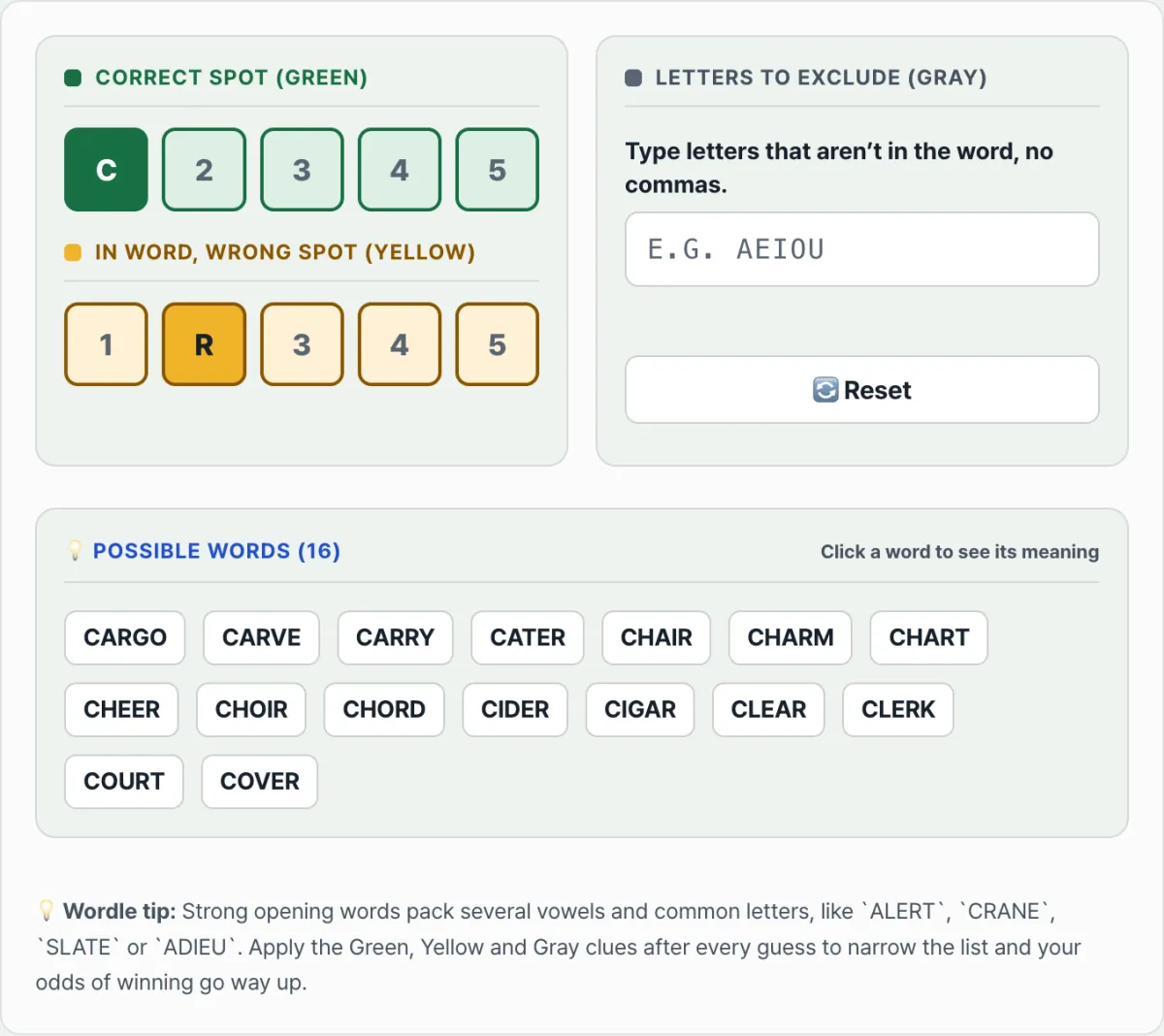
Enter the green, yellow, and gray hints you have so far, and the Wordle 5-Letter Hint Solver finds five-letter words that fit and their meanings right away
How the Wordle 5-Letter Hint Solver Does the Math
The Wordle 5-Letter Hint Solver takes the green, yellow, and gray information from every guess you've entered and applies the pool-depletion rule exactly, position by position. You don't have to count letters yourself or keep track of which positions have already used up a green.
This is especially useful when you've made several guesses with repeated letters. The tool filters the candidates in one pass and shows only the words that fit every color hint so far without a contradiction. It also shows an English definition for each candidate, so you can pick your next guess based on meaning instead of throwing in any word that fits.
Key Takeaways
- Wordle scores in two passes. It locks in greens first, uses those letters up from the answer's remaining pool, then scores yellow and gray.
- Yellow and gray are scored left to right. A letter turns yellow only if a copy is still left in the pool.
- If a letter appears once in the answer but twice in your guess, one copy must be gray. That's a designed rule, not an error.
- Don't ask "Is the letter in the answer?" Ask "Is an unused copy still in the pool?" That's how you read the colors correctly.
- As hints pile up, filtering candidates with a tool is faster and more accurate than recalculating the pool by hand.
Enter the green, yellow, and gray hints you have so far, and the Wordle 5-Letter Hint Solver finds five-letter words that fit and their meanings right away
Frequently Asked Questions
Why Did One of My Two Yellow Letters Turn Gray in Wordle?
Because the number of copies in the answer is what matters. If the answer contains only one copy of that letter, the pool started with one copy, even if your guess uses it twice. Wordle processes tiles from left to right, so the first copy can be yellow or green and the second becomes gray.
Can a Letter Be Gray Even Though It's in the Answer?
Yes. If the answer has one copy of a letter and your guess uses it two or more times, any copy that appears after the first one has been used as green or yellow will be gray. If you assume that letter is completely absent from the answer, you'll make a bad call on your next guess.
Does Wordle Score Green or Yellow First?
Green always comes first. Wordle finds every exact position match and uses those letters up from the answer's pool before it scores yellow and gray on the remaining tiles. Because of that order, a letter already used by a green may no longer be available when Wordle scores yellow.
Is It a Disadvantage to Guess a Word With Repeated Letters?
Not necessarily. If the answer also contains that letter twice, both copies can get a color. But when you don't know how many copies the answer has, repeated letters make the result harder to read. Don't rule a letter out completely just because you saw one gray tile. Consider it together with the colors from the other positions.
This article was adapted from our Korean original. Read the Korean original