
Dog Food Portion Calculator: RER & DER Formulas Explained
Contents
This post is for anyone who has wondered where the numbers on the "feeding amount by weight" table on the back of a food bag — or on the handout from your vet — actually come from. The short answer: those numbers start with a resting energy requirement (RER) calculated from body weight, multiply it by a factor for life stage and neuter status to get daily energy requirement (DER), then divide by the food's calorie density (kcal/kg). The formulas themselves are fixed, so you can work through them by hand using the steps below.
Summary ① Daily energy requirement (DER) is the resting energy requirement (RER), which scales with body weight to the power of 0.75, multiplied by a factor for life stage and neuter status. ② Doubling body weight does not double the feeding amount. The 0.75 exponent makes the increase flatten out. ③ Even with the same DER, a different kcal/kg number on the food bag changes the final gram amount a lot.
Why feeding amounts get confusing
It's common to switch to a new food and keep scooping the same number of cups as before. The problem is that calorie density (kcal/kg) varies from food to food. If the new food packs more calories per volume and you feed the same amount, your dog is actually taking in a different number of calories.
The "feeding amount by weight" tables on vet handouts and food bags have the same limitation. Those tables are pre-calculated using one specific product's calorie density and a typical life stage. If your pet's neuter status or life stage doesn't match those assumptions, the numbers won't line up exactly.
In the end, feeding amount isn't a number set by body weight alone. It's the result of a calculation that takes in three things: body weight, life stage, and the food's calorie density.
How to calculate it by hand, no calculator app needed
The whole calculation has five steps, and a basic calculator is all you need to follow along.
Step 1: Find the resting energy requirement (RER)
The formula is RER = 70 × (body weight in kg)^0.75. Put the weight in kilograms, raise it to the 0.75 power, and multiply by 70 to get the calories (kcal) needed for basic daily metabolism. For example, at 5 kg, 5 to the 0.75 power is about 3.34, and multiplying by 70 gives an RER of about 234 kcal/day.
The key detail is that the exponent is 0.75, not 1. If a 5 kg dog goes to exactly double the weight at 10 kg, 10 to the 0.75 power is about 5.62 — only about 1.68 times the 5 kg value of about 3.34. So when body weight doubles, RER doesn't double; it rises only about 1.68 times. That's because bigger bodies have a relatively lower metabolism per kilogram of body weight, which is why the exponent is set at 0.75 instead of 1.
Step 2: Look up the life stage and neuter status factor
The factor you multiply RER by is set by species and condition, as shown below.
| Type | Condition | Factor |
|---|---|---|
| Dog | Growth (puppy) | 3.0 |
| Dog | Neutered adult | 1.6 |
| Dog | Intact adult | 1.8 |
| Dog | Obese | 1.0 |
| Dog | Senior | 1.4 |
| Cat | Growth (kitten) | 2.5 |
| Cat | Neutered adult | 1.2 |
| Cat | Intact adult | 1.4 |
| Cat | Obese | 0.8 |
| Cat | Senior | 1.15 |
Step 3: Calculate DER
DER = RER × factor. Using the 5 kg neutered adult dog example from above, multiply the RER of about 234 kcal by 1.6 to get a DER of about 374 kcal/day.
Step 4: Convert to grams using the food's calorie density
The back of a food bag usually lists calories in kcal/kg. The grams to feed come from (DER ÷ kcal/kg) × 1000. For example, if the food is 3500 kcal/kg, then 374 ÷ 3500 × 1000 = about 107 g per day.
Step 5: Convert to paper cups
For dry food, assume a standard paper cup holds roughly 80 g, then divide the gram amount by 80 to get cups. In the example above, 107 ÷ 80 = about 1.3 cups.
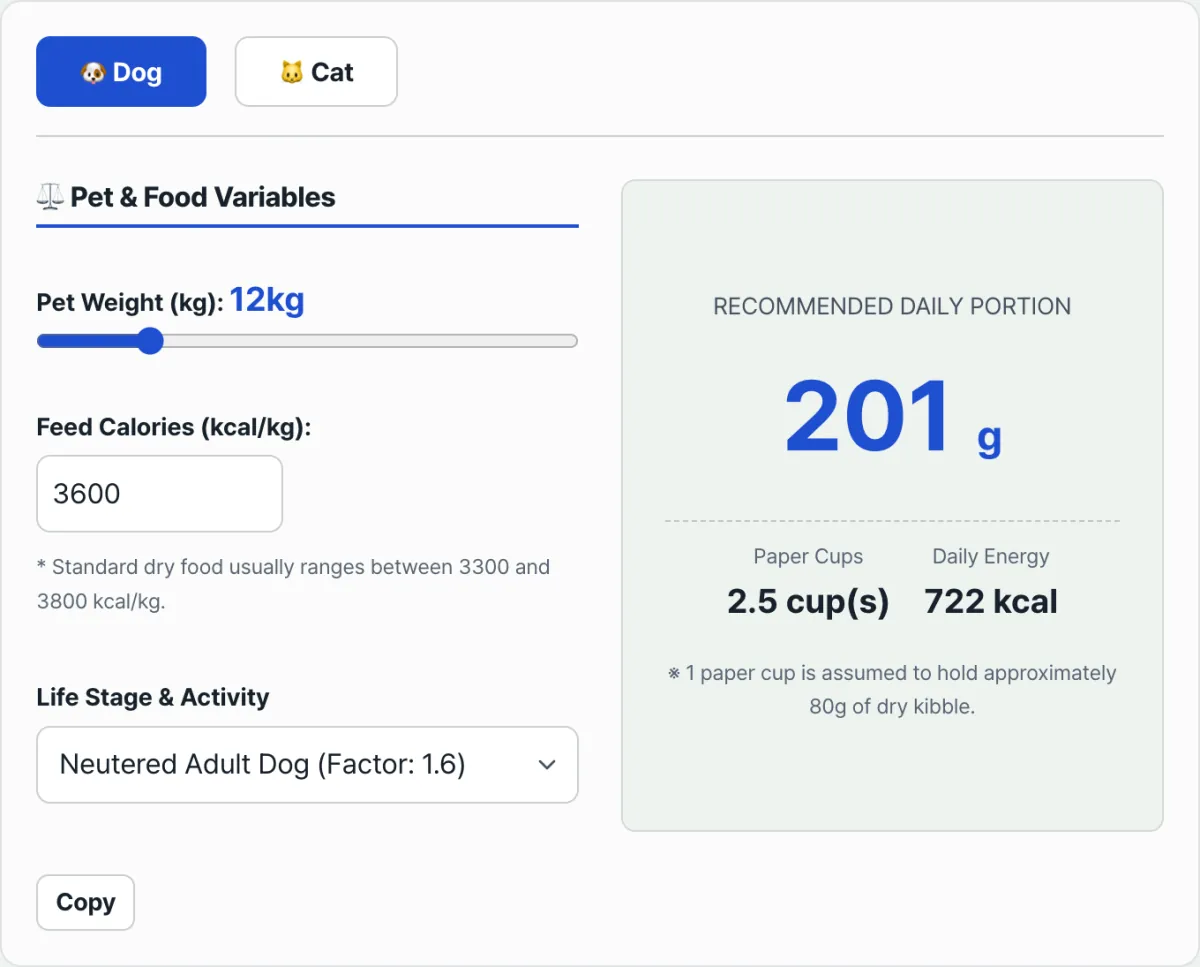
Check it with our tool.
Enter your pet's weight, food calories (kcal/kg), and life stage for free, and it instantly calculates the daily serving in grams and cups.
Points that often cause confusion
Even once you understand the structure of the calculation, there are spots where people get stuck when they plug in real numbers. The table below summarizes which input affects which part of the result.
| Input | Effect on the result |
|---|---|
| Body weight | Used in the RER calculation; because of the 0.75 exponent, it rises more slowly than the weight increase |
| Life stage and neuter status | Acts as the multiplier in the DER calculation, so a different factor gives a different DER even at the same weight |
| Food kcal/kg | The value you divide by for the final gram amount; a higher number (higher-calorie food) means fewer grams |
The most common mistake is misreading the unit on the calorie label. Some products list kcal/kg and others list kcal/100g. 350 kcal/100g is the same as 3500 kcal/kg, but if you enter 350 without checking the unit, your result will be off by a factor of 10.
The factor changing with neuter status isn't arbitrary either. It's generally accepted that metabolism tends to drop after neutering, so neutered pets get a lower factor (1.6 for dogs, 1.2 for cats) than intact pets (1.8 for dogs, 1.4 for cats) at the same body weight.
The 80 g per paper cup figure assumes an average volume-to-weight ratio for dry food. Actual weight varies with kibble size, density, and whether the food is wet, so treat the cup number as a rougher estimate than the gram number.
Recap
- RER = 70 × (body weight in kg)^0.75, and DER = RER × the factor for life stage and neuter status.
- Grams to feed = (DER ÷ food kcal/kg) × 1000, and paper cups = grams ÷ 80.
- Doubling body weight doesn't double the feeding amount. The 0.75 exponent makes the increase flatten out.
- At the same weight, a different life stage or neuter status changes the factor, which changes DER.
- Check the unit on the food's kcal/kg number (per kg or per 100 g) so your gram result is accurate.
Enter your pet's weight, food calories (kcal/kg), and life stage for free, and it instantly calculates the daily serving in grams and cups.
Frequently asked questions
What do RER and DER mean?
RER (Resting Energy Requirement) is the baseline metabolic calories calculated from body weight alone. DER (Daily Energy Requirement) is the estimated daily calorie need you get by multiplying RER by a factor for life stage and neuter status. Feeding amounts are ultimately calculated from DER.
If my dog weighs twice as much, should I feed twice as much?
Following the formula, no. Because the RER formula scales with body weight to the 0.75 power, doubling the weight raises RER only about 1.68 times when the same factor applies. That reflects the relationship where larger bodies need relatively fewer calories per kilogram.
What if the food bag lists kcal/100g instead of kcal/kg?
Multiply by 100 to convert it to kcal/kg before putting it into the calculation. For example, 350 kcal/100g becomes 3500 kcal/kg. If you misread the unit and enter it as-is, your gram result will be off by a factor of 10.
Do these factors apply the same way to every pet?
These factors are based on typical life stages and neuter status. The formula itself is fixed, but the result is a reference number that shows how the calculation works — it doesn't account for individual variation.
This article was adapted from our Korean original. Read the Korean original