
Pregnancy Weeks From Last Period: Why 4 Weeks Is Really 2
Contents
- Let's fix the starting point first: 0 weeks 0 days is your period start date
- So "4 weeks" means "2 weeks since conception"
- Why anchor to the inconvenient period date?
- Where does the 280 days come from?
- What if the ultrasound dating differs: which one is right?
- A due date is a mark on the scale, not a deadline
- Frequently asked questions
Pregnancy weeks are counted from the first day of your last period (LMP). So when you're told you're "4 weeks pregnant," conception actually happened only about 2 weeks ago — and that 2-week gap is the whole reason pregnancy weeks get confusing.
In short 0 weeks 0 days of pregnancy = the first day of your last period. Conception happens about 2 weeks later, so your pregnancy week count is usually about 2 weeks ahead of the baby's actual age. A due date is a mark on the scale at LMP + 280 days (40 weeks 0 days), not a deadline.
Let's fix the starting point first: 0 weeks 0 days is your period start date
The starting point for pregnancy weeks is not the day you conceived — it's the day your last period started. That day is "0 weeks 0 days."
Lock in that one fact and every other number follows. The moment you pass your expected period date and think "could I be?" is about 4 weeks. The due date is 40 weeks 0 days. Whatever day you're on now is just that starting point plus the elapsed days.
Korea's National Health Information Portal (KDCA) uses the same rule: "The total length of pregnancy is roughly 280 days, or 40 weeks, from the first day of the last menstrual period."
So "4 weeks" means "2 weeks since conception"
Ovulation and conception happen in the middle of your cycle — about 2 weeks after your period starts. But the week count has already been running from your period start date, 2 weeks before that.
The result: the baby's actual age is usually about 2 weeks younger than the pregnancy week count. The MSD Manual (Consumer Version) puts it precisely:
"As a result, the fetus is usually about 2 weeks younger than the number of weeks assigned to the pregnancy. That is, a woman who is 4 weeks pregnant is carrying a 2-week-old embryo."
The NHS goes a step further and notes that by this counting method, "the first 2 weeks or so are not actually pregnancy at all — your body is preparing to ovulate." So "I missed my period 2 weeks ago, how am I 4 weeks pregnant?" isn't a mistake on your part. It's how the counting system was designed.
Why anchor to the inconvenient period date?
If conception or ovulation dates look more accurate, why use the period date? That's the real question. The answer is not because it's accurate, but because it's the only date you can actually observe.
Most people don't know their ovulation or conception date exactly. But anyone can pin down the first day of their last period. So medicine chose a standard "everyone can count the same way" over "the most accurate possible date."
The Merck Manual (Professional Version) sums up the trade-off in one sentence:
"Defining gestational age by the last menstrual period is the universal standard used by obstetricians and neonatologists when discussing fetal maturity, but it is not an accurate measure of the actual weeks of fetal development."
In other words, that 2-week offset isn't a bug. It's the price everyone agreed to pay so we're all reading the same scale.
Where does the 280 days come from?
The 280 in the due date formula "LMP + 280 days" comes from the same rule. 28-day cycle × 10 cycles = 280 days = 40 weeks.
The manual way to work this out is Naegele's rule. Take the first day of your last period, add 7 days, subtract 3 months, then add 1 year — that's your due date. It works with nothing but paper, and the KDCA gives the same method.
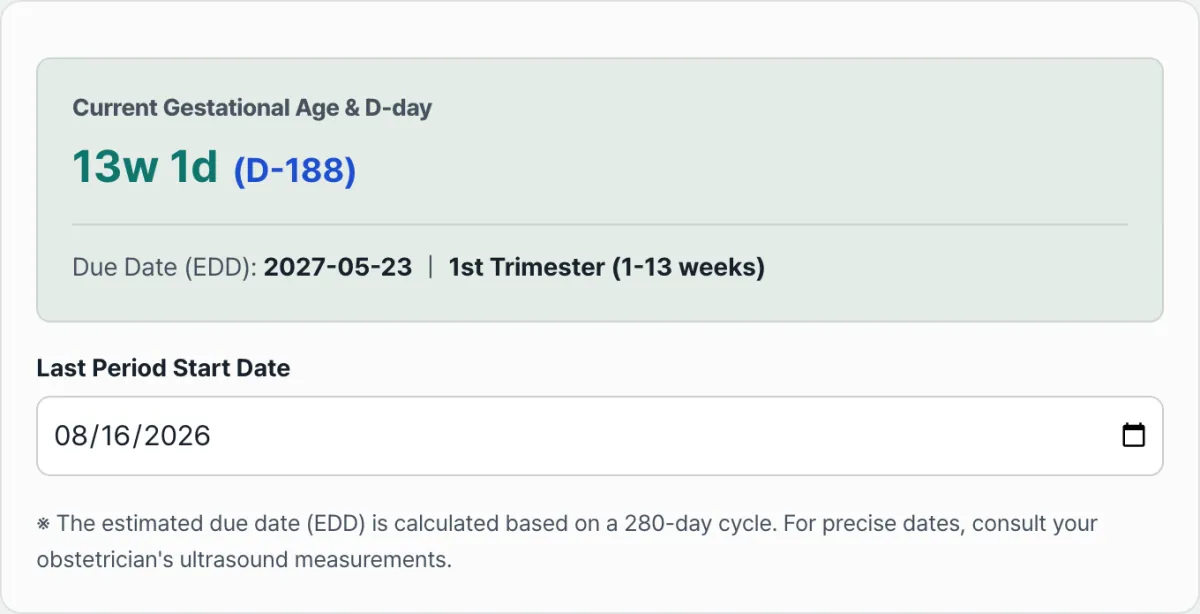
There's a hidden assumption in it. According to StatPearls (NIH), this calculation assumes a 28-day cycle with ovulation on day 14. So if your cycle is longer, say 35 days, ovulation and conception come later, and the LMP-based due date can drift from reality. The Pregnancy Week Calculator below uses the same 28-day assumption, so you only enter your last period start date and it shows your current week, due date, and D-day using that formula.
Enter just the first day of your last period and it calculates your current pregnancy week, due date, and D-day all at once
What if the ultrasound dating differs: which one is right?
The week count from your hospital ultrasound and the one from a calculator often differ by a few days. This isn't a judgment call — it's a procedure for setting the date, so there are rules for it.
An ultrasound before 13 weeks 6 days (first trimester) is the most accurate. Measuring the embryo's crown-rump length (CRL) at this stage carries a margin of error of roughly ±5–7 days. Under the ACOG criteria reproduced in StatPearls, if the gap between LMP and ultrasound exceeds the number of days below for that timing, the pregnancy is re-dated by the ultrasound.
| Ultrasound timing | Re-date by ultrasound if the gap exceeds |
|---|---|
| Up to 8 weeks 6 days | 5 days |
| 9 weeks 0 days–13 weeks 6 days | 7 days |
| 14 weeks 0 days–15 weeks 6 days | 7 days |
| 16 weeks 0 days–21 weeks 6 days | 10 days |
| 22 weeks 0 days–27 weeks 6 days | 14 days |
And once a due date is set, the standard is generally not to change it afterward (ACOG Committee Opinion 700). So the practical answer to "which one is right" is whichever was established first keeps standing. Ultrasounds done later carry more error (in the third trimester, ±3 weeks or more), so they aren't used as the reference.
The calculator shows you the LMP-based "standard scale." If your hospital has given you a due date adjusted by ultrasound, go with that one.
A due date is a mark on the scale, not a deadline
The "D-day" the tool shows just counts how many days remain until 40 weeks 0 days. It doesn't mean the baby arrives that day.
The NHS considers a normal pregnancy to run "from 37 to 42 weeks from the first day of your last period." ACOG (Committee Opinion 579) defines full term as 39 weeks 0 days to 40 weeks 6 days, with 37–38 weeks as early term and 41 weeks as late term.
So the due date at 40 weeks 0 days is just a mark in the middle of a wide normal range. Going a few days past it, or a few days early, is perfectly normal under this scale idea.
Enter just the first day of your last period and it calculates your current pregnancy week, due date, and D-day all at once
Frequently asked questions
Why do pregnancy weeks count from your period instead of conception?
Because most people don't know their conception or ovulation date exactly, but anyone can identify the first day of their last period. It's a standard chosen for "can everyone count the same way" rather than for accuracy. The trade-off is a number that's usually about 2 weeks ahead of the baby's actual age.
If I'm 4 weeks pregnant, is my baby 4 weeks old?
No. Pregnancy weeks count from your period start date, and the baby's age counts from conception, so there's about a 2-week difference. At 4 weeks pregnant, the embryo is about 2 weeks old. The MSD Manual gives the same example.
Where does the 40 weeks (280 days) figure come from?
It's a 28-day cycle repeated 10 times (28 × 10 = 280 days = 40 weeks). It matches Naegele's rule — add 7 days, subtract 3 months, add 1 year to your last period start date — and assumes a 28-day cycle with ovulation on day 14. If your cycle is longer or shorter, the result can be off.
My calculator due date and my hospital due date differ: which one should I trust?
If your hospital adjusted your due date with an early ultrasound, go with that one. An early ultrasound is the most accurate, and once a due date is set, the standard is generally not to change it. The calculator is there to show you the standard scale based on your last period.
This article was adapted from our Korean original. Read the Korean original