
Toggle Case Converter: Invert, Alternate (aBaB), or Randomize
Contents
You'd think flipping the case of an English text — inverting every letter, or alternating letter by letter — would take a complicated rule. It doesn't. Our tool handles it four ways, and once you know exactly what each one computes, the output stops being a mystery.
Here's the full breakdown: Invert, alternating aBaB, alternating AbAb, and random. What each one does, and why Korean characters, digits, and spaces come out untouched. Examples included.
Summary ① Invert flips the case of every single letter (uppercase↔lowercase). ② Alternating (aBaB/AbAb) counts only alphabet letters and alternates lowercase/uppercase across them; spaces, digits, and symbols don't advance the count. ③ Random assigns each letter a 50/50 chance, so the result changes every time you run it.
Why changing case one letter at a time is such a hassle
When people want a mocking tone on social media or in forums, you often see text with alternating case (like aLtErNaTiNg cApS). Same thing when you're making a meme or going for a distinctive text effect.
The problem is that swapping each letter by hand is tedious. Slip one character out of sync, or miscount a space as one step, and the whole rhythm falls apart.
What you need here isn't judgment — it's a fixed rule. Once you know which rule produces which change, the result is always predictable (random mode is the only exception).
The rules for doing it by hand
All four modes can be done manually. Here's how.
The four conversion rules
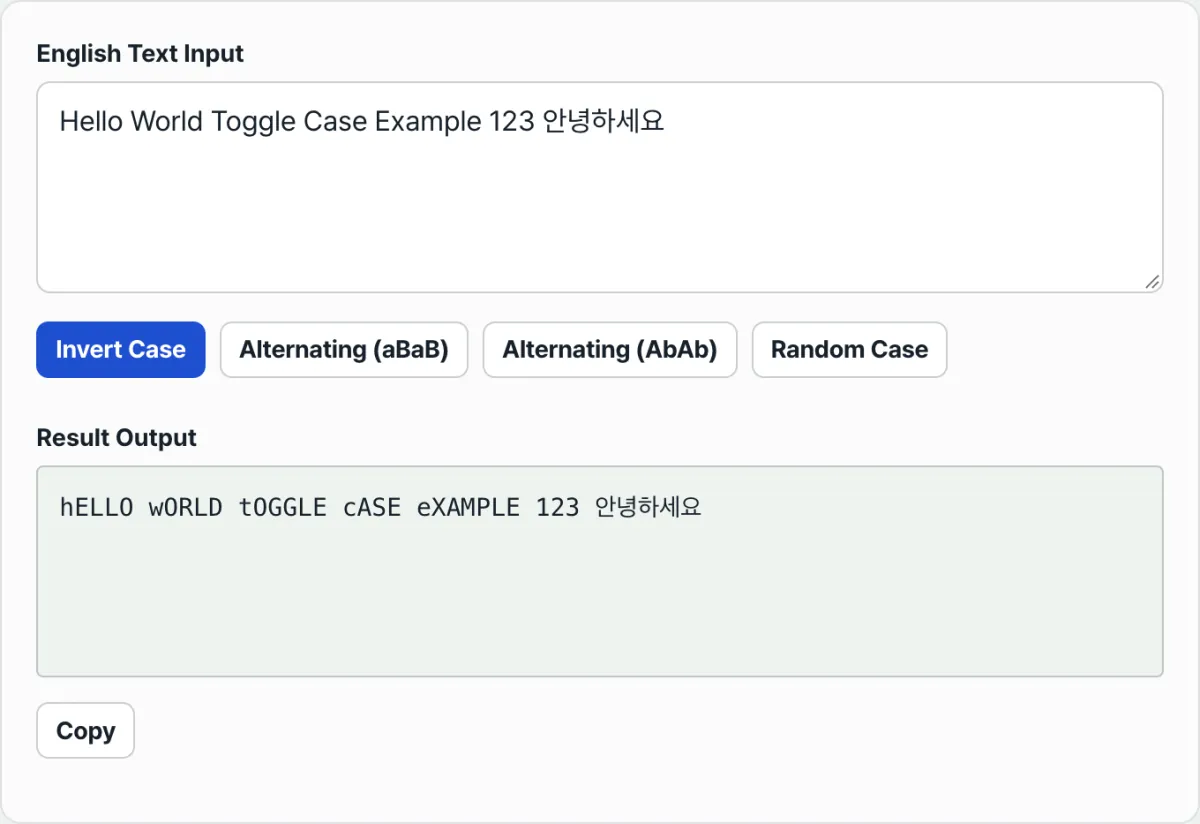
Invert — For each letter, uppercase becomes lowercase and lowercase becomes uppercase. Anything that isn't a letter (Korean characters, digits, spaces, symbols) is left exactly as it is.
Alternating aBaB — Start the first alphabet letter as lowercase, then alternate lowercase/uppercase for each alphabet letter that follows. Non-letter characters stay as they are and don't advance the count.
Alternating AbAb — Only the starting point differs. Start the first alphabet letter as uppercase, then alternate. Everything else works the same as aBaB.
Random — For each letter, flip a coin: 50/50 for uppercase or lowercase. Non-letters stay as they are.
Check it with examples
With the input Hello World, each mode gives you:
- Invert:
hELLO wORLD - Alternating aBaB:
hElLo WoRlD - Alternating AbAb:
HeLlO wOrLd
Here's one more example that shows the heart of alternating mode. Turn ab cd into aBaB and you get aB cD.
If the space in the middle had pushed the count by one, c would have become uppercase and you'd get aB Cd. But a space doesn't touch the count, so c stays lowercase and d becomes uppercase, giving you aB cD naturally. That's why a space never breaks the rhythm.
Korean characters and digits work the same way. Invert Hello 서울 2026! and you get hELLO 서울 2026! — only the alphabet letters flip, everything else is untouched.
Try it with our free tool.
Convert right in your browser — no install, no sign-up. All four modes (invert, alternating aBaB/AbAb, and random) show results as you type.
The points people trip over most
There are three common misunderstandings: whether Korean characters and digits change, whether spaces shift the sequence in alternating mode, and whether a random result can be reproduced.
Here's how the four modes compare at a glance (input is Hello).
| Mode | What it does | Result per run | Hello → |
|---|---|---|---|
| Invert | Flips case letter by letter | Always the same | hELLO |
| Alternating aBaB | Alternates starting lowercase | Always the same | hElLo |
| Alternating AbAb | Alternates starting uppercase | Always the same | HeLlO |
| Random | 50:50 per letter | Different every time | (e.g., hELlo) |
To sum up: all four modes only touch letters (a-z, A-Z). Korean characters, digits, spaces, and special characters are left alone. Alternating mode only advances the count when it hits a letter, so spaces never throw off the sequence.
Random is the odd one out. The same input gives a different result on each run, so a result you've already seen won't come back exactly the same way.
The short version
Here's the core again.
- Invert flips uppercase↔lowercase entirely, and the result is always fixed.
- Alternating applies only to letters; aBaB starts lowercase and AbAb starts uppercase.
- In alternating mode, spaces, digits, and symbols don't advance the count, so the rhythm holds even with spaces in the text.
- Random is 50/50 per letter, so the result differs every run.
- In every mode, Korean characters, digits, and special characters are preserved as-is.
Convert right in your browser — no install, no sign-up. All four modes (invert, alternating aBaB/AbAb, and random) show results as you type.
FAQ
Do Korean characters or digits change case?
No. All four modes only convert letters (a-z, A-Z). Korean characters, digits, spaces, and special characters stay exactly as they were. For example, inverting Hello 서울 2026! gives you hELLO 서울 2026! — only the letters flip.
Do spaces in alternating mode throw off the sequence?
No. The alternating count only moves up when a letter appears, and spaces, digits, and symbols don't affect it. That's why ab cd becomes aB cD in aBaB. The c after the space just picks up the lowercase turn.
I like a random result: can I generate it again?
Getting that exact same result again isn't guaranteed. Random decides 50/50 for each letter every time. A result you got once will come out differently on the next run, so you can't reproduce the previous one.
What's the difference between aBaB and AbAb?
If the first letter starts lowercase, it's aBaB. If it starts uppercase, it's AbAb. After that, both alternate letter by letter. For example, Hello becomes hElLo in aBaB and HeLlO in AbAb.
This article was adapted from our Korean original. Read the Korean original