
N·m to kgf·m Conversion: Fix the 12x lb-ft vs lb-in Mistake
Contents
This article is for anyone who needs to take a torque value listed in N·m in a service manual or an overseas document and read it in the kgf·m, lb·ft, or lb·in markings on the tool in their hand or in local documentation.
These four units convert only through fixed constants (9.80665, 1.3558179483314, 0.11298482902762), so once you understand the principle you can work them out by hand without a calculator.
This article covers that calculation principle and the spots where misreading kgf·m, lb·ft, or lb·in markings throws the value off badly.
Summary ① To convert N·m to kgf·m, divide by 9.80665; to convert to lb·ft, divide by 1.3558179483314; to convert to lb·in, divide by 0.11298482902762. ② The "kg" in kgf isn't mass. It's a unit of force that already has gravitational acceleration (9.80665 m/s²) multiplied in, so if you confuse it with weight (kg), you'll easily set the calculation in the wrong direction. ③ lb·ft and lb·in look similar, but 1 ft = 12 in, so mixing them up makes the result exactly 12 times off.
Why this conversion comes up so often
Service manuals and analog torque wrenches that have been used for a long time often use kgf·m markings. Imported car manuals, overseas spec sheets, and online sources, on the other hand, often list N·m or lb·ft.
Because each source uses a different base unit, you can't compare the number you see directly against the scale on your tool.
Add in units with similar names like lb·ft and lb·in and the confusion gets worse. Both contain "pound-force," but whether the reference distance is feet or inches changes the value completely. If you don't read the marking correctly, you can do the math right and still land on the wrong result.
The principle: know the constants and you can do it by hand
All four units are torque units defined as "force × distance." They just express the same rotational force on different bases. That's why they convert exactly through the fixed proportionality constants below.
- kgf·m → N·m: kgf (kilogram-force) is a unit of force equal to the mass of 1 kg multiplied by standard gravitational acceleration of 9.80665 m/s². 1 kgf·m = 9.80665 N·m, so to go the other way and convert N·m to kgf·m, divide by 9.80665.
- lb·ft → N·m: 1 lb·ft (pound-force foot) is 1.3558179483314 N·m. To convert N·m to lb·ft, divide by this value.
- lb·in → N·m: 1 lb·in (pound-force inch) is 0.11298482902762 N·m. To convert N·m to lb·in, divide by this value.
Here's what it looks like worked out. If the manual says "34 N·m" and you have a wrench with kgf·m markings, 34 ÷ 9.80665 = 3.4670 kgf·m (rounded to four decimal places).
The other direction works the same way. If an overseas source says "80 lb·ft," then 80 × 1.3558179483314 = 108.4654 N·m. To convert that to kgf·m, divide by 9.80665 and you get 11.0604 kgf·m.
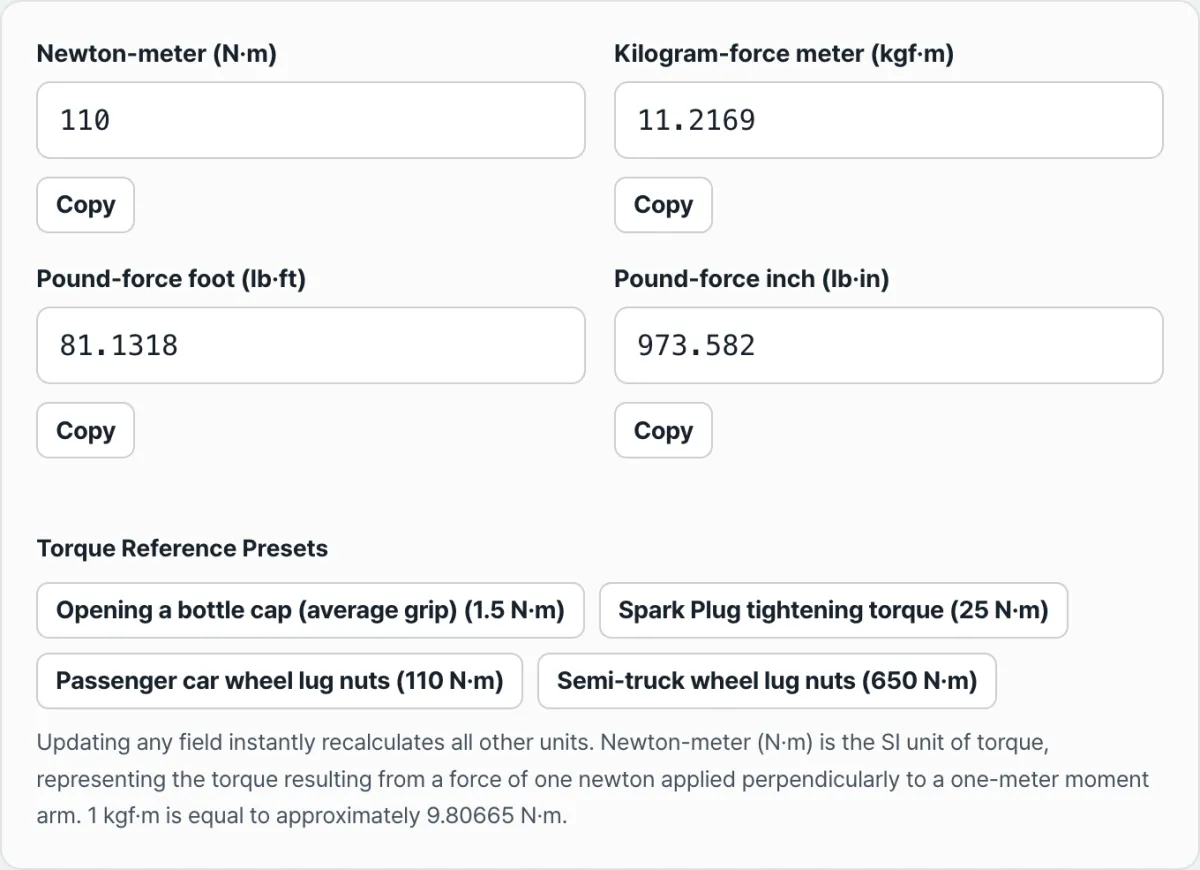
If multiplying and dividing by these constants every time is a hassle, it's faster to use a tool where you type a number into one field and the rest fill in automatically. Check it with our tool.
A free converter that calculates all four units — N·m, kgf·m, lb-ft, and lb-in — the moment you type a value.
Where misread markings throw the value off
Even if you calculate the number correctly, reading the unit marking itself wrong will throw off the result. These three in particular get mixed up a lot.
| Marking | What it actually means | Common mistake |
|---|---|---|
| kgf·m | Force from 1 kg of mass times gravitational acceleration × 1 m distance | Mistaken for the same unit as "kilogram (mass)" |
| lb·ft (ft-lb) | Pound-force × feet of distance | Mistaken for the same value as lb·in |
| lb·in (in-lb) | Pound-force × inches of distance | Mistaken for the same value as lb·ft (it's actually 12 times different) |
| N·m / Nm | Newton × meter (SI unit) | The middle dot is just a style difference; the value is the same |
Confusing kgf·m with weight (kg)
The "kgf" in kgf·m is already a unit of force with gravitational acceleration multiplied in. The letters overlap with kg, the unit of mass, but the physical quantity itself is different. So if you read an kgf·m figure as "how many kg of force," you'll easily set the calculation in the wrong direction.
Confusing lb·ft with lb·in
The difference between lb·ft and lb·in is clearer when you look at the numbers. Take the same figure of 50: 50 lb·ft is 50 × 1.3558179483314 = 67.7909 N·m.
If you misread it as 50 lb·in instead, you'd calculate 50 × 0.11298482902762 = 5.6492 N·m. The ratio between the two values is exactly 12, and that difference comes from 1 ft being 12 in.
Some sources write lb·ft as ft-lb and lb·in as in-lb, swapping the word order. A swapped order is the same unit, so you can ignore it. But markings that use a different distance unit, like ft versus in, are different values, and you need to keep that distinction.
The short version
- Converting N·m to another unit means dividing by a fixed constant, not multiplying: divide by 9.80665 for kgf·m, 1.3558179483314 for lb·ft, and 0.11298482902762 for lb·in.
- The kgf in kgf·m is a unit of force, not mass, so you shouldn't compare it directly with kg (mass).
- Mixing up lb·ft and lb·in gives you an error of exactly 12 times, so always check the unit marking on the source or the tool.
- N·m and Nm differ only in notation style and are the same value, so you don't need to worry about whether the middle dot is there.
A free converter that calculates all four units — N·m, kgf·m, lb-ft, and lb-in — the moment you type a value.
Frequently asked questions
What's a quick way to convert N·m to kgf·m in my head?
Divide the N·m value by 10, then add about 2%. That gives you a close approximation, because the difference between dividing by 9.80665 and dividing by 10 is about 2%.
For example, 34 N·m becomes 3.4 plus 2%, or about 3.468, which is close to the actual 3.4670. If you need the exact value, it's safer to divide by 9.80665 directly or use a converter.
Are N·m and Nm different units?
No. Whether the middle dot (·) is there is just a notation style difference; both refer to the same newton-meter value. Even if different sources write N·m, N-m, or Nm, the calculation is the same.
Are lb·ft and ft-lb the same thing?
Yes. Only the word order differs; it's the same unit (pound-force feet). lb·in and in-lb are the same unit as each other too. The thing to watch is that lb·ft (ft-lb) and lb·in (in-lb) use different reference distances, feet versus inches, so the values themselves differ. Don't confuse those two.
How many decimal places does it calculate?
This converter rounds to four decimal places. The underlying constants (9.80665, 1.3558179483314, 0.11298482902762) are fixed definition values, so apart from rounding error there's no additional error from the calculation method.
This article was adapted from our Korean original. Read the Korean original