
US Restaurant Tip Calculator: Tip, Total, and Per-Person Split
Contents
When you get the bill at a US restaurant, it's easy to freeze up over how much tip to add — and if you ate with a group, over how much each person should put in.
The whole thing comes down to two moves: multiply the bill by a percentage, then divide that total by the number of people.
The catch is that every country handles this differently. In the US and Canada, tipping is effectively required. In the UK, Germany, and France, a service charge is usually included and an extra tip is optional. In Korea and Japan, there's no tipping culture at all.
This post lays out the math, the country-by-country differences, and the spots where reading the results tends to trip people up.
Summary ① The tip total is bill amount × rate (%), the grand total with tip is bill amount + tip total, and the per-person amount is grand total ÷ number of people. ② Change the country and the default rate used in the calculation changes with it — the US and Canada sit in a near-mandatory range, the UK, Germany, and France sit in an optional range that assumes a service charge is already included, and Korea and Japan default to 0%. ③ The calculator does not judge whether tax or a service charge is already baked into the bill amount. It just multiplies the number you enter by the rate.
Why the tip math on a US restaurant bill gets confusing
When you get the bill at a US restaurant while traveling, it often shows only the subtotal and the tax, with the tip line left blank.
The receipt doesn't tell you what percentage to leave, and if you're with a group, working out each person's share in your head right before you pay is rough.
Say the bill is 186.40 dollars and four people ate together. Whether you tip 18% or 20% changes the total you pay.
That total then gets divided by 4, which gives what each person actually owes — so changing one percentage changes the per-person amount too.
How to do the math yourself without a tool
You can do all of this by hand with three steps of multiplication and division.
- Tip total = bill amount × tip rate (%) ÷ 100
- Grand total with tip = bill amount + tip total
- Per-person amount = grand total with tip ÷ number of people (if the party size is under 1, it counts as 1)
Plug the earlier example in (bill of 186.40 dollars, 4 people, 18% tip) and you get this.
- Tip total = 186.40 × 18 ÷ 100 = 33.55 dollars
- Grand total with tip = 186.40 + 33.55 = 219.95 dollars
- Per-person amount = 219.95 ÷ 4 = 54.99 dollars
That's where the math ends. What's left is which percentage to multiply by, and that default rate varies by country.
Default rates by country
| Region | How tipping works | Default rate range used in the calculation |
|---|---|---|
| US, Canada | Effectively expected | 15%–22% |
| UK, Germany, France | Service charge included; extra is optional | 0% (when included) or 5%–10% (when adding) |
| Korea, Japan | No official tipping system | 0% |
In the UK, Germany, and France, a service charge is often already included in the base amount on the receipt, so an extra tip isn't required.
Check it with our free tool.
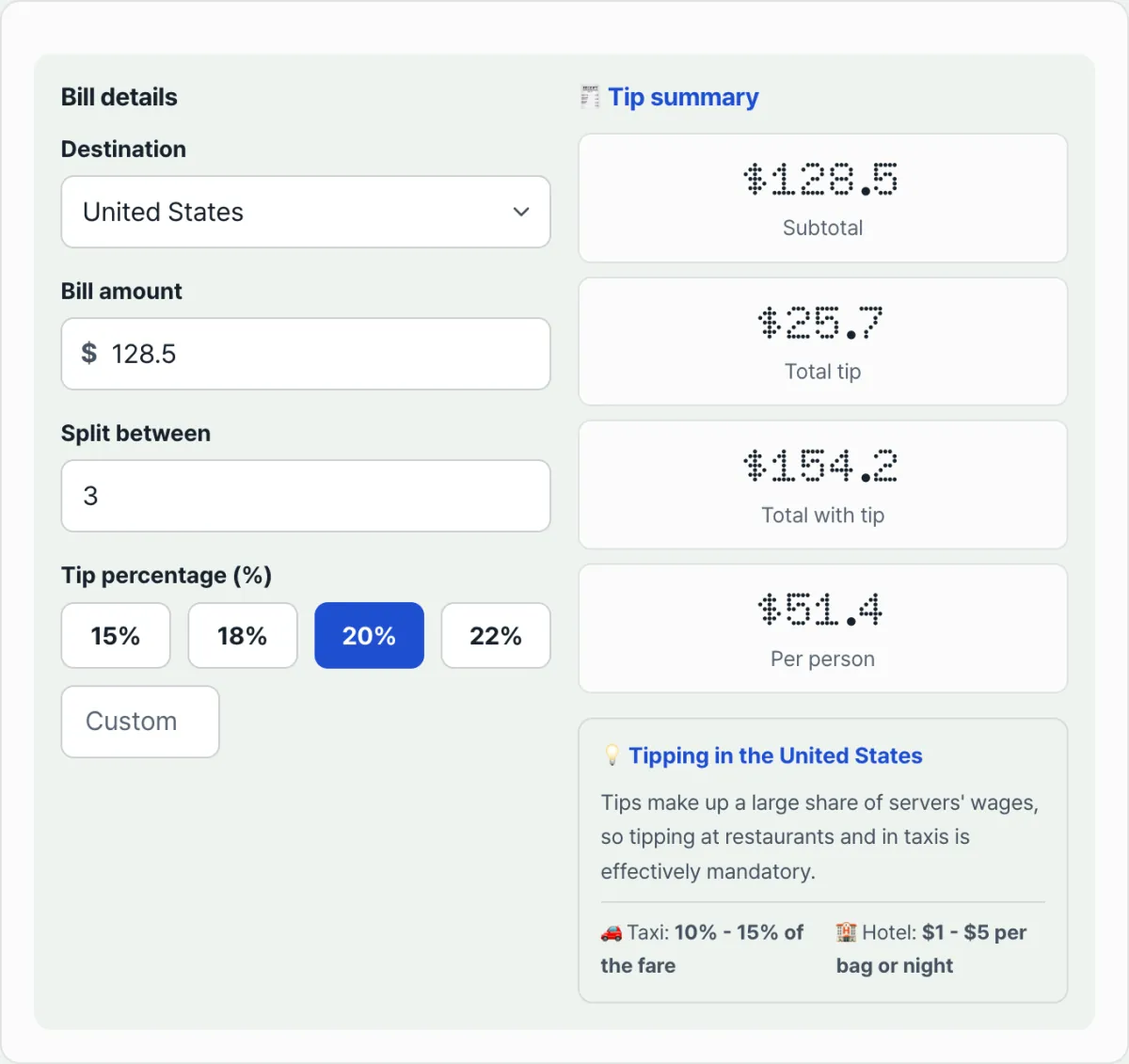
Enter a country's default tip rate, the bill amount, and the number of people, and the tool instantly works out the total tip and how much each person pays.
Where reading the results gets confusing
The formula itself is simple, but a few spots change how you should read the result depending on which number you put where.
The calculator doesn't decide for you whether the bill amount field should hold the pre-tax amount (subtotal) or the post-tax amount (total including tax).
It just multiplies whatever you enter by the rate. So whether you enter the receipt's subtotal or the total with tax added is a call you have to check and make yourself.
When a service charge is included, and switching countries
In countries where a service charge is already part of the bill amount (the UK, Germany, France, and others), multiplying that amount by a tip rate again means, structurally, that the service cost gets counted twice.
That's part of why these countries' default rate options are set to lower, optional ranges than the US.
When you switch countries, the default rate you pick with the buttons resets automatically to the new country's value.
But if you've typed in a number yourself, that value still takes priority even after you change countries. Right after switching countries, it's worth double-checking that the applied rate is the one you intended.
| Confusing point | What the calculator actually does |
|---|---|
| Pre-tax or post-tax amount? | Multiplies the number you enter by the rate as-is (no distinction) |
| Whether a service charge is included | Doesn't detect whether the amount you entered includes a service charge |
| When you have both a button rate and a typed rate | If you typed a value, that value takes priority |
| When the per-person row appears | Shown only when the party size is 2 or more |
The bottom line
- Tip total = bill amount × rate, grand total with tip = bill amount + tip total, and per-person amount = grand total ÷ number of people (minimum 1).
- If you've typed in a tip rate yourself, it takes priority over the country default.
- Switching countries resets the button rate to the new country's default, but any value you typed in stays as is.
- The US and Canada sit in a near-mandatory range, the UK, Germany, and France sit in an optional range that assumes a service charge is included, and Korea and Japan default to 0%.
- The calculator doesn't judge whether the bill amount includes tax or a service charge, so look at the receipt and decide for yourself which number to enter.
Enter a country's default tip rate, the bill amount, and the number of people, and the tool instantly works out the total tip and how much each person pays.
Frequently asked questions
Do I calculate the tip on the amount with tax, or before tax?
The calculator just multiplies the bill amount you enter by the rate — it doesn't tell whether that number is pre-tax or post-tax.
US receipts often print both the subtotal (pre-tax) and the total including tax, so you need to look at the receipt and pick which number to enter.
If the receipt in Europe already includes a service charge, do I need to calculate a tip on top of it?
The way the calculator works — multiplying the bill amount by a rate — is the same no matter the country.
That said, in countries where a service charge is already part of the bill amount, multiplying that amount by a tip rate again means, structurally, that the service cost gets counted twice.
Because of this, the UK, Germany, and France have their default rate options set to lower, optional ranges than the US.
I entered the party size, but I don't see a per-person amount.
The per-person row only shows up when the party size is 2 or more. With 1 person, the per-person amount is the same as the grand total, so it isn't displayed separately.
If I tap a tip rate button and then type a number myself, which one applies?
If you've typed in a number, that value takes priority. If the field is empty, the rate you picked with the buttons (or the country default) applies.
Switching countries resets the button rate to the new country's default, but any value you already typed in stays as is.
Right after switching countries, it's worth double-checking that the applied rate is the one you intended.
This article was adapted from our Korean original. Read the Korean original