
UV Index Scale and Safe Sun Exposure Time Calculator
Contents
The UV index number in your weather forecast doesn't tell you how many minutes you can actually stay outside once your skin type and the SPF of the sunscreen you applied are factored in.
The UV index is first sorted into five WHO risk levels, and only after you plug in skin type, SPF, a hat, and shade does the number you really want appear: safe exposure time.
This post explains what criteria and formulas each of those steps — the classification and the calculation — is built on.
Summary ① The UV index uses the WHO 0–11+ scale and splits into five levels: low, moderate, high, very high, and extreme. ② Each skin type (Fitzpatrick classification) has a different baseline time until burning, so the same UV index produces different safe exposure times. ③ SPF multiplies your safe time upward, while a hat and shade lower the UV index that actually reaches your body.
Why One Number Isn't Enough to Go On
Open a weather app and the UV index shows up as a single number. See a value like "8" and the first thing you wonder is whether that's something to worry about or not.
On top of that, this number isn't the value your skin actually gets. Whether you're wearing a hat or standing in shade changes how much UV reaches your body, and the SPF of your sunscreen changes how long you can go before burning.
So "UV index 8" alone doesn't answer "how many hours can I stay outside today?" You have to put the risk level, your skin type, SPF, a hat, and shade into a single calculation to get an answer.
How to Do the Math Yourself Without a Tool
The calculation goes through these four steps in order.
Step 1: Classify the Risk Level
Sort the UV index using the WHO scale (0–11+). The ranges break down like this.
- Low (0–2): No special precautions needed
- Moderate (3–5): Find shade around midday; SPF 15 or higher is recommended
- High (6–7): Reduce exposure between 10 a.m. and 4 p.m.; SPF 30 or higher is recommended
- Very high (8–10): Skin can burn fast, so shade, long sleeves, and SPF 30 or higher matter most
- Extreme (11 and up): Burn risk within minutes, so minimizing time outdoors is the focus
Step 2: Look Up the Base Time for Your Skin Type
The Fitzpatrick classification sorts skin by how easily it burns and how easily it tans in sunlight.
In this calculation, the baseline time until burning at a UV index of 1 is set per skin type like this.
- Very fair skin: 100 minutes
- Fair skin: 200 minutes
- Medium skin: 300 minutes
- Dark skin: 450 minutes
- Very dark skin: 600 minutes
The bigger the number, the longer that baseline lasts at the same UV index.
Step 3: Calculate the Actual Exposure UV Index
A hat and shade don't change the risk level itself. They're factored in by lowering how much UV actually reaches your body.
Actual Exposure UV Index = UV index × (0.5 with shade, 1 without) × (0.7 with a hat, 1 without)
Step 4: Calculate Safe Exposure Time
SPF comes in as a multiplier applied to the result of dividing by the Actual Exposure UV Index.
Safe exposure time (minutes) = (baseline minutes for your skin type ÷ Actual Exposure UV Index) × SPF multiplier
The SPF multiplier is 1 with no sunscreen, 15 for SPF 15, 30 for SPF 30, and 50 for SPF 50 and above. However large the result gets, the display caps at 480 minutes (8 hours).
Worked Example
Here's the math for a UV index of 8 with medium skin (300-minute baseline).
- No precautions: actual exposure 8 → 300 ÷ 8 = 38 minutes
- Hat only: actual exposure 8 × 0.7 = 5.6 → 300 ÷ 5.6 ≈ 54 minutes
- Shade plus hat: actual exposure 8 × 0.5 × 0.7 = 2.8 → 300 ÷ 2.8 ≈ 107 minutes
- SPF 30 applied (no other precautions): actual exposure 8 → (300 ÷ 8) × 30 = 1,125 minutes → 480-minute cap applies
Run those four steps in order and you can get the same result by hand without a calculator.
If you'd rather drag sliders and switch options to compare values on the spot, a tool is faster.
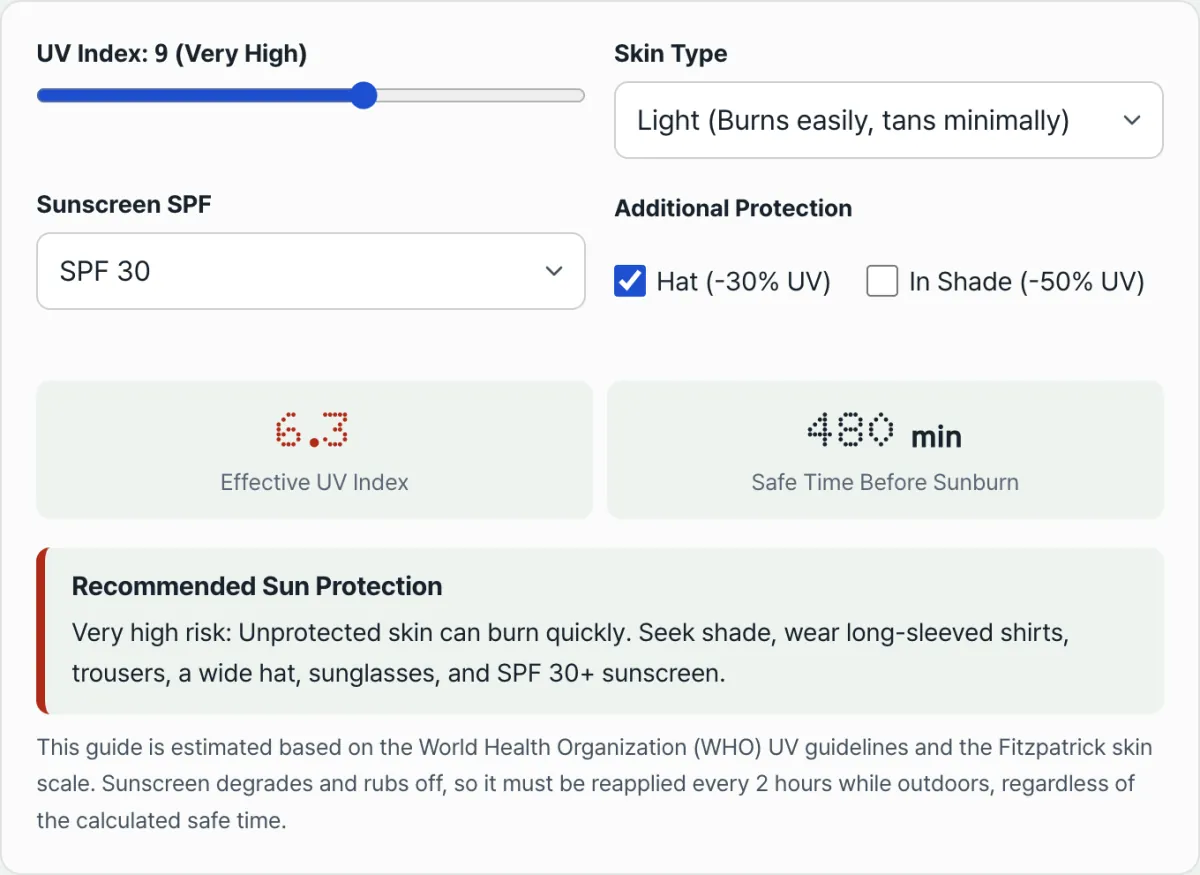
Enter the UV index, your skin type, SPF, and whether you're wearing a hat or in shade. The slider updates your actual exposure UV index and safe exposure time instantly.
Where People Get It Wrong
The formula itself is simple, but there are spots where reading the numbers goes wrong.
| The confusion | How it actually works |
|---|---|
| UV index = Actual Exposure UV Index | The risk level (low through extreme) is based on the original UV index. The Actual Exposure UV Index is a separate, lower value that reflects shade and a hat |
| Hat (−30%) + shade (−50%) = −80% | They multiply: 8 × 0.7 × 0.5 = 2.8, so about 35% of the original index remains, not 20% |
| SPF lowers the risk level | SPF doesn't change the level. It only enters the math as a multiplier that extends safe exposure time |
| The 480-minute cap = 8 hours is always safe | The cap just stops the display when the math produces a big number. It doesn't mean 8 hours of exposure is always safe |
The calculated safe exposure time assumes the sunscreen stays effective after a single application.
Sweat and friction wearing sunscreen off aren't built into this formula, so your real protection can be lower than the calculated value.
The Bottom Line
- The UV index uses the WHO scale with five levels: 0–2 low, 3–5 moderate, 6–7 high, 8–10 very high, and 11 and up extreme.
- Each skin type has a different baseline time until burning, so the same UV index gives different safe exposure time results.
- The Actual Exposure UV Index comes from multiplying the original UV index by shade (×0.5) and a hat (×0.7), and the two conditions apply together as a product.
- Safe exposure time is calculated as (baseline minutes for your skin ÷ Actual Exposure UV Index) × SPF multiplier, and it caps at 480 minutes.
- The calculated time is an estimate from fixed baseline values. It doesn't replace your own skin's actual response or medical judgment.
Enter the UV index, your skin type, SPF, and whether you're wearing a hat or in shade. The slider updates your actual exposure UV index and safe exposure time instantly.
Frequently Asked Questions
Where do I check the UV index?
Weather services such as the Korea Meteorological Administration forecast it every day. It follows the 0–11+ scale used by the WHO and other international health and weather organizations. Just enter that forecast value into the tool's slider.
What's the difference between the Actual Exposure UV Index and the UV index?
The UV index is the original number issued for the day, and the Actual Exposure UV Index is the lower value after shade and a hat are factored in. The risk level (low through extreme) is assigned based on the original UV index.
Exactly how much safer is SPF 50 than SPF 30?
In the formula, SPF enters as a multiplier on safe exposure time. SPF 30 multiplies the time by 30, and SPF 50 multiplies it by 50.
That said, this is a multiplier on paper. Real-world results depend on how much you apply and whether you reapply.
Will I definitely burn once the calculated safe time passes?
No. This calculation is an estimate that plugs fixed baseline values per skin type into a UV index formula. Real skin reactions vary from person to person, and this isn't a medical diagnosis, so treat the result as a reference.
This article was adapted from our Korean original. Read the Korean original