
US Cup vs Korean Cup: Convert Cups, Tbsp, and Tsp to mL
Contents
The "1 cup" in a US recipe is not the same amount as the 200 mL measuring cup most Korean kitchens use. One cup in the US customary system is 236.5882365 mL, about 18% more than a Korean or Japanese measuring cup. If you measure without knowing this, the ratio of ingredients like water or flour gets thrown off, and the texture or taste of the finished dish changes.
Summary ① "1 cup" in a US recipe means 236.5882365 mL under the US customary cup, about 18% more than a Korean or Japanese measuring cup (200 mL). ② Everything is fixed as a fraction of the gallon (3.785411784 L): a quart, pint, cup, and fluid ounce are 1/4, 1/8, 1/16, and 1/128 of it. ③ A tablespoon (tbsp) is about 14.79 mL and a teaspoon (tsp) is about 4.93 mL, and 3 teaspoons equal 1 tablespoon.
Why Following a US Recipe as Written Throws Off Your Measurements
When you bake cookies or a cake from an overseas baking blog or a recipe written in English, the ingredient list often uses cup and spoon units exactly as written: "1 cup flour," "2 tbsp sugar." If you measure those with the 200 mL cup common in Korea, you add less than the recipe intended.
For example, if a US recipe calls for "2 cups of milk," it actually means 2 × 236.5882365 mL, or about 473.18 mL. Measure that with two Korean measuring cups (400 mL) and you're about 73 mL short — roughly 15% less.
The more a dish depends on its liquid ratio — dough, soup, stew — the more this gap shows. One cup's difference looks small, but when a recipe calls for cups again and again, the error adds up.
How to Convert Cups and Tablespoons to mL by Hand
You can work out exactly how many mL a cup or tablespoon really is by hand, with no calculator. That's because the US customary system splits quarts, pints, cups, and fluid ounces into fixed fractions of a gallon.
| Unit | Fraction of a gallon | Liters (L) | Milliliters (mL) |
|---|---|---|---|
| 1 gallon | 1 | 3.785411784 | 3785.411784 |
| 1 quart | 1/4 | 0.946352946 | 946.352946 |
| 1 pint | 1/8 | 0.473176473 | 473.176473 |
| 1 cup (US customary cup) | 1/16 | 0.2365882365 | 236.5882365 |
| 1 fluid ounce (US fl oz) | 1/128 | 0.0295735295625 | 29.5735295625 |
As the table shows, 1 cup is fixed at 1/16 of a gallon, which gives 236.5882365 mL. That's not a rounded-off value — it comes out evenly from the definition of a gallon.
The problem is that the word "cup" itself means a different number of mL in each measuring system. In practice, there are three cup standards.
| Cup standard | Definition | Base mL |
|---|---|---|
| US customary cup | 8 US fl oz | 236.5882365 mL |
| Metric cup | Fixed at 250 mL by definition | 250 mL |
| Korean and Japanese measuring cup | Fixed at 200 mL by convention | 200 mL |
So check which standard the recipe assumes first. As a rule, a recipe published in the US means the 236.5882365 mL cup, a cookbook from a metric country such as Australia, New Zealand, or the UK means the 250 mL cup, and a Korean or Japanese recipe means the 200 mL cup.
Tablespoons and teaspoons also derive from the fluid ounce at fixed ratios.
| Measuring spoon | Definition | mL |
|---|---|---|
| 1 tablespoon (tbsp) | 1/2 of 1 fl oz | about 14.79 mL |
| 1 teaspoon (tsp) | 1/6 of 1 fl oz | about 4.93 mL |
This is also where you can see that 3 teaspoons equal 1 tablespoon (4.93 mL × 3 ≈ 14.79 mL). Older English-language recipes sometimes use a capital T for tablespoon and a lowercase t for teaspoon to keep them apart.
Here's the order of operations.
- Note the units in the recipe (cup, tbsp, tsp, fl oz, qt, pt, gal).
- Decide which cup standard the source assumes (US customary, metric, or Korean/Japanese).
- Multiply the fixed mL value from the table above by the quantity in the recipe.
- If needed, convert the resulting mL to liters or another unit.
Those four steps get you an exact mL value without a calculator. But when a recipe mixes several units, or you need to check numbers often, repeating the multiplication every time gets old.
Check it with our tool.
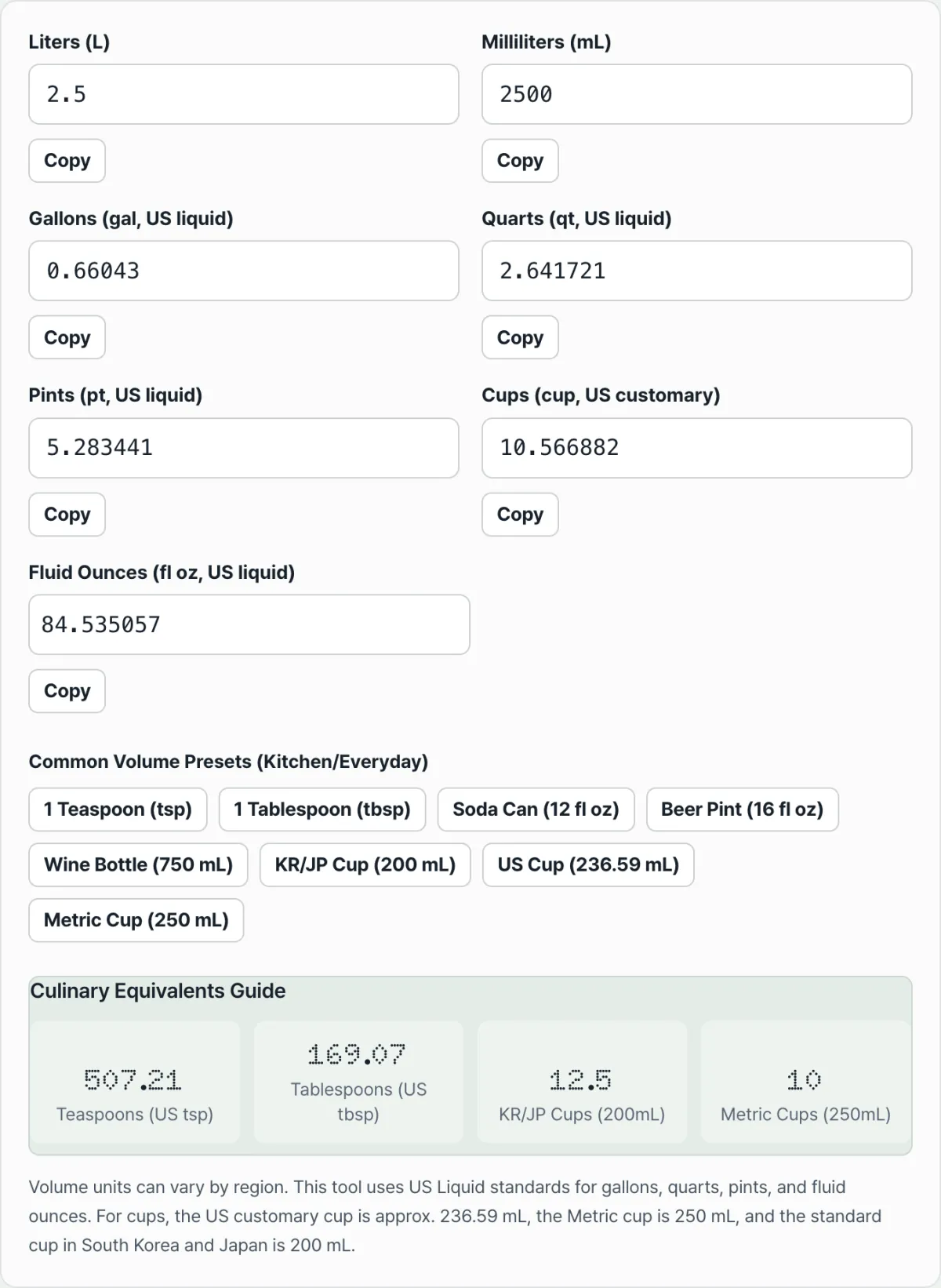
Enter any of seven volume units (L, mL, gal, qt, pt, cup, fl oz) and Volume Converter converts them instantly, and it also shows reference values for the Korean and Japanese 200 mL cup and the metric 250 mL cup. No install or signup.
Notations That Are Easy to Mix Up
Here are the mix-ups that come up most often with cup and spoon units.
| Notation | Meaning | mL (approx.) |
|---|---|---|
| cup (US recipe) | US customary cup | 236.59 mL |
| cup (metric recipe) | Metric cup | 250 mL |
| cup (Korean/Japanese recipe) | 200 mL measuring cup | 200 mL |
| T, tbsp | tablespoon | 14.79 mL |
| t, tsp | teaspoon | 4.93 mL |
| fl oz | US fluid ounce | 29.57 mL |
Read a capital T (tablespoon) as a lowercase t (teaspoon) and you'll be off by nearly 3x. The smaller the amount — salt, baking soda — the more this matters, because those ingredients decide how the dish tastes.
Another common mistake is seeing the word "cup" and automatically calculating 200 mL. If the recipe comes from the US, use 236.59 mL. If it's metric, use 250 mL.
Summary
- The US customary cup is 236.5882365 mL, about 18% more than a Korean or Japanese measuring cup (200 mL).
- Quarts (1/4), pints (1/8), cups (1/16), and fluid ounces (1/128) are defined as fixed fractions of a gallon (3.785411784 L).
- The metric cup is fixed separately at 250 mL and is a different standard from the US customary cup.
- A tablespoon is about 14.79 mL and a teaspoon is about 4.93 mL, and 3 teaspoons equal 1 tablespoon.
- Check where the recipe comes from (US, metric, or Korean/Japanese) before deciding which cup standard applies.
Enter any of seven volume units (L, mL, gal, qt, pt, cup, fl oz) and Volume Converter converts them instantly, and it also shows reference values for the Korean and Japanese 200 mL cup and the metric 250 mL cup. No install or signup.
Frequently Asked Questions
Exactly how many mL is 1 cup in a US recipe?
Under the US customary system, 1 cup is 8 fluid ounces (fl oz), and the exact value is 236.5882365 mL. That's a fixed value equal to 1/16 of 1 gallon (3.785411784 L).
How much difference is there between a Korean measuring cup (200 mL) and a US measuring cup?
The difference is about 36.59 mL, and by ratio the US cup holds about 18.3% more than the Korean cup (236.5882365 ÷ 200 ≈ 1.183). The more cups a recipe calls for, the more that gap adds up.
What is a metric cup?
It's a fixed value of 250 mL, used in cookbooks from metric countries such as Australia, New Zealand, and the UK. It's a separate standard from the US customary cup (236.59 mL) and the Korean/Japanese measuring cup (200 mL).
How many mL are in a tablespoon (tbsp) and a teaspoon (tsp)?
A tablespoon is about 14.79 mL (1/2 of 1 fluid ounce) and a teaspoon is about 4.93 mL (1/6 of 1 fluid ounce). Three teaspoons equal 1 tablespoon.
This article was adapted from our Korean original. Read the Korean original