
Trigonometry Calculator: 6 Trig Values and Why tan 90° Fails
Contents
If you've ever entered an angle and wondered exactly what the six trig ratios (sine, cosine, tangent, and the rest) come out to — or why some angles give you "undefined" — this post walks through the math from the ground up. Once you know a single point on the unit circle (a circle with radius 1), all six trig ratios fall out of a few divisions. And the reason tan and sec are undefined at 90° and 270° is baked into those divisions too. We'll lay out the formulas and the order of operations first, then point you to a tool that does the same math automatically.
Summary ① For an angle θ on the unit circle, the coordinates are (cosθ, sinθ). Sin and cos come first, and the other four are built from their ratios. ② Tan and sec break down at 90° and 270°, where cos is 0. Csc and cot break down at 0° and 180°, where sin is 0. The division doesn't work, so the value shows as Undefined. ③ Inverse trig functions arcsin and arccos only accept inputs from -1 to 1, because the outputs of sin and cos are confined to that range.
Where people actually get stuck
There are usually two places people stall on trig calculations. One is mixing up degrees and radians, which gives you the wrong number. The other is angles like tan(90°) or sec(270°) that produce no value at all.
Say you meant to enter 45 in degrees but the calculator was in radian mode. You won't get sin(45°) = 0.7071. You'll get sin(45 rad) ≈ 0.8509 — a completely different number. Nothing was wrong with the calculation itself. One unit setting made the answer wrong.
The other case is putting 90° or 270° into tan or sec. Different calculators will return a huge number, Infinity, or an error message. If you don't know why, it's easy to assume the calculator is broken.
How to work it out by hand, no tool needed
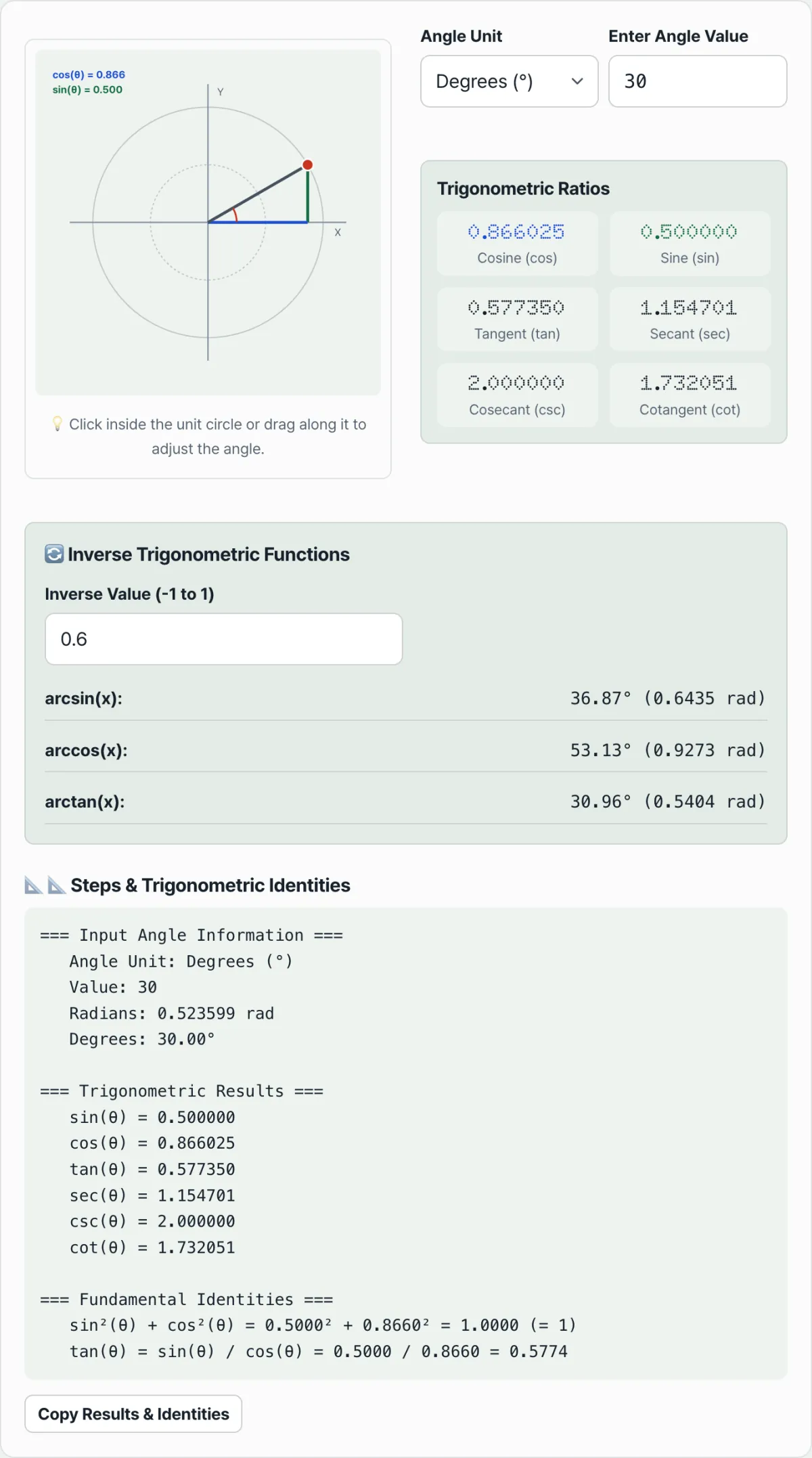
All six trig ratios start from a single point on the unit circle (centered at the origin, radius 1). Move counterclockwise from the positive x-axis by an angle θ, and the coordinates of that point are exactly (cosθ, sinθ). In other words, cosine is the x-coordinate and sine is the y-coordinate.
Convert degrees to radians, then take the ratios
Trig functions inside a calculator or programming language (for example, JavaScript's Math.sin and Math.cos) always take radians as input. If you know the angle in degrees, convert it to radians first. The formula is:
radians = degrees × (π / 180)
45° is 45 × (π/180) ≈ 0.7854 radians, and 90° is 90 × (π/180) = π/2 ≈ 1.5708 radians.
Once you have sin and cos, the other four are all defined by their ratios.
- tan θ = sin θ ÷ cos θ
- sec θ = 1 ÷ cos θ
- csc θ = 1 ÷ sin θ
- cot θ = cos θ ÷ sin θ
Here are the exact values for the angles you'll use most.
| Angle | Radians | sin | cos | tan |
|---|---|---|---|---|
| 0° | 0 | 0 | 1 | 0 |
| 30° | π/6 | 1/2 | √3/2 | √3/3 |
| 45° | π/4 | √2/2 | √2/2 | 1 |
| 60° | π/3 | √3/2 | 1/2 | √3 |
| 90° | π/2 | 1 | 0 | undefined |
| 180° | π | 0 | -1 | 0 |
| 270° | 3π/2 | -1 | 0 | undefined |
Why some values are undefined
The table shows exactly why tan and sec are undefined at 90° and 270°. At both angles cos is 0, and tan is sin÷cos while sec is 1÷cos — so the denominator is 0 and the division doesn't work. The result doesn't settle on a single number, which is why "undefined" is more mathematically accurate than writing it as infinity.
Same principle for csc and cot: they're undefined at 0°, 180°, and 360°, where sin is 0. Whatever the numerator is, a denominator of 0 means the division itself is impossible.
The -1 to 1 input limit on inverse trig functions (arcsin, arccos) comes from the same unit circle. Sin and cos are coordinates on a circle of radius 1, so they always sit between -1 and 1. That means "the angle whose sine is 2" simply doesn't exist, and an out-of-range input like arcsin(2) has no matching angle, so it can't be computed. Arctan is different: tan grows without bound as the angle approaches 90°, so its input has no such limit.
Check it with our tool.
A free calculator that shows the sin, cos, tan, sec, csc, and cot values and the unit circle graph in real time as you type an angle.
Common points of confusion
Mixing up angle units is the most common one. Enter the same number, 45, and you get completely different results depending on whether the unit is degrees or radians.
| Input 45 | Unit | sin result |
|---|---|---|
| Degrees (°) | degree | 0.7071 |
| Radians | radian | 0.8509 |
If a result looks off, check the angle unit indicator first.
Undefined and Infinity aren't the same thing. tan(90°) doesn't converge on a single value. Just below 90° it grows without bound, and just above 90° it drops without bound (diverging toward negative infinity) — two different behaviors. Since you can't pin it to one value, "undefined" is the mathematically correct description.
When a computer converts 90° to radians (π/2) and computes the cosine, floating-point arithmetic sometimes gives you something extremely close to 0 but not exactly 0 (for example, 6.12×10⁻¹⁷). Divide by that value and you can get an absurdly large number even though it isn't zero. That's why calculators filter out denominators that are effectively zero and report Undefined instead.
arcsin and arccos have different input ranges than arctan.
| Function | Valid input range | Why |
|---|---|---|
| arcsin(x) | -1 ≤ x ≤ 1 | Sin values range from -1 to 1 |
| arccos(x) | -1 ≤ x ≤ 1 | Cos values range from -1 to 1 |
| arctan(x) | all real numbers | Tan has no upper or lower bound |
The takeaway
- All six trig ratios start from the point (cosθ, sinθ) on the unit circle. Find sin and cos, and the other four come from ratios.
- The formula for converting degrees to radians is radians = degrees × (π/180). Trig functions in calculators and programs mostly take radians.
- Tan and sec are undefined at 90° and 270°, where cos is 0. Csc and cot are undefined at 0°, 180°, and 360°, where sin is 0. The division doesn't work.
- arcsin and arccos are limited to inputs from -1 to 1 because the outputs of sin and cos can never leave that range. Arctan has no such limit.
A free calculator that shows the sin, cos, tan, sec, csc, and cot values and the unit circle graph in real time as you type an angle.
Frequently Asked Questions
Why does tan(90°) come out as Undefined instead of Infinity?
Because cos(90°) is 0, the denominator in tan(90°) = sin ÷ cos becomes 0. Approaching from below 90° sends the value toward positive infinity, while approaching from above sends it toward negative infinity — the two diverge in opposite directions, so no single number can be assigned. That's why "undefined" is the mathematically correct label here rather than one infinite value.
Should I enter the angle in degrees or radians (rad)?
Both units work, and you should follow whichever unit the calculator is set to. The conversion formula is radians = degrees × (π/180). The same number gives completely different results in different units, so if a result looks off, check the unit setting first.
Why is there a -1 to 1 limit on inverse trig functions?
sin and cos are coordinates on a unit circle with radius 1, so their outputs always land between -1 and 1. No angle exists that would produce a value outside that range, which is why an input like arcsin(2) can't be calculated. tan has no upper or lower bound, so arctan isn't limited this way.
How are sec, csc, and cot different from sin, cos, and tan?
Each of the three is the reciprocal of its counterpart: sec is 1 ÷ cos, csc is 1 ÷ sin, and cot is cos ÷ sin (= 1 ÷ tan). So at any angle where cos or sin equals 0, those values are undefined as well.
This article was adapted from our Korean original. Read the Korean original