
Travel Adapter or Voltage Converter? Check Plug Type and Voltage
Contents
Whether your Korean electronics will work overseas comes down to two separate checks. Whether the outlet holes match (plug type) and whether the power level matches (voltage) are two different standards. Once you check them separately, you can figure out for yourself whether a plug adapter is enough or you also need a voltage converter.
Summary ① Plug type (A–I) describes the shape of the outlet holes; voltage (V) describes the strength of the electricity. They are separate standards. ② If your device says "100-240V," it's dual voltage, so a shape-only adapter is enough no matter what the destination voltage is. ③ Korean Type F and European Type C have different pin diameters (4.8mm vs. 4.0mm), so they look similar but aren't the same.
Why "I'll just grab a plug adapter" gets confusing
Every time you pack a suitcase, the same question comes back: do I just need a plug adapter, or do I need a voltage converter too? Search results make it worse, because the answer varies by country — and sometimes within the same country.
In places like Vietnam or Thailand, where several plug shapes are used side by side, it's hard to know in advance what your hotel outlet will look like. Sometimes your laptop charger plugs in fine but the hair dryer won't power on — often because you lumped these two things (shape and voltage) together instead of separating them.
"Needing an adapter" and "needing a voltage converter" are two different questions. Check them one at a time, in order, and the answer turns out to be pretty simple.
How to check by hand, without any tool
The most reliable starting point isn't a search engine — it's the device you're bringing. The input voltage is always printed on the charger or adapter body.
Start with the input voltage on the device label
If it reads a range like "INPUT: 100-240V ~50/60Hz," it's a free-voltage (dual-voltage) device. If it reads a single number like "INPUT: 220V," it was built to work properly only at that voltage.
Laptop and smartphone chargers are mostly dual voltage, but heat-producing appliances like hair dryers and flat irons often are not.
Look up the destination country's standard
Once you've checked the label, the next step is the destination country's standard. The World Plugs page run by the International Electrotechnical Commission (IEC) at iec.ch/world-plugs lists plug types and standard voltage and frequency by country, so you can use it as a reference.
The plug type letters (A, B, C, F, G, I, and so on) aren't specifications set by each country's law. They're a conventional code used in travel and electrical information to describe outlet hole shapes internationally — how many pins, what shape, and how grounding works.
For example, A means two flat pins (North America and Japan), F means the German style with two round pins and grounding clips on the side (Korea falls in this group), and G means the British style with three rectangular pins.
Compare the two and decide
Now compare the two. Check whether the plug type letters for your home country and destination overlap at all, and — if your device isn't dual voltage — whether the voltage gap between the two countries is large (roughly a 100V range versus a 220V range, nearly double).
If none of the letters match, you need an adapter. If the voltage is also very different and your device is fixed voltage, you need a voltage converter too.
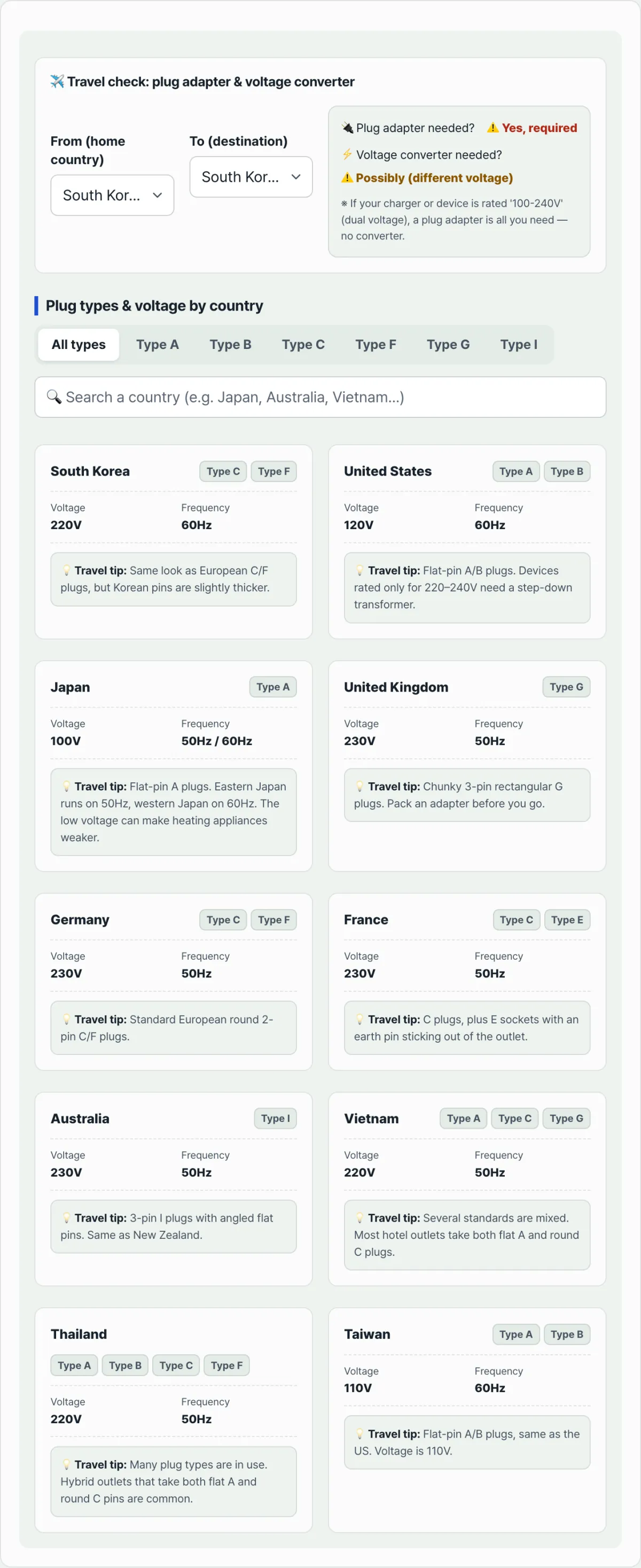
Check it with our free tool, World Plug & Voltage Directory.
Pick your departure country and destination to see right away whether the plug types match, how big the voltage gap is, and whether you need a voltage converter.
Common points of confusion
| Common misconception | What's actually true |
|---|---|
| Plug adapter = voltage converter | An adapter only fixes the shape; changing voltage takes a separate converter |
| Dual voltage means everything works | Heat-producing appliances like hair dryers often aren't dual voltage |
| Similar shape means the same standard | Korean Type F pins are 4.8mm and European Type C pins are 4.0mm, so the thickness differs — which is what the loose-fit debate is about |
| One country = one plug type | Some countries, like Vietnam and Thailand, use several types side by side |
The most commonly misunderstood pair is Korea (Type F) and much of Europe (Type C). Both outlets have two round pins, so they look the same at a glance, but Korean plug pins are 4.8mm in diameter, while typical European Type C pins are thinner at 4.0mm.
Because of that difference, plugging a European plug into a Korean outlet can leave it loose and the connection unstable, and there's ongoing discussion about loose fits and fire risk. In the other direction, trying to plug a Korean device into a European outlet can fail because the holes are too narrow.
This article doesn't cover which product to buy. It only explains the structure behind why these differences exist.
The short version
- Adapters (shape) and voltage converters (voltage) are two different problems, and you need to check them one at a time.
- If the device label shows a range like "100-240V," an adapter alone is enough regardless of the destination voltage.
- Plug type letters (A–I) are a conventional code for the shape of the outlet holes — pin count and grounding method.
- Similar shapes don't guarantee the same pin diameter (Korea's F at 4.8mm vs. Europe's C at 4.0mm).
- Even within one country, several plug types may be in use.
Pick your departure country and destination to see right away whether the plug types match, how big the voltage gap is, and whether you need a voltage converter.
Frequently asked questions
Can I use Korean electronics overseas with just a plug adapter?
Look at the input voltage on the device label first. Dual-voltage products marked "100-240V, 50/60Hz" will work with a shape-only adapter, but fixed-voltage devices marked something like "220V only" may not work properly in the US, Japan, and other countries that use 100–120V, because the voltage is too low.
Are Korean and European plugs exactly the same shape?
Similar, but not the same. Korean (Type F) plug pins are 4.8mm in diameter, while typical European Type C pins are thinner at 4.0mm. They'll go in, but they can fit loosely, which is what the debate is about.
Who decides the plug type letters (A, B, C, F, G, I...)?
Not each country's law — they're a code used by convention in travel and electrical information to tell the world's outlet shapes apart. The letters are divided by pin count, pin shape, and grounding method, and you can look up which letters are used in each country on the IEC World Plugs page and similar sources.
Why does one country show several plug types?
In countries like Vietnam and Thailand, where different standards arrived at different times and in different regions, two or three plug shapes are used side by side within the same country. Which type is actually in your outlet depends on the hotel or building, so multiple types are listed.
This article was adapted from our Korean original. Read the Korean original