
Running Pace Calculator: Target Pace & Race Splits Guide
Contents
- Why Isn't "Just Running Hard" Enough to Finish?
- How It Works: Aerobic Pace and the Physiological Limit
- Required Pace Matrix for Common Marathon Goal Times
- 5 Common Pacing Mistakes Runners Make
- A 5-Step Pacing Workflow for Finishing Your Marathon
- 7 Tips for Managing Your Pace
- Final Decision Tree: Which Pacing Strategy Should You Choose?
- Running & Marathon Cheat Sheet
- Frequently Asked Questions
More people than ever are taking up running for their health or as a hobby, and many of them set their sights on a marathon or a 10K race.
But even if you've trained hard, the start signal can change everything. The crowd gets you fired up, you go out too fast (over-pace), and by the 5–7 km mark your heart rate spikes and your legs cramp. Walking or dropping out is a common result.
Key Takeaways ① Finishing a marathon comes down to managing your pace, meaning how many minutes and seconds you run each kilometer. ② If you know your splits table (checkpoint times), you can check your speed on your smartwatch as you run and avoid burning out early. ③ For beginners, the safest strategy, and one that often helps you run a faster time, is the negative split: start relaxed and hold your speed in the second half.
Why Isn't "Just Running Hard" Enough to Finish?
If you push too hard early, your body shifts away from the aerobic energy system and into anaerobic metabolism. Blood lactate builds up fast, and your glycogen runs out early. Distance running is a strategy sport built on science. You have to spread your cardiorespiratory endurance and stored glycogen evenly across all 42.195 km.
These are the three main pacing strategies used in races and long training runs.
1. Even Pace
- What it is: You hold a perfectly steady speed for every kilometer from the start line to the finish (for example, 5:30 per km).
- Why it works: Your heart rate stays steady and your energy use is as efficient as it gets. In theory, it's the best strategy. Over 90% of elite world records are set this way.
2. Negative Split
- What it is: You run the first part (the first 1–5 km, or the first half) 10–15 seconds slower than your goal pace to warm up. Then you pick up to your real goal pace in the second part.
- Why it works: It keeps you from going out too fast on race-day adrenaline. In the second half, you'll pass lots of other runners, which helps you stay mentally strong. Of the three strategies, it has the highest finish rate.
3. Positive Split: The Trap to Avoid
- What it is: You think, "I'll get tired late, so I'll bank time early while I feel fresh," and you run the start at full speed.
- The risk: Once you cross your lactate threshold, you pay for it later by hitting the wall. You end up walking, and your total finish time gets much worse.
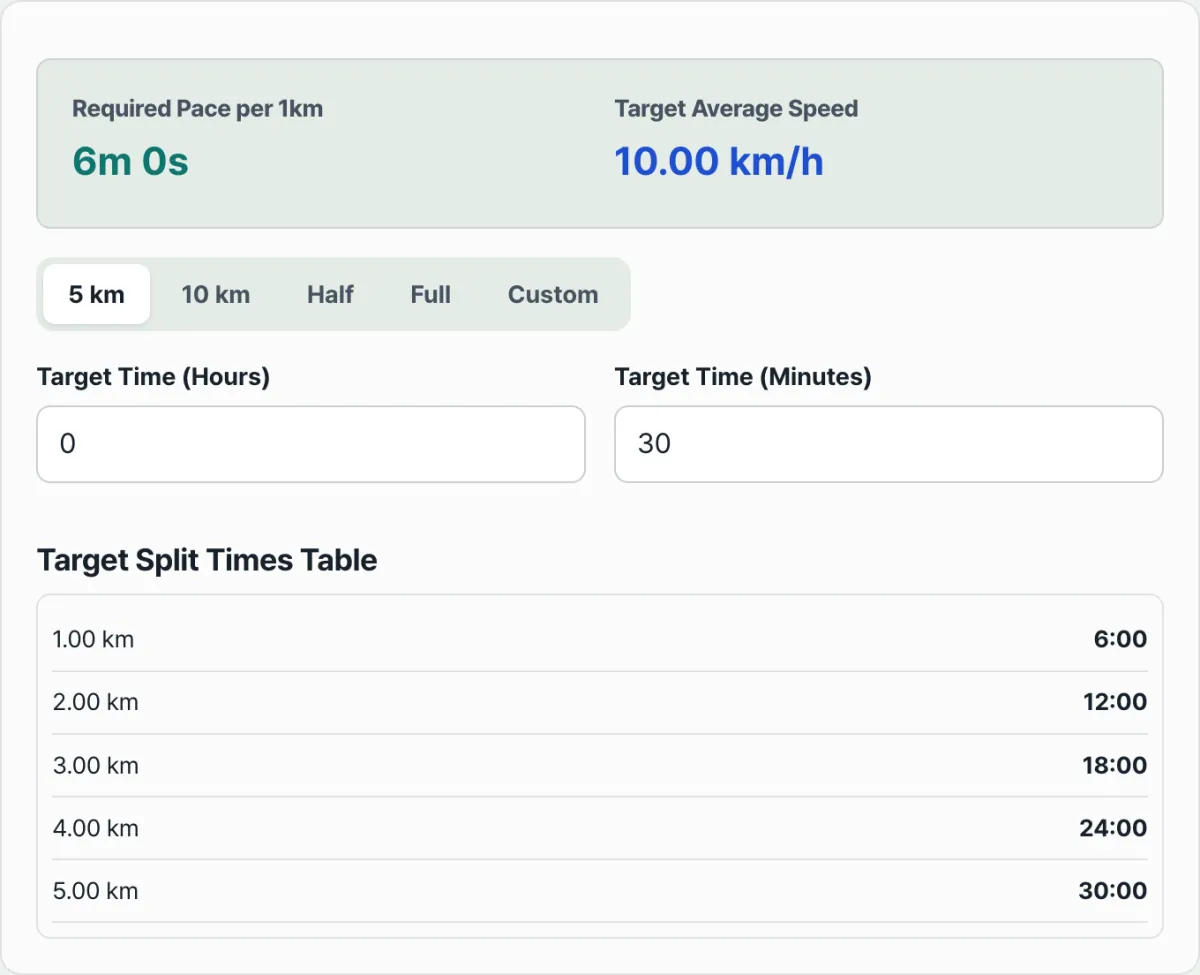
Free · No install · Enter your distance and goal time to get your per-km pace and split chart in one second
How It Works: Aerobic Pace and the Physiological Limit
Here's how a running pace calculator works out speed (km/h), pace (min:sec per km), and split times for each segment.
1. How Pace and Speed Convert to Each Other
- Time per km (seconds): Time Per Km = Total Target Seconds/Distance in Km
- Converting pace to minutes and seconds: Minutes = ⌊Time Per Km/60⌋, Seconds = Time Per Km (mod 60)
- Average speed (km/h): Speed = Distance in Km/Total Hours = 3600/Time Per Km
2. Lactate Threshold and Heart Rate Zones 2/3
- In the aerobic zones (Zones 2–3), your body burns fat and carbohydrate with oxygen. That produces energy you can sustain.
- If your pace creeps up past your lactate threshold (LT) into Zones 4–5, your body makes lactate faster than it can clear it. Your muscles' ability to contract then drops off sharply.
Required Pace Matrix for Common Marathon Goal Times
| Goal finish time | Distance | Required pace per km | Average speed | 5 km split | Halfway split |
|---|---|---|---|---|---|
| 10K in 60 minutes | 10.0 km | 6:00 / km | 10.00 km/h | 30:00 | - |
| 10K in 50 minutes | 10.0 km | 5:00 / km | 12.00 km/h | 25:00 | - |
| Half marathon in 2 hours | 21.0975 km | 5:41 / km | 10.55 km/h | 28:27 | 2:00:00 |
| Full marathon, sub-4 (Sub-4) | 42.195 km | 5:41 / km | 10.55 km/h | 28:27 | 1:59:57 |
| Full marathon, sub-3 (Sub-3) | 42.195 km | 4:15 / km | 14.07 km/h | 21:19 | 1:29:58 |
5 Common Pacing Mistakes Runners Make
- Going out too fast in the first kilometer: The cheering and the crowd sweep you along, and you run 30 seconds to 1 minute faster than normal. That one minute can cost you 10 minutes later.
- Trying to hold your pace on uphills: On climbs steeper than 3% grade, slow down by 15–30 seconds and keep your heart rate steady.
- Sudden speeding up and slowing down at aid stations: Stopping short to drink, then surging to make up the time, puts a lot of strain on your heart.
- Skipping the temperature and humidity adjustment: Once it's above 20°C (68°F), slow your pace by 10–20 seconds per km to stay safe and regulate your body temperature.
- Obsessing over your GPS watch's instant pace: In tunnels or among tall buildings, GPS can jump and give you inaccurate instant speed. Trust your cumulative 1 km lap times instead.
A 5-Step Pacing Workflow for Finishing Your Marathon
- Step 1 (set your goal time and distance): Pick your event (5K, 10K, half, or full marathon) and a realistic goal finish time.
- Step 2 (build a splits table with this calculator): Enter your goal time, then check your target pace per km and your checkpoint times at every 5 km.
- Step 3 (train at race pace): Two to four weeks before the race, run tempo runs at your goal pace so your breathing and stride get used to it.
- Step 4 (write a negative split plan): Plan to run the first 1–3 km 10 seconds slower than goal pace, then settle into an even pace after that.
- Step 5 (hold your pace and fuel on race day): Stick closely to your 5 km split times and your energy gel timing all the way to the finish line.
7 Tips for Managing Your Pace
- Keep your cadence at 175–185 steps per minute (SPM): Don't overstretch your stride. A light, quick turnover of about 180 steps per minute can cut the impact on your knees by 30%.
- Write your 5 km split times on your wrist with a marker: Even if your watch battery dies or your GPS jumps, you can check your pace against the course markers.
- Tuck in behind other runners in a headwind: Simply running behind a group in a headwind can save you more than 10% of your energy.
- Don't brake on downhills: Pounding your heels down to slow yourself can tear your quadriceps. Lean your upper body forward slightly and let yourself roll down naturally.
- Fuel with glycogen before 30 km to prepare for the wall: Take an energy gel every 45 minutes, before you feel hungry, to head off a crash at the 30 km mark.
- Carb-load three days before the race: Eat mostly pasta, rice, rice cakes, and bananas to top off the glycogen stored in your muscles.
- Kick for the last 1 km before the finish line: When you see the final 1 km sign, spend the energy you've saved. Crossing the finish line this way is a thrill you won't forget.
Final Decision Tree: Which Pacing Strategy Should You Choose?
- Situation A (first 10K or first marathon) ➔ Negative split (start 10 seconds slower, finish strong)
- Situation B (experienced runner chasing a personal best, or PB) ➔ Strict even pace (hold steady within ±3 seconds)
- Situation C (extreme heat, hot and humid weather, or a rolling hill course) ➔ Heart-rate-based adjusted pace (slow down by 15–20 seconds per km)
- Situation D (weekend long slow distance, or LSD, training) ➔ Zone 2 pace where you can chat comfortably (40–60 seconds slower than goal pace)
Running & Marathon Cheat Sheet
- Pace: The time it takes you to run 1 km (minutes:seconds per km).
- Splits: The time it takes you to cover a specific segment (usually every 1 km or 5 km).
- Sub-3 / Sub-4: Finishing a full marathon in under 3 hours or under 4 hours, respectively. Both are major milestones.
- Cadence: The total number of steps per minute, counting both feet hitting the ground (SPM: Steps Per Minute).
- Carbo shot: A concentrated glucose energy gel that quickly replaces the glycogen you burn through on long runs.
Frequently Asked Questions
What speed do I need to run a 10K in 50 minutes?
To run 10 km in 50 minutes, you need to hold exactly 5:00 per km. On a treadmill, set the speed to 12.0 km/h and run for 50 minutes.
Why does my smartwatch show a different distance than the course markers?
Official marathon courses are measured along the shortest possible path (the tangents). But you won't run a perfect line. You'll pass other runners and swing around corners, so your GPS watch will usually read 1–2% long. For a full marathon, that's about 42.5–42.8 km. This is normal.
Is the target time I enter in the calculator saved anywhere?
No. Nothing is stored. All pace calculations and split table generation happen in real time inside your browser.
This article was adapted from our Korean original. Read the Korean original