
Infant Fever Reducer Dosage by Weight and Alternating Meds
Contents
Baby fever reducer doses are based on weight. For acetaminophen, the single dose is 10–15 mg/kg (with a 32 mg/mL syrup, weight × about 0.31–0.47 mL). For ibuprofen, it's 5–10 mg/kg (with a 20 mg/mL syrup, × 0.25–0.5 mL). For dexibuprofen, it's 5–7 mg/kg (with a 12 mg/mL syrup, × about 0.42–0.58 mL). If the product label has a dosing chart, follow that first.
Two "fever syrups" can hold different amounts of medicine in the same mL if the ingredient or strength is different. This article draws on the approved labeling from Korea's Ministry of Food and Drug Safety (MFDS, via its Drug Safety Nara site) and guidance from the National Institute of Food and Drug Safety Evaluation. It covers how to calculate the dose for each ingredient, cautions about alternating medicines (cross-dosing), and when to get medical care right away.
Summary ① Acetaminophen (32 mg/mL): 10–15 mg/kg per dose, every 4–6 hours, no more than 5 doses a day (75 mg/kg). The label doses start at 4 months old. ② Ibuprofen (20 mg/mL): 5–10 mg/kg per dose. Dexibuprofen (12 mg/mL): 5–7 mg/kg per dose. Both: every 6–8 hours, no more than 4 doses a day, from 6 months old. ③ Alternating medicines: The MFDS advises, as a rule, not to alternate the two types of medicine. Only if a doctor has prescribed it, give the other medicine at a 2–3 hour interval. ④ Under 3 months old with a fever of 38℃ or higher: See a doctor first, before giving a fever reducer.
This article and the calculator are for reference only. They are not a diagnosis or a prescription. Follow the product label and the instructions of your doctor or pharmacist when giving any medicine.
How do you calculate the single dose for each ingredient?
Weight (kg) × single dose (mg/kg) ÷ syrup strength (mg/mL) = mL per dose. Be sure to check the strength printed on the syrup box (for example, "32 mg per 1 mL" or "100 mg per 5 mL").
| Ingredient (strength) | Single dose | Interval · daily maximum | mL per 1 kg of weight |
|---|---|---|---|
| Acetaminophen (32 mg/mL) | 10–15 mg/kg | 4–6 hours, 5 doses | 0.31–0.47 mL |
| Ibuprofen (20 mg/mL) | 5–10 mg/kg | 6–8 hours, 4 doses | 0.25–0.5 mL |
| Dexibuprofen (12 mg/mL) | 5–7 mg/kg | 6–8 hours, 4 doses | 0.42–0.58 mL |
Examples of Korean products: Children's Tylenol Suspension (어린이타이레놀현탁액) and Champ Syrup (챔프시럽) are acetaminophen at 32 mg/mL. Children's Brufen Syrup (어린이부루펜시럽) and Champ Ibuphen Syrup (챔프이부펜시럽) are ibuprofen at 20 mg/mL. Maxibuphen Syrup (맥시부펜시럽) is dexibuprofen at 12 mg/mL (approved labeling from Drug Safety Nara).
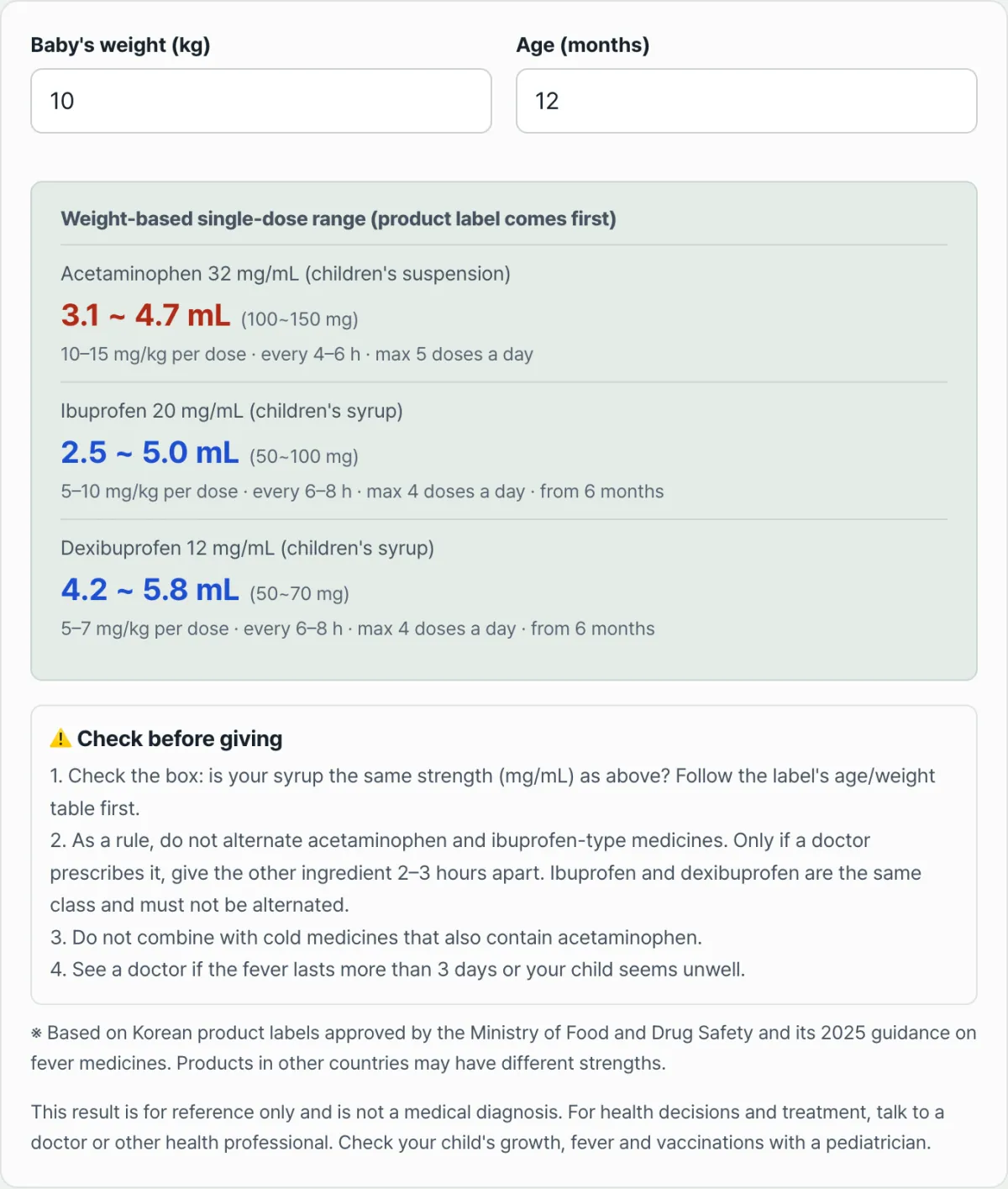
Example: weight 10 kg, 12 months old
- Acetaminophen: 100–150 mg → 3.1–4.7 mL
- Ibuprofen: 50–100 mg → 2.5–5.0 mL
- Dexibuprofen: 50–70 mg → 4.2–5.8 mL
The label for Children's Tylenol Suspension lists 3.5 mL (120 mg) per dose for ages 7–23 months (8–11.9 kg). That falls within the range above. If the calculated value and the label chart differ, follow the label.
Free · Enter your baby's weight and age to get a single-dose range in mL for acetaminophen, ibuprofen and dexibuprofen syrups
How old does a baby need to be?
The label dosing charts start at 4 months old for acetaminophen syrup and at 6 months old for ibuprofen and dexibuprofen syrups. If your baby is younger than that, the calculator won't show a dose for that ingredient.
- If a baby under 3 months old has a fever of 38℃ or higher, go to a pediatrician or the emergency room right away, before giving a fever reducer (MFDS guidance).
- At 4–5 months, only acetaminophen has a label dose.
- Even for a child who weighs a lot, a single dose should not go over the maximum single amount in the label chart. The calculator caps the dose at 640 mg for acetaminophen, 250 mg for ibuprofen, and 300 mg for dexibuprofen.
Can you alternate acetaminophen and ibuprofen?
As a rule, don't alternate them. The National Institute of Food and Drug Safety Evaluation says one fever reducer is enough in most cases and advises against alternating the two types. Only if a doctor has prescribed it, give the other medicine at a 2–3 hour interval.
- Ibuprofen and dexibuprofen are in the same class, so you must not alternate them with each other.
- Many cold medicines also contain acetaminophen. If you give one along with a fever reducer, your baby could get the same ingredient twice. Check the ingredient list.
- For the same ingredient, keep to the set interval (4–6 hours for acetaminophen, 6–8 hours for ibuprofen-type medicines) and don't exceed the daily maximum number of doses.
When should you see a doctor right away?
If any of the following applies, don't try to get by with a fever reducer. See a doctor.
- A baby under 3 months old has a fever of 38℃ or higher
- The fever lasts more than 3 days (a caution from the label)
- Your child is limp and hard to wake, has trouble breathing, or can barely drink water
- Your child has a seizure, or the seizure lasts more than 5 minutes (call 119 in Korea, or your local emergency number, such as 911 in the US)
Summary
- Calculate the fever reducer dose as weight × mg/kg ÷ strength, and follow the label's dosing chart first.
- Acetaminophen: from 4 months, every 4–6 hours, no more than 5 doses a day. Ibuprofen-type medicines: from 6 months, every 6–8 hours, no more than 4 doses a day.
- Alternate the two types of medicine only when a doctor has prescribed it.
- The calculated result is for reference only.
Free · Enter your baby's weight and age to get a single-dose range in mL for acetaminophen, ibuprofen and dexibuprofen syrups
Frequently asked questions
Can you alternate Maxibuphen and Brufen?
No. Maxibuphen (dexibuprofen) and Brufen (ibuprofen) are in the same class of medicine. Alternating them means giving the same class twice in a row.
My baby took a fever reducer, but the temperature didn't come down to normal. Can I give more?
A fever reducer lowers the fever a bit to make your child more comfortable. It doesn't always bring the temperature all the way down to normal. Keep to the set interval and the daily maximum number of doses. If your child looks unwell or the fever continues, see a doctor.
My baby threw up right after taking the medicine. Should I give it again?
It depends on when and how much your baby threw up. Giving the same medicine again right away could lead to an overdose, so ask a pharmacist or doctor.
The syrup I have at home has a different strength from the table above.
The calculator is based on the strengths commonly used in Korea (32 mg/mL, 20 mg/mL, and 12 mg/mL). If your syrup has a different strength, calculate with weight × mg/kg ÷ that syrup's strength, and follow the label's dosing chart.
Is my baby's weight saved when I enter it?
No. The calculation happens only in your browser. Nothing is sent to a server or saved.
Sources
- Ministry of Food and Drug Safety, Drug Safety Nara — Children's Tylenol Suspension approved labeling https://nedrug.mfds.go.kr/pbp/CCBBB01/getItemDetail?itemSeq=202200525 (checked 2026-11-17)
- Ministry of Food and Drug Safety, Drug Safety Nara — Children's Brufen Syrup https://nedrug.mfds.go.kr/pbp/CCBBB01/getItemDetail?itemSeq=198601920 · Maxibuphen Syrup https://nedrug.mfds.go.kr/pbp/CCBBB01/getItemDetail?itemSeq=200608160 (checked 2026-11-17)
- Ministry of Food and Drug Safety card news "My child has a fever" (2023-11-17, Korea Policy Briefing) https://www.korea.kr/multi/visualNewsView.do?newsId=148922737 (checked 2026-11-17)
This article was adapted from our Korean original. Read the Korean original