
Degrees to Radians Converter: Formulas and Live SVG Guide
Contents
- Why There Are So Many Angle Units
- Degree and Radian Conversion Formulas
- Core Technical Mechanism: The Math Behind Why Radian Measure Became the Standard in Modern Calculus
- Conversion Matrix for the Four Main Angle Units
- 5 Common Mistakes When Calculating Angles and Writing Code
- A 5-Step Workflow for Perfect Angle Unit Conversion
- 7 Practical Angle Conversion Tips
- Final Decision Tree: Which Angle Unit Should You Use?
- Cheat Sheet: Key Angle and Geometry Terms
- Frequently Asked Questions
When measuring the angles of a triangle or slicing a pizza, we usually use degrees (°). The idea that a right angle is 90 degrees and a full circle is 360 degrees is very intuitive in everyday life.
But the moment you get to high school math class, college engineering, or computer graphics programming, an unfamiliar unit called the radian (rad) suddenly shows up and confuses countless developers and students. Why do all the trig functions in programming languages (Math.sin, Math.cos) require radians instead of degrees?
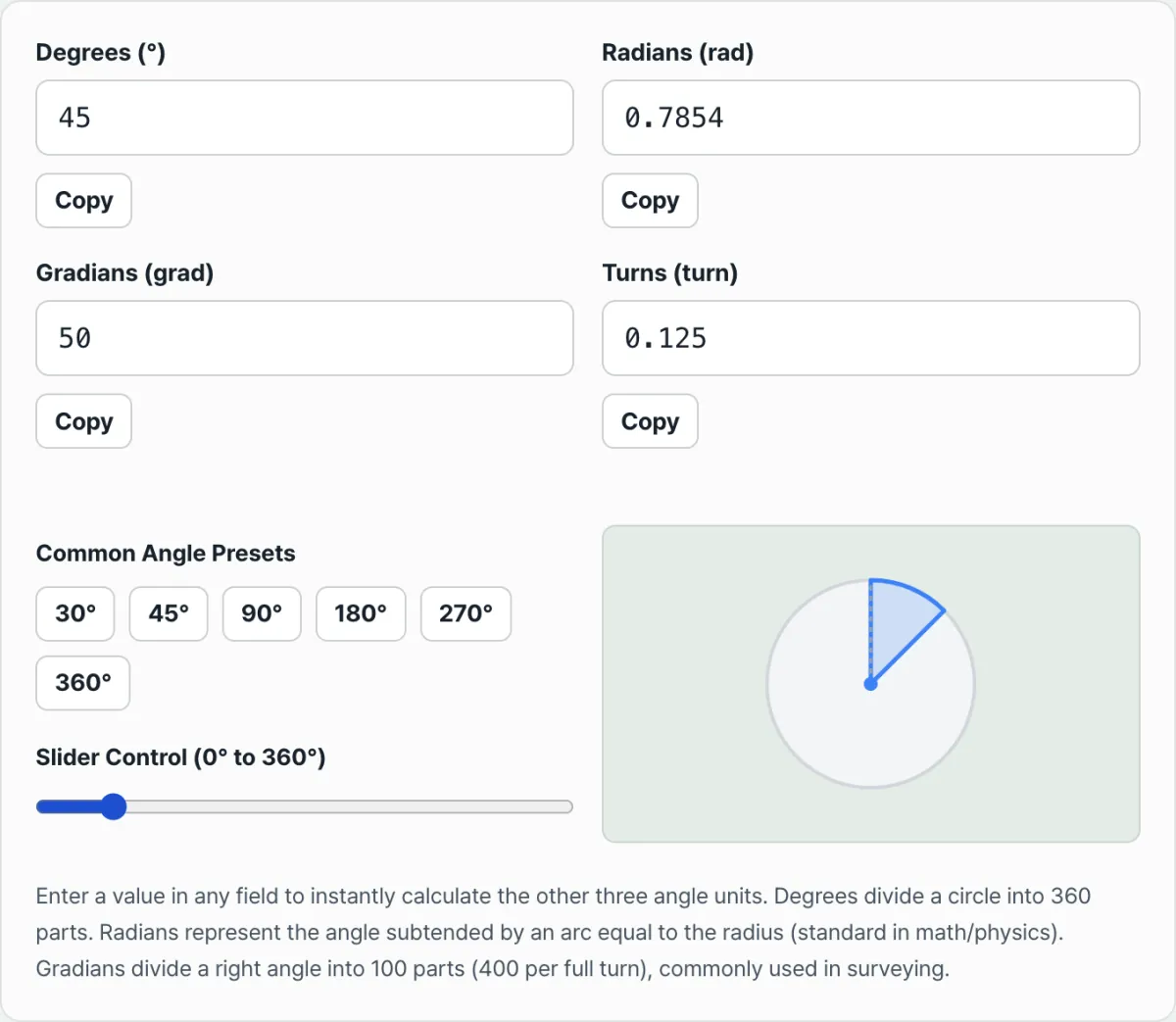
Key takeaways ① Degrees (°): A unit that splits one full circle into 360 equal parts, ideal for everyday life and protractor measurements. ② Radians (rad): An arc-measure unit that defines 1 rad as the angle at which the arc length equals the radius. It makes coefficients equal 1 in calculus and physics formulas. ③ Math trig functions in every programming language—JavaScript, C++, Python, and others—take radian values as arguments, so the conversion rad = deg × (π / 180) is essential. ④ The Angle Converter's live SVG circular sector visualization lets you instantly grasp the physical size of unfamiliar radian and gradian angles.
Why There Are So Many Angle Units
Human history has developed two main approaches to defining angles.
1. The History of the Sexagesimal System and Degrees
The degree (°) goes back to the Babylonian period before the Common Era. The Babylonians used a base-60 system, and based on astronomical observations that a year is about 360 days, they defined one full circle as 360 degrees (360°).
The number 360 has 24 divisors—including 2, 3, 4, 5, 6, 8, 9, 10, 12, and more—which makes it very convenient for splitting a pizza or a circle into 2, 3, 4, or 6 equal parts. Using 90 degrees for a right angle is also a legacy of this 360-based system.
2. The Birth of Arc Measure and the Radian
But in pure mathematics and the natural sciences, 360 is just an inconvenient constant that was chosen arbitrarily. If extraterrestrial civilizations exist, there is no reason they would have divided a circle into 360 parts.
Defining angles based on the circle's own geometric properties, rather than human-centered arbitrariness, is arc measure, and its unit is the radian.
The radian defines 1 rad as the central angle at which the circle's radius (r) and arc length (s) are exactly equal. Because angle is defined as a ratio of lengths (arc length ÷ radius), it is a pure dimensionless number with no unit dimension, and the unnecessary coefficient (π / 180) disappears when you do calculus with trig functions.
Degree and Radian Conversion Formulas
The circumference of a circle is 2π r. When you go one full turn around the circle (360°), the arc length is 2π times the radius, so 360° = 2π rad holds.
- Radians ➔ degrees: deg = rad × 180/π (1 rad ≈ 57.2958°)
- Degrees ➔ radians: rad = deg × π/180 (1° ≈ 0.0174533 rad)
- Gradians (grad): One full circle divided into 400 equal parts (right angle = 100 grad, 1 grad = 0.9°)
- Turns (tr): A full circle expressed as 1.0 (1 turn = 360° = 2π rad)
Free · no install · enter a number to convert degrees, radians, gradians, and turns in a second, with SVG visualization
Core Technical Mechanism: The Math Behind Why Radian Measure Became the Standard in Modern Calculus
Why did physics and computer engineering adopt radians, not degrees, as the absolute standard?
1. Trigonometric Limits and Taylor Series
The following elegant mathematical limit holds only when you use radians:
- limx → 0 sin x/x = 1 (x가 라디안일 때) If you use degrees for x, this limit produces the messy constant π/180 ≈ 0.01745....
- Only with radians does the derivative formula come out cleanly with no coefficient—(sin x)′ = cos x—and the Maclaurin series sin x = x − x3/3! + x5/5! − … holds.
2. Radically Simpler Arc Length and Sector Area Formulas
For a radius of r and a central angle of θ:
- Arc length: s = rθ (in degrees: s = 2π r × θ/360)
- Sector area: A = 1/2r2θ (in degrees: A = π r2 × θ/360) With radians, the π and 360 constants disappear from every geometry formula, leaving only intuitive multiplication.
Conversion Matrix for the Four Main Angle Units
| Reference angle | Degrees (°) | Radians (rad) | Gradians (grad) | Turns (tr) |
|---|---|---|---|---|
| 0° (zero angle) | 0° | 0 rad | 0 grad | 0 tr |
| 30° (special angle) | 30° | π/6 (≈ 0.5236 rad) | 33.33 grad | 0.0833 tr |
| 45° (special angle) | 45° | π/4 (≈ 0.7854 rad) | 50 grad | 0.125 tr |
| 90° (right angle) | 90° | π/2 (≈ 1.5708 rad) | 100 grad | 0.25 tr (1/4 turn) |
| 180° (straight angle) | 180° | π rad (≈ 3.1416 rad) | 200 grad | 0.5 tr (half turn) |
| 270° | 270° | 3π/2 (≈ 4.7124 rad) | 300 grad | 0.75 tr (3/4 turn) |
| 360° (full angle) | 360° | 2π rad (≈ 6.2832 rad) | 400 grad | 1.0 tr (1 full turn) |
5 Common Mistakes When Calculating Angles and Writing Code
- Passing degree values directly to trig functions in code: Calling Math.cos(60) and getting -0.9524 instead of 0.5 (you must convert to radians first).
- Comparison failures from floating-point error: Math.sin(Math.PI) does not output exactly 0; it outputs 1.22e-16, so you need a tolerance like Math.abs(val) < 1e-9.
- Reversing the argument order (Y, X) in atan2: In Math.atan2(y, x), the y coordinate is the first argument, but putting the x coordinate first produces a vector that is 90 degrees off.
- Omitting the unit in CSS transform rotate: Writing transform: rotate(90) without a unit (deg, rad, turn) causes the browser to ignore the CSS property.
- Confusing gradian with radian: Mixing up grad and rad in civil surveying software causes a serious 10% angle error.
A 5-Step Workflow for Perfect Angle Unit Conversion
- Step 1 (Identify the angle value and current unit): Decide on the number you want to convert (for example, 90) and its source unit (Degree, Radian, Gradian, Turn).
- Step 2 (Enter the value in the tool's input field): Type the number into the matching unit field.
- Step 3 (Real-time sync of all four units in 1 second): Confirm that the degree, radian, gradian, and turn fields sync instantly with no error.
- Step 4 (Verify with the SVG circular sector on the right): Visually check that the blue circular sector on the right side of the screen fills to the actual angle.
- Step 5 (Copy the formula and apply it to your source code): Copy the converted radian value or the programming conversion formula (val * Math.PI / 180) into your project.
7 Practical Angle Conversion Tips
- Make JavaScript angle-conversion helpers production-ready: Register const toRad = deg => deg * (Math.PI / 180); and const toDeg = rad => rad * (180 / Math.PI); in your utilities.
- The turn unit is the most intuitive choice for CSS rotation: rotate(0.5turn) (half a turn) and rotate(1turn) (a full turn) are far more readable than 360deg.
- Track mouse direction with arctangent (atan2): When you rotate a character toward mouse coordinates (x, y), Math.atan2(dy, dx) is the right answer because it automatically determines the quadrant.
- Euler angles and gimbal lock: In 3D game development, use quaternion rotations to avoid gimbal lock, where the x, y, and z rotation axes overlap.
- Use gradians (gon) in civil surveying: The gradian unit, which divides a right angle into 100, is very useful for slope percentage (%) calculations and decimal subdivision.
- Use the tau constant (τ = 2π): If you write one full circle as τ instead of π, then τ/4 = 90° and τ/2 = 180° make radians far more intuitive.
- Round decimals for precision calculations: To avoid floating-point errors, format output with parseFloat(val.toFixed(6)).
Final Decision Tree: Which Angle Unit Should You Use?
- Scenario A (everyday conversation, measuring with a paper protractor, 3D modeling UI sliders) ➔ Degrees (degree, °)
- Scenario B (JavaScript/Python/C++ trigonometric functions, physics simulations, calculus operations) ➔ Radians (radian, rad)
- Scenario C (CSS web animation keyframe rotation) ➔ Turns (turn) or degrees (deg)
- Scenario D (civil surveying, cartography, European road gradients) ➔ Gradians (gradian, gon)
Cheat Sheet: Key Angle and Geometry Terms
- Radian Measure: An angle system that defines 1 rad as the angle subtended by an arc equal in length to the radius.
- Sexagesimal Measure: A system that divides a circle into 360 "degrees (°)", each degree into 60 "minutes (′)", and each minute into 60 "seconds (″)".
- Dimensionless Quantity: Defined as a ratio of length to length, so it is a pure mathematical number with no physical unit dimension.
- Gradian / Gon: A French-style unit that divides a right angle into 100 parts and a full circle into 400 parts to fit the base-100 system.
Frequently Asked Questions
Exactly how many degrees (°) is 1 radian (rad)?
1 radian equals 180 / π degrees, which is about 57.2957795° (about 57.3 degrees).
Why doesn't Math.sin(30) return 0.5 in programming languages?
The Math.sin function in every modern programming language takes radians, not degrees, as its input. To pass 30 degrees, convert it to radians with Math.sin(30 * Math.PI / 180); only then will you get exactly 0.5.
Is the number I enter into the calculator sent to a server?
It is never sent. This Angle Converter processes everything offline and in real time using your browser's local JavaScript engine and inline SVG.
This article was adapted from our Korean original. Read the Korean original