
Keyword Combination Math: Permutations and Birthday Paradox
Contents
- The Math Behind Brainstorming Keyword Combinations
- Why Do Repeats Show Up So Fast?: The Birthday Paradox Secret
- The Core Technical Mechanism: Fisher-Yates Shuffle Random Selection
- Matrix of Word Counts (n) and Permutation Possibilities by Category
- 5 Common Brainstorming Naming Mistakes
- The Flawless 5-Step Brand Naming Workflow
- 7 Naming Idea Tips
- Final Decision Tree: Which Word-Combination Approach Should You Use?
- Brainstorming & Naming Cheat Sheet
- Frequently Asked Questions
When you're brainstorming with your team ahead of launching a new startup, shipping a new service, or starting a YouTube channel, you end up asking yourself, "Which keywords should I combine to create a name that's fresh and memorable?"
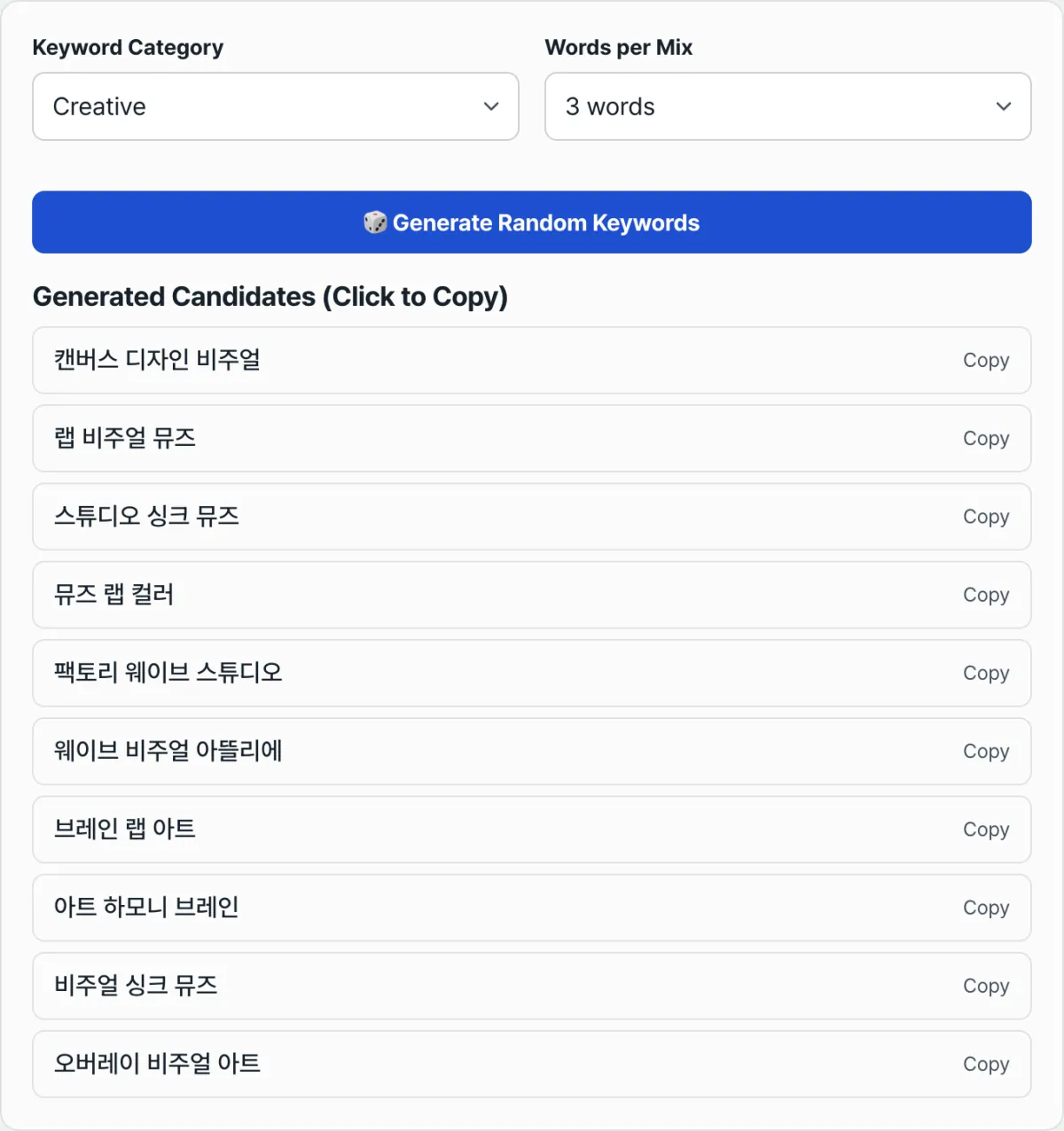
Click the Brainstorming Keyword Generator a few times and a stream of weird, clever word combos pours out. Click a few more times, and a word pair you just saw shows up again.
That's not an algorithm bug. It's a completely natural math phenomenon that comes from combining the number of permutation cases with the statistical Birthday Paradox.
Here's the full breakdown: the permutation formula (n Pr) for a word pool per category (n) and combination length (r), the probability math for why repeats show up faster than you'd expect, and a 5-step naming workflow that breaks your brain out of its ruts.
Key takeaways ① Permutation formula: The order you pick words in changes the name, so total possibilities are n P2 = n(n−1) and n P3 = n(n−1)(n−2). ② Combination counts explode: With 18 words, 2-word combos give 306 options, and 3-word combos give a whopping 4,896 — a 16x jump. ③ Birthday Paradox: Even with 380 total possibilities, after just 23 random draws the chance of hitting a combo you've already seen (a collision) passes 50%. ④ With this keyword generator, you can pull thousands of fresh idea combos in one second across 4 themes: IT/Tech, Business, Creative, and Lifestyle.
The Math Behind Brainstorming Keyword Combinations
Change the order of the words and you get a completely different brand name, so the statistical permutation (Permutation, n Pr) formula applies:
1. The 2-Word Combination Formula
- One of the n words goes in the first slot, and the second slot pairs it with one of the remaining (n−1) words.
- Example (20 IT/Tech words): 20 × 19 = 380 combinations
2. The 3-Word Combination Formula
- Example (20 IT/Tech words): 20 × 19 × 18 = 6,840 combinations
- You added just one word and the variety jumped 18x, which pushes you toward completely new ideas.
Why Do Repeats Show Up So Fast?: The Birthday Paradox Secret
There are 380 total possibilities, yet if you click 10 at a time three times (30 total), word pairs you've already seen come back. The reason is the same probability law behind the Birthday Paradox:
- Pull just k = 23 random combos from a pool of N = 380, and the chance that at least two of them overlap already hits 50.05%.
- Draw k = 40, and the duplicate chance climbs to 88.4%.
- So if you want to avoid repeats and find new inspiration, the statistically efficient move is to switch to 3-word mode or switch categories.
Free · Just pick a theme and get thousands of fresh brand naming keywords in one second
The Core Technical Mechanism: Fisher-Yates Shuffle Random Selection
Let's break down the O(N) algorithm the browser uses to combine words fairly and without repeats.
1. Fisher-Yates Shuffle Algorithm
function getRandomCombination(wordList, count) {
  const pool = [...wordList];
  const selected = [];

  for (let i = 0; i < count; i++) {
    const randomIndex = Math.floor(Math.random() * (pool.length - i));
    selected.push(pool[randomIndex]);
    // Send the picked word to the end and redraw only from the remaining range
    pool[randomIndex] = pool[pool.length - 1 - i];
  }

  return selected.join(" ");
}

* Within $O(r)$ time complexity, this algorithm guarantees a perfect random permutation where the same word never appears twice in one string (sampling without replacement).
Matrix of Word Counts (n) and Permutation Possibilities by Category
| Category theme | Registered words (n) | 2-word combos (n P2) | 3-word combos (n P3) | 4-word combos (n P4) | Best use cases |
|---|---|---|---|---|---|
| IT / Tech | 20 | 380 | 6,840 | 116,280 | SaaS, app services, developer tools |
| Business / Finance | 18 | 306 | 4,896 | 73,440 | Consulting, fintech, e-commerce |
| Creative | 18 | 306 | 4,896 | 73,440 | Design studios, art, fashion |
| Lifestyle | 20 | 380 | 6,840 | 116,280 | F&B, beauty, travel, wellness |
5 Common Brainstorming Naming Mistakes
- Sticking to 2-word combos and complaining your ideas dried up: Not moving to 3 words to widen your options (with 20 words, that's 380 → 6,840).
- Skipping the homophone/negative connotation check: Not checking whether the name means something profane or insulting in another language when you go global.
- Not checking domain (.com, .co.kr) availability: You settle on a great name, then drop it because someone already owns the domain.
- Not searching trademarks (KIPRIS): Using a generic noun or someone else's registered trademark as-is, when it can't be registered.
- Word combos that are too hard to pronounce or too long: Clunky 4+ word foreign-sounding combos that hurt how well users remember you.
The Flawless 5-Step Brand Naming Workflow
- Step 1 (Pick your target theme): Choose the category that fits your brand identity: Business, IT/Tech, Creative, or Lifestyle.
- Step 2 (Generate 50 two-to-three-word combos): Hit the tool's [Generate Keywords] button to print a wide batch of word combination candidates.
- Step 3 (Screen your top 5): Narrow to your 5 best picks based on how they sound, how intuitive the pronunciation is, and what service they call to mind.
- Step 4 (Check domain & social handles): Check Whois and whether the handle is available on Instagram/X.
- Step 5 (Search KIPRIS trademarks and lock it in): Do a final check on KIPRIS (the Korean Intellectual Property Rights Information Service) for identical or similar trademarks, then finalize.
7 Naming Idea Tips
- The law of juxtaposition: Pairing words with opposite vibes, like "Cold" and "Lava," makes the name stand out more.
- Say it out loud: A 2–3 syllable rhythm that rolls off the tongue without tripping creates the best word-of-mouth effect.
- Use alliteration: Combos that repeat the leading consonant, like "PayPal" or "Coca-Cola," are the easiest to remember.
- Portmanteau shortening: Cut the front and back of two words and fuse them (e.g., Breakfast + Lunch = Brunch).
- Think about verb potential: Gauge whether the noun works naturally as a verb, the way people say "Google it."
- Blind poll 10 target customers: Don't decide among your own team. Show it to real potential customers and watch their gut reaction.
- Bookmark this generator: Whenever you're stuck planning a new project, writing a slogan, or titling content, run it for one second.
Final Decision Tree: Which Word-Combination Approach Should You Use?
- Case A (a straightforward, trustworthy SaaS / tech service) ➔ IT/tech 2-word combo ('Cloud Core', 'Data Link')
- Case B (a stylish, trendy design studio / fashion brand) ➔ Creative 3-word combo ('Neon Velvet Space')
- Case C (a friendly, mainstream lifestyle café / YouTube channel) ➔ Lifestyle 2-word combo ('Urban Sunset', 'Daily Log')
- Case D (a high-trust fintech / corporate consulting firm) ➔ Business 2-word combo ('Global Partners', 'Value Asset')
Brainstorming & Naming Cheat Sheet
- Permutation: the number of ways to arrange r items chosen from n distinct items, where order matters (n Pr).
- Birthday Paradox: a statistical phenomenon where the chance of a collision (a duplicate) rises sharply after far fewer random draws than the size of the sample space would suggest.
- KIPRIS: a free, comprehensive search portal for intellectual property and trademarks run by the Korean Intellectual Property Office.
- Ideation: the creative process of breaking out of fixed assumptions and generating new ideas in a burst.
Frequently Asked Questions
I found a name I like in the generator. Can I register it as a company trademark right away?
The word combinations this tool generates are raw material for brainstorming. Before you register an actual corporate name or trademark, you must have a patent attorney review it and search KIPRIS (the Korean Intellectual Property Office's search portal) to check whether an identical or similar trademark is already registered.
Why don't you offer 4-word combinations?
Modern branding and marketing research shows that names longer than four words exceed a customer's working memory capacity, and recall rate drops sharply. The strongest brands are born from two- to three-word combinations.
Is the word list sent to a server every time I click the generate button?
Not at all. Every permutation shuffle and combination algorithm runs locally and instantly in the JavaScript engine inside your web browser, so you can use it safely with no worry about your ideas leaking.
This article was adapted from our Korean original. Read the Korean original