
cm to inches Conversion: Why You Multiply by 2.54
Contents
- When You Need to Turn a Tape-Measure Reading in cm Into Inches
- The cm↔inch Formula: How to Do the Math Without a Tool
- Easy to Confuse: Similar Names, Different Factors
- Summary
- The Core Mechanism: Why 2.54 cm?
- Length Conversions by Situation and Display Spec Comparison Table
- 5 Critical Length Conversion Mistakes People Make
- The 5-Step Ultra-Precision Length Measurement and Conversion Workflow
- 7 Precision Measurement Tips
- Decision Tree: The Right Conversion for Every Situation
- Key Terminology Cheatsheet
- Frequently Asked Questions
When you convert centimeters to inches or inches to centimeters, the numbers can look slightly different from site to site in the last decimal places. That's not because the math is wrong — it's because each site rounds to a different number of digits. An inch is a fixed ratio: 1 inch = 2.54 cm. Know that one ratio, and you can check the result yourself no matter which tool you used.
This post covers the math behind that conversion and why units with similar names — feet, yards, miles — are so easy to mix up.
Summary ① One inch is fixed at 2.54 cm, and other length units like centimeters, feet, yards, and miles are each defined by their own factor relative to the meter (m). ② A conversion is a two-step calculation: first change the input value into the base unit (m), then divide that value by the factor of the target unit. ③ The number you see on screen is the result rounded for display, so the trailing digits can look different depending on how many decimal places a tool shows.
When You Need to Turn a Tape-Measure Reading in cm Into Inches
Some international shopping sites list luggage, monitor, or picture-frame sizes in inches only. If the value you measured with a tape measure is in centimeters and the product spec is in inches, it's hard to compare them directly.
What you need here is an exact conversion, not a rough guess. Centimeters and inches aren't built on different principles — they're the same length divided by different factors, so the math lines up exactly.
The cm↔inch Formula: How to Do the Math Without a Tool
Every length unit is defined by a factor relative to one base unit: the meter (m). The factor is the number of meters in one of that unit. Here are the factors for the main length units.
- cm = 0.01 m
- mm = 0.001 m
- inch = 0.0254 m
- feet = 0.3048 m
- yard = 0.9144 m
- mile = 1609.344 m
Converting a unit takes two steps. First multiply the input value by the factor of the original unit to get meters, then divide that meter value by the factor of the unit you want.
Converted value = (input value × factor of the original unit) ÷ factor of the target unit
To convert 1 cm to inches: 1 × 0.01 = 0.01 m, and 0.01 ÷ 0.0254 = 0.39370079 inch. For 10 cm: 10 × 0.01 = 0.1 m, and 0.1 ÷ 0.0254 = 3.93700787 inch.
Going the other way, 1 inch to centimeters: 1 × 0.0254 = 0.0254 m, and 0.0254 ÷ 0.01 = 2.54 cm.
Both calculations pass through meters, so dividing one factor by the other (0.01 ÷ 0.0254) and using that directly gives the same result. To go from cm to inches, divide the cm value by 2.54. To go from inches to cm, multiply the inch value by 2.54. This shortcut comes from the meter terms canceling out in the two-step calculation, so with just the factor table you can check it by hand.
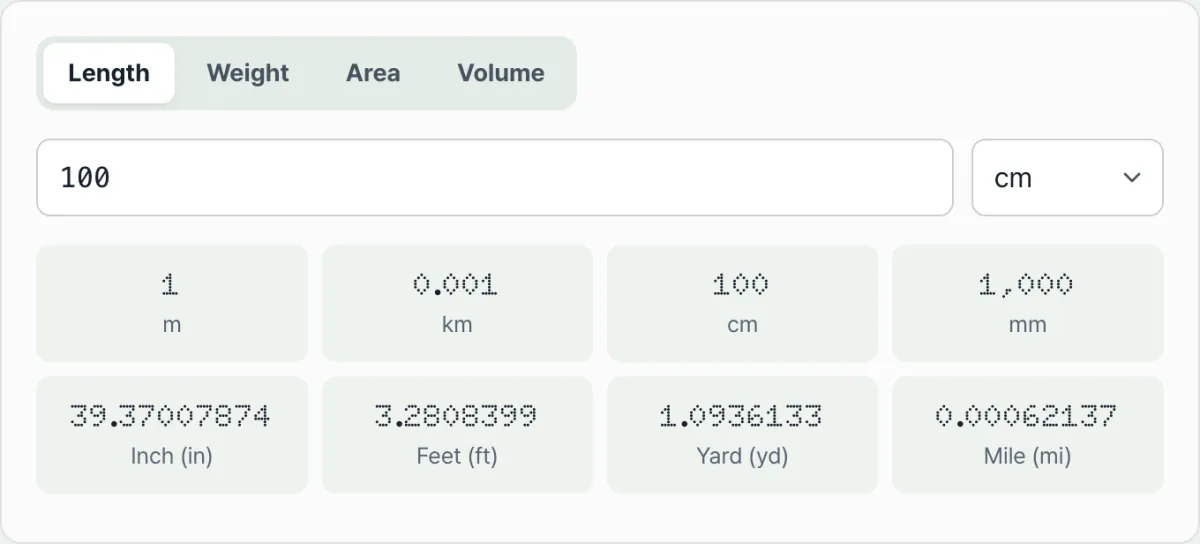
Check it with our tool.
Enter a value and a unit, and the converted length, weight, area, and volume values appear on one screen in real time.
Easy to Confuse: Similar Names, Different Factors
People often remember that feet, yards, and miles are all length units but mix up their factors. Put the factors side by side and the differences are obvious.
| Unit | Factor relative to the meter (m) | 1 unit in cm |
|---|---|---|
| cm | 0.01 | 1 cm |
| inch | 0.0254 | 2.54 cm |
| feet | 0.3048 | 30.48 cm |
| yard | 0.9144 | 91.44 cm |
| mile | 1609.344 | about 160,934.4 cm |
Yards and feet differ by a factor of 3 (0.9144 ÷ 0.3048 = 3). In other words, 1 yard is exactly 3 feet. Since 1609.344 ÷ 0.9144 = 1760, 1 mile is 1760 yards (= 5280 feet).
It also helps to know that the value on screen is rounded at a fixed number of decimal places. For example, converting 1 m to inches gives a number that goes on forever (39.370078740157…), but the screen shows the rounded 39.37007874. If you need more digits, divide directly by the factor (0.0254) to check it.
Summary
- One inch is a fixed ratio of 2.54 cm — not a rounded approximation.
- Every length unit is defined by a factor relative to the meter (m), and conversion takes two steps: multiply by the original unit's factor, then divide by the target unit's factor.
- For cm↔inch you can use the shortcut of ÷2.54 and ×2.54, which is what's left after the meter terms cancel out in the two-step calculation.
- Feet, yards, and miles have similar names but different factors (1 yard = 3 feet, 1 mile = 1760 yards), so check the unit first.
- The values on screen are rounded, so if you need higher precision, it's safer to check by hand with the factor.
Enter a value and a unit, and the converted length, weight, area, and volume values appear on one screen in real time.
The Core Mechanism: Why 2.54 cm?
The 1959 International Yard and Pound Agreement
One inch being 2.54 cm is not a rough approximation. Under the International Yard and Pound Agreement signed in 1959 by six countries, including the United States and the United Kingdom, one international inch was strictly defined by definition as exactly 25.4 mm (2.54 cm).
- Linear conversion formulas: Lengthinch = Lengthcm/2.54 = Lengthcm × 0.39370078740157… Lengthcm = Lengthinch × 2.54
Screen Geometry and Aspect Ratio
The inches (D) of a monitor or TV are the diagonal length. When you know the width (W) to height (H) ratio, these are the formulas for the exact length in cm.
- Width (cm) = 2.54 × D × W/√W2 + H2
- Height (cm) = 2.54 × D × H/√W2 + H2
Floating-Point Precision and Fractional Inches
The metric system uses decimal base-10 values down to 0.1 mm, while the imperial system uses a binary fraction system: 1/2, 1/4, 1/8, 1/16, 1/32, and 1/64 of an inch. Because of this, converting to decimals can produce repeating values or rounding errors, so in precision machining you should always confirm whether a spec is given in decimal inches.
Length Conversions by Situation and Display Spec Comparison Table
This matrix converts lengths and display sizes you run into in daily life and at work into centimeters (cm), inches (in), and feet (ft).
| Item / Spec | Centimeters (cm) | Inches (Decimal in) | Feet/Inches (ft' in") | Diagonal/Area Notes |
|---|---|---|---|---|
| Standard office ruler | 10 cm | 3.937 in | 0' 3.94" | 10 cm is just under 4 inches |
| 30 cm ruler | 30 cm | 11.811 in | 0' 11.81" | Slightly short of one foot (30.48 cm) |
| 12-inch MacBook | 30.48 cm | 12.000 in | 1' 0.00" | Diagonal measurement, 16:10 ratio |
| 24-inch monitor | 60.96 cm | 24.000 in | 2' 0.00" | About 53 cm wide, 30 cm tall (16:9) |
| 27-inch monitor | 68.58 cm | 27.000 in | 2' 3.00" | About 60 cm wide, 34 cm tall (16:9) |
| 32-inch TV | 81.28 cm | 32.000 in | 2' 8.00" | About 71 cm wide, 40 cm tall (16:9) |
| 55-inch TV | 139.70 cm | 55.000 in | 4' 7.00" | Standard size for a living room |
| 65-inch TV | 165.10 cm | 65.000 in | 5' 5.00" | Premium TV size |
| 6-foot adult height | 182.88 cm | 72.000 in | 6' 0.00" | Above average height for men in Western countries |
| 100-yard field | 9144 cm | 3600.00 in | 300' 0.00" | American football field spec |
5 Critical Length Conversion Mistakes People Make
- The "just multiply by 2.5" trap: If you calculate 1 inch as 2.5 cm instead of 2.54 cm, you pick up 4 mm of error for every 10 inches, which can cause serious defects when assembling large furniture or building materials.
- Misunderstanding monitor inches: You mistake the screen's inch measurement for its width and end up with too little desk space, or you buy a 21:9 ultrawide monitor and get disappointed by how short the vertical height is.
- Confusing the survey foot with the international foot: Even within the United States, the survey foot used in land surveying (1 ft = 0.3048006 m) and the international foot (1 ft = 0.3048 m) differ slightly, which can cause coordinate errors in ultra-precise GPS mapping.
- Misreading fractional calipers in the Imperial system: You can't instantly convert 5/8 inch to a decimal (0.625 inch = 1.5875 cm), or you misread the fractional scale on a vernier caliper — a machining mistake.
- Overlooking vanity sizing in clothing brands: The mistake is trusting that the 28 inches on the tag equals an actual 71.12 cm waist. Manufacturers tend to label sizes smaller than the real measurements to play to shoppers' psychology.
The 5-Step Ultra-Precision Length Measurement and Conversion Workflow
- Measurement: Use a non-stretch steel metric tape measure to measure the object's length precisely in millimeters (mm).
- Basic conversion: Divide the millimeter measurement by 25.4, or divide the cm value by 2.54, to get a decimal inch value.
- Decide on precision: Depending on whether it's woodworking, machining, or just buying clothes, decide whether you need fractional inches in 1/16, or three decimal places.
- Cross-check against standard specs: For manufactured products like displays or pipes, compare the converted value against standard size charts to confirm it matches available sizes.
- Two-way check with a converter: Enter the inch value back into the unit converter on this site and confirm you get the original cm value.
7 Precision Measurement Tips
- Memorize 10 cm and 30 cm by feel: Remember that 10 cm is about 3.94 inches and 30 cm is about 11.81 inches (roughly 1 foot), and you can eyeball overseas orders quickly.
- Check screen size with the Pythagorean theorem: When buying a monitor, don't just look at the inch figure. Plug the manufacturer's 16:9, 16:10, or 21:9 aspect ratio into the Pythagorean formula to find the actual width and height.
- The absolute rule in CAD/CNC work: When setting up precision 3D modeling and CNC machining, always enter 1 inch as exactly 25.4 mm to avoid CAM toolpath collisions.
- Memorize height conversion: Six feet (6' 0"), which shows up often in Western profiles, is 72 inches — exactly 182.88 cm.
- Compare monitors by area: When comparing a 34-inch 21:9 monitor with a 32-inch 16:9 monitor, note that the 32-inch has a much taller vertical height and a larger total area.
- Check airline baggage limits: The strict IATA carry-on size of 55 x 40 x 20 cm converts to 21.6 x 15.7 x 7.8 inches. If you buy a 22-inch carry-on, always check whether the handles and wheels are included in the measurement.
- Make web calculators a habit: Don't rely on mental math or rough multiplier estimates. For tricky fractional inches or feet conversions, always use a verified web-based unit conversion tool.
Decision Tree: The Right Conversion for Every Situation
- Situation A (Buying a monitor or TV) ➔ Check the aspect ratio and diagonal (calculate the width and height in cm yourself and compare against your desk space)
- Situation B (Buying clothes from overseas) ➔ Check the actual size guide (ignore the bare inch label and look at the detailed cm chart for total length and rise)
- Situation C (Blueprint-based woodworking and 3D printing) ➔ Apply the exact 2.54 multiplier with decimals (keep the original dimensions with no rounding)
- Situation D (Airline baggage and shipping specs) ➔ Convert all three dimensions to cm strictly (avoid surprise excess-baggage fees caused by rounding errors)
Key Terminology Cheatsheet
- Inch: A unit of length in the imperial system. By a 1959 international agreement, 1 inch is defined as exactly 25.4 mm (2.54 cm).
- Centimeter: A unit of length in the metric system. One hundredth of a meter.
- Diagonal: The baseline used to express display size. The distance from one corner of the screen to the opposite corner.
- International Yard and Pound Agreement (1959): The international agreement that precisely standardized imperial lengths against the metric system.
- Fractional inch: A binary-based way of splitting an inch into 1/2", 1/8", 1/16", and so on, common in American woodworking and machining.
- 16:9 aspect ratio: The standard width-to-height ratio for modern TVs and monitors. The key variable for working backward from a diagonal inch measurement to width and height.
- Feet: A unit of length equal to 12 inches. One foot is exactly 30.48 cm.
Frequently Asked Questions
Q1. Why does 1 inch equal exactly 2.54 cm with no repeating decimal?
A1. Because it isn't a natural measurement — in 1959, six countries legally agreed by international treaty that "1 yard shall be 0.9144 meters." Since 1 yard is 36 inches, dividing 0.9144 m by 36 gives exactly 0.0254 m (2.54 cm). In other words, it's an agreed-upon definition.
Q2. Why are TV and monitor sizes given as a diagonal in inches instead of a width?
A2. The practice stuck from the days of CRT TVs, when size was based on the diameter of the round glass tube. There's also a marketing advantage: the diagonal is the biggest, most impressive number you can use to describe a product's size.
Q3. What's the easiest way to convert an American fractional inch like 5/16 into millimeters?
A3. First turn the fraction into a decimal, then multiply by 25.4. 5 divided by 16 is 0.3125, and multiplying that by 25.4 mm gives exactly 7.9375 mm.
This article was adapted from our Korean original. Read the Korean original