
Density Conversion: g/cm³, kg/m³, lb/ft³ Formulas & Chart
Contents
1. The Math Behind Density Units and Conversion Formulas
The basic density formula is a physical fraction that measures how much mass is packed into a unit of volume.
- Density formula: Density (ρ) = mass (m) ÷ volume (V) (where ρ is rho, the symbol for density, m is mass, and V is volume.)
The conversion you run into most in practice is between the CGS system (centimeter-gram) and the SI system (meter-kilogram).
Deriving the 1,000× formula for g/cm³ and kg/m³
- Numerator (mass) conversion: 1 g = 10⁻³ kg
- Denominator (volume) conversion: 1 cm³ = (10⁻² m)³ = 10⁻⁶ m³
- Putting it together: 1 g/cm³ = 10⁻³ kg ÷ 10⁻⁶ m³ = 10³ kg/m³ = 1,000 kg/m³ What this means: 1 g/cm³ is exactly 1,000 kg/m³ numerically. This base conversion rate is where the imperial pound factor (1 g/cm³ ≈ 62.43 lb/ft³) comes from.
2. Standard Density Table for Everyday and Industrial Materials (at room temperature, 20℃)
A reference database of density constants for real materials you can check when designing something or ordering stock.
- Helium (gas):
0.00018 g/cm³(lighter than air, so it floats up) - Water (reference liquid):
1.0 g/cm³(reaches its maximum density at 4℃) - Aluminum (light metal):
2.7 g/cm³(light and strong, widely used in aircraft frames) - Concrete (building material): about
2.3 g/cm³ ~ 2.5 g/cm³ - Iron (ordinary steel):
7.87 g/cm³ - Lead (heavy metal):
11.34 g/cm³ - Gold (precious metal):
19.3 g/cm³(very heavy for its volume, so even a small gold bar feels substantial)
※ Tip: If wood or plastic has a density below water's reference density of 1.0, it floats. If the density is above 1.0, as with metal or stone, gravity outweighs buoyancy and it sinks.
How to Use the Density Converter
If working out pounds per cubic inch by hand or dividing by cubic meters feels like a hassle, try a dedicated density conversion tool.
Free · no sign-up · convert all four density units — g/cm³, kg/m³, lb/in³, and lb/ft³ — in one click
Using the tool is straightforward.
- Enter density: type the reference density value you already know into the text box.
- Set the unit: pick a unit from the dropdown next to the input, or type it directly into the field.
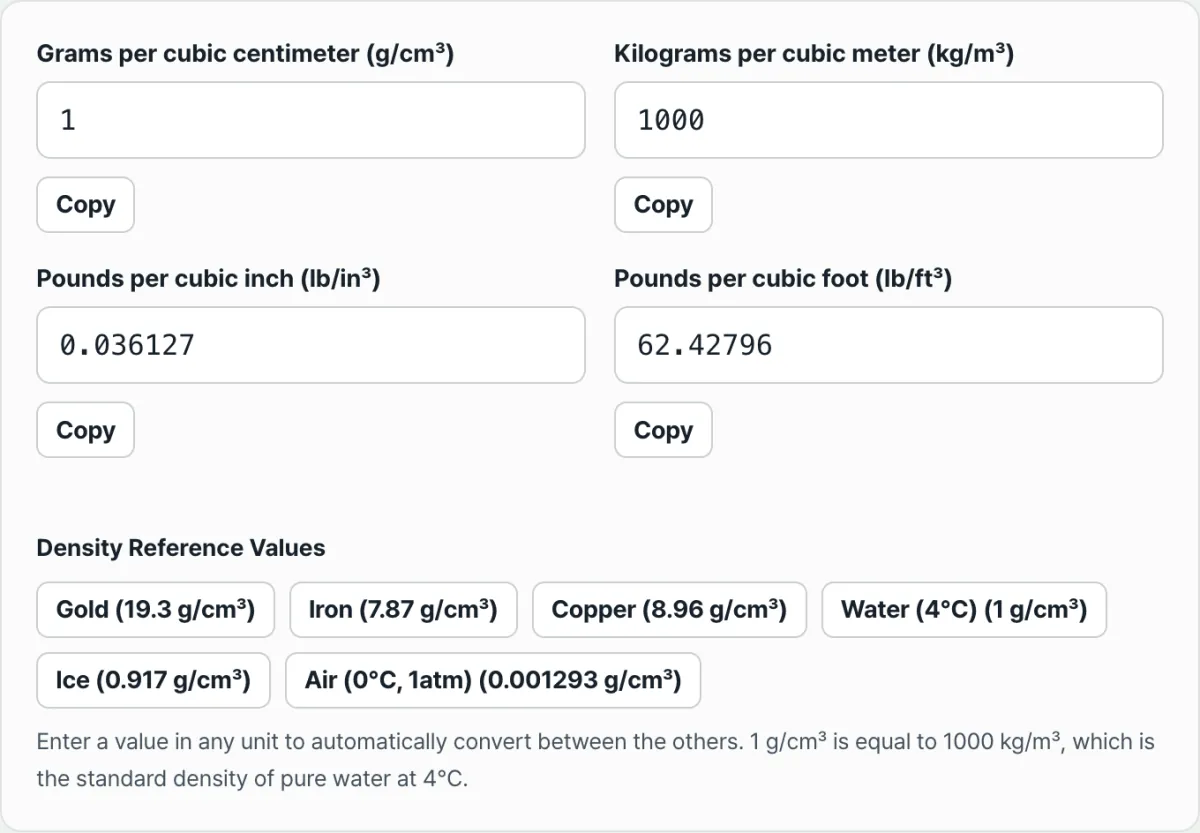
- As soon as you enter a value, the dashboard list converts and displays all four unit results in parallel — g/cm³, kg/m³, lb/in³, and lb/ft³ — in real time.
- In the reference quick-search tabs at the bottom, click a button for a common material such as gold, iron, copper, water, ice, or air, and its density constant is loaded into the main converter automatically. That makes it easy to estimate expected weight for a given volume.
Summary
Density is a fundamental physical measurement in countless settings — architectural design, chemistry research, and volume-weight calculations for shipping and logistics. To prevent material design failures caused by unit conversion errors, run your numbers through the Density Converter before you start work and cross-check carefully so you can lock in precise design values.
Free · no sign-up · convert all four density units — g/cm³, kg/m³, lb/in³, and lb/ft³ — in one click
Frequently Asked Questions
Is specific gravity exactly the same thing as density?
They're related, but they're different kinds of quantities.
- Density is mass ÷ volume, and it always carries units (g/cm³, kg/m³, and so on).
- Specific gravity is the ratio of a material's density to the density of a reference material (usually water at 4℃). It has no units — it's a dimensionless number.
- For example, iron's density is 7.87 g/cm³, but specific gravity is that value divided by water's density of 1 g/cm³, so you just write 7.87. The number looks the same, but the real difference is whether a physical unit is attached.
Why does density change with temperature and pressure?
As temperature rises, the molecules that make up a material move more actively and the material expands (thermal expansion).
- In the volume formula, the denominator (V) grows while the numerator (mass m) stays fixed, so most materials lose density as temperature rises.
- With pressure, gases in particular compress a lot when you squeeze them, so the denominator drops sharply and density shoots up.
- That's why lab reports always tag density with standard conditions such as "at 20℃, 1 atm (STP)."
This article is based on the physics definition of density and commonly used density constants for various materials. For actual design work or experiments, also consult separately verified reference data.
This article was adapted from our Korean original. Read the Korean original