
mph to km/h Conversion: Fixed Factors and Rounding Errors
Contents
When you look at an overseas car review, a dashboard, or a US highway sign, the mph number on it often doesn't tell you much until you work out what it is in km/h. The five speed units — m/s, km/h, mph, knots, and Mach — each start from a different definition, so quick mental math won't land exactly on the right answer.
This post covers which fixed factor converts each unit into the others, and where each factor comes from.
Summary ① mph, knots, and km/h convert through fixed factors that come from distance definitions — the mile (1,609.344 m) and the nautical mile (1,852 m) — so those factors never change. ② Mach isn't a distance at all. It's a relative value based on the speed of sound at that moment, so if the "dry air at 20°C" premise changes, the same Mach number means a different actual speed. ③ Results are shown to four decimal places and rounded below that, so converting back and forth between units can make the last digit drift slightly.
When the speed units in foreign sources get confusing
Car review videos made in the US, and spec sheets for imported cars, often list top speed or acceleration in mph. Domestic sources mostly use km/h, so comparing the two side by side takes a conversion.
Aircraft cruise speeds are often given in knots (kn) or Mach. Even if you want to gauge how many km per hour that spec number means, you can't do it accurately in your head unless you know what each of mph, knots, and Mach is defined against.
What you need is the ratio that links each unit to the others — and that ratio isn't an arbitrary number. It's a fixed factor that comes from the definition of each unit.
How to convert by hand, without a calculator
All five units connect to each other through m/s (meters per second). Once you know the fixed factor that turns each unit into m/s, you can work your way to any other unit.
- km/h → m/s: speed ÷ 3.6
- mph → m/s: speed × 0.44704
- knots → m/s: speed × 0.514444
- Mach → m/s: speed × 343 (dry air at 20°C)
Where those factors come from is the important part.
mph's 0.44704 comes from the definition of the mile
The 1959 international yard and pound agreement set 1 mile at exactly 1,609.344 m. Divide that by 3,600 seconds (one hour) and you get 1 mph = 0.44704 m/s exactly. It's not an approximation from measurement — it's a value fixed by definition.
Knots' 0.514444 comes from the definition of the nautical mile
The internationally standardized nautical mile is exactly 1,852 m, and dividing that by one hour (3,600 seconds) gives 1 knot = 0.5144444… m/s, a repeating decimal. The 0.514444 this tool uses is an approximation truncated at six digits.
In km/h it comes out clean: 1 knot = 1.852 km/h.
Mach's 343 is a speed-of-sound reference, not a distance
Mach 1 is a relative value that treats the speed of sound in air at that moment as 1, and the speed of sound changes with temperature. 343 m/s is the speed of sound under one specific condition: dry air at 20°C.
If that premise changes (say, at high altitude where the air is colder), the actual speed in km/h that Mach 1 points to changes too.
Working out 65 mph by hand
For example, here's how 65 mph — the number you often see on US highway signs — converts step by step.
- 65 × 0.44704 = 29.0576 m/s
- 29.0576 × 3.6 = 104.60736 km/h
So 65 mph is about 104.6 km/h. To go the other way, from km/h to mph, run those two steps in reverse: divide by 3.6, then divide by 0.44704.
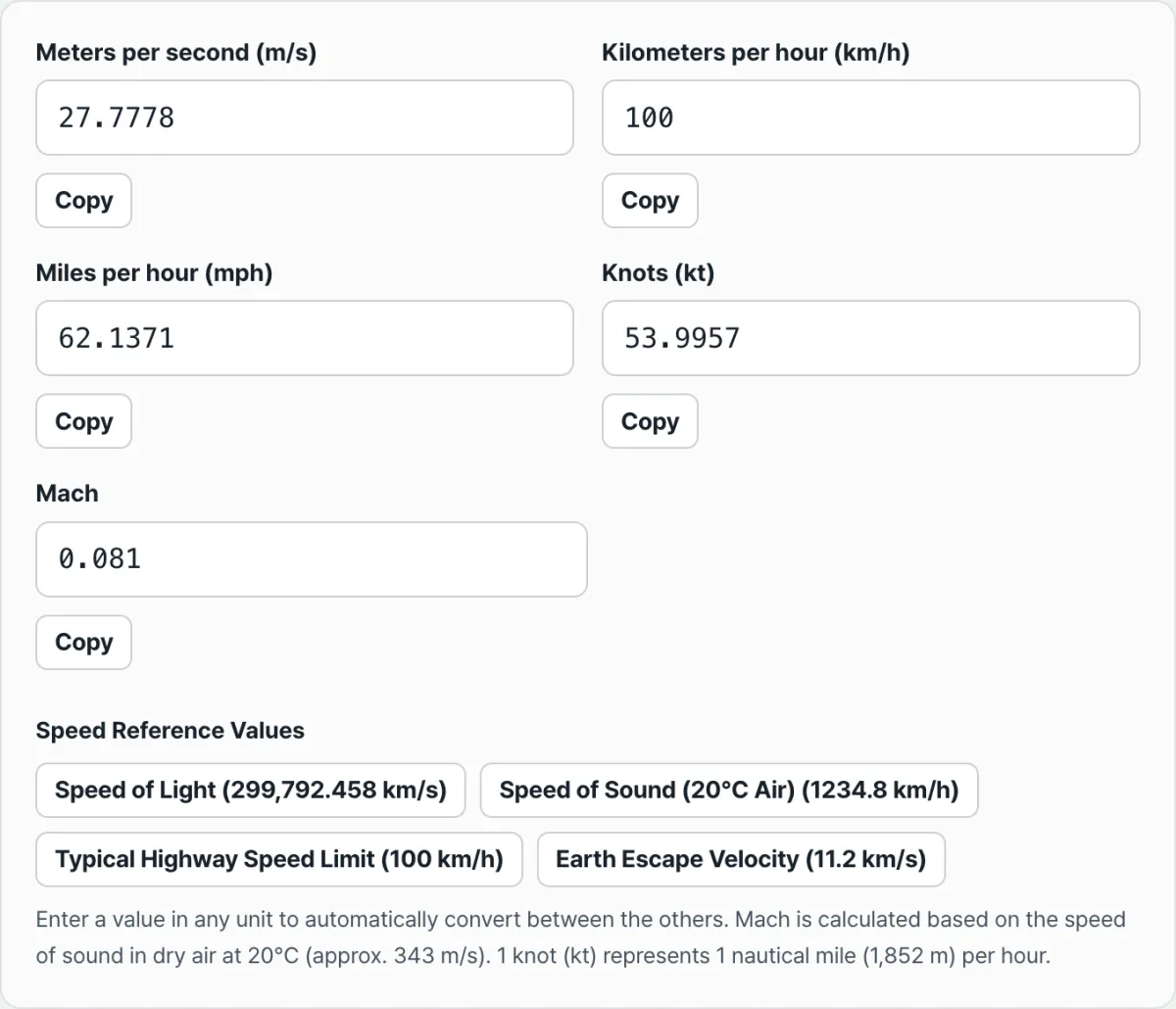
Check it with our free tool, mph to km/h Converter: Copy Any Unit Instantly.
Type into whichever of the five boxes you already know and the other four units recalculate instantly. All the math runs in your browser.
Common mix-ups
| Unit | Definition it's based on | m/s conversion factor |
|---|---|---|
| km/h | 1 km = 1,000 m (fixed distance) | ÷3.6 |
| mph | 1 mile = 1,609.344 m (fixed distance) | ×0.44704 |
| knots | 1 nautical mile = 1,852 m (fixed distance) | ×0.514444 (approximate) |
| Mach | The speed of sound at that moment (changes with temperature) | ×343 (dry air at 20°C) |
Two mix-ups come up most often, and it also helps to understand how the rounding works.
Mistaking mph and knots for the same unit
Both are written as "OO per hour" and the numbers don't look wildly different, so they're easy to confuse. But mph is based on the mile (1,609.344 m) and knots on the nautical mile (1,852 m), so the same number means a different actual speed.
100 mph is about 160.9 km/h, while 100 knots is about 185.2 km/h — a difference of more than 24 km/h.
Assuming Mach 1 is the same speed everywhere
The 343 m/s this tool calculates with assumes sea-level conditions: dry air at 20°C. At the altitudes aircraft actually fly (around the stratosphere, temperatures are below freezing), the speed of sound is lower, so the same Mach 1 works out to a smaller km/h value than the ground-level calculation.
If you take a Mach number from an aircraft spec sheet and convert it at ground-level km/h, you'll calculate a faster speed than the aircraft really flies.
Differences that come from rounding decimals
Results are shown to four decimal places and rounded below that. When a factor is a repeating decimal, as with knots, converting to mph and back to knots can shift the last digit slightly from the value you started with.
That isn't a calculation error — it's a normal difference that comes from how the rounding is displayed.
The short version
- m/s, km/h, mph, and knots all convert through fixed factors that come from distance definitions (meter, kilometer, mile, nautical mile), and those factors never change.
- mph's 0.44704 and knots' 1.852 (in km/h) come from standards that define the mile and the nautical mile in exact meter values.
- Mach isn't a distance but a relative value based on the speed of sound at that moment, so if the 343 m/s premise (dry air at 20°C) changes, the same Mach number means a different actual km/h.
- Anything below four decimal places in the result is rounded, so converting back and forth between units can make the last digit drift slightly.
- If converting by hand is a hassle, enter one value in the tool below and see the other four units at once.
Type into whichever of the five boxes you already know and the other four units recalculate instantly. All the math runs in your browser.
Frequently asked questions
How many km/h is 65 mph?
About 104.6 km/h. 65 × 0.44704 = 29.0576 m/s, and multiplying that by 3.6 gives 104.60736 km/h, which displays as 104.6074 km/h at four decimal places.
Exactly how many km/h is 1 knot?
1.852 km/h. The internationally standardized nautical mile is exactly 1,852 m, so dividing by one hour (3,600 seconds) gives a clean value. In m/s it becomes 0.5144444… m/s, a repeating decimal, and this tool approximates it as 0.514444.
Is Mach 1 always the same km/h?
No. Mach is a relative value that treats the speed of sound in air at that moment as 1, so the actual speed depends on temperature. This tool uses 343 m/s — the speed of sound in dry air at 20°C — as Mach 1, which assumes ground-level conditions.
Why does a conversion come out with different decimal places on another site?
Because sites differ in how many digits they keep when rounding the factors used in the math, and in how many decimal places they show the final result. This tool shows results to four decimal places, and for factors that are repeating decimals, like knots, it uses an approximation.
This article was adapted from our Korean original. Read the Korean original