
How to Split a Bill With a Tip: Per-Person Amount
Contents
Your per-person amount in a split bill always comes out a little higher than the total divided evenly by the number of people, because the math is set up differently.
The tip or service charge gets added to the total first, and then that payment amount is divided and rounded up to a set unit. That's why it differs from simply dividing by headcount.
This post walks through the formula step by step, so the person handling the money for your group can check it by hand too.
Summary ① The per-person amount is not the total — it's the total payment including tip divided by the number of people. ② You don't collect that divided number as-is; you round it up to a set unit (1, 10, 100, or 1,000 won). ③ The extra collected from rounding shows up as leftover money, and how to handle it is up to the group.
Why This Calculation Gets Confusing
People tend to think a split bill is just "divide the total by the number of people," but two more variables sneak into a real settlement. One is a tip or service charge. The other is the leftover won that doesn't divide evenly and is awkward to send by bank transfer.
Say six people have a meal and the bill comes to 218,000 won, and the place adds a 10% service charge. What you actually need to split isn't 218,000 won — it's 239,800 won with the service charge added.
Now divide 239,800 won by six and you get 39,966.66… won. That's an awkward number to transfer, so whoever's handling the money has to decide on the spot how much to round it to and what to do with the difference.
How to Calculate It Yourself Without a Tool
Run these four steps in order and you'll get the same result by hand, no tool needed.
Steps 1–2: Total Payment and the Original Per-Person Amount
Step 1 — Find the total payment. Add the tip or service charge rate to the total. With no tip, the total payment is just the total.
Total payment = total × (1 + tip rate)
Step 2 — Find the original per-person amount. Divide the total payment by the number of people. This number usually has decimals and doesn't come out even.
Original per-person amount = total payment ÷ number of people
Steps 3–4: Rounding Up and Checking the Leftover
Step 3 — Round up to your unit. Round the Step 2 value up to a unit that's easy to send by bank transfer (pick 1, 10, 100, or 1,000 won). This is the per-person amount you actually collect.
Step 4 — Check the amount collected and the leftover. Multiply the per-person amount by the number of people to get the total you actually collect. Subtract the total payment from that, and you have the leftover money (the difference).
Amount collected = per-person amount × number of people Leftover money = amount collected − total payment
Check It with an Example
Let's run the numbers. Four people pay 118,000 won, add a 10% tip, and round up to 100 won.
- Total payment = 118,000 × 1.10 = 129,800 won
- Original per-person amount = 129,800 ÷ 4 = 32,450 won
- Round up to 100 won → per-person amount = 32,500 won
- Amount collected = 32,500 × 4 = 130,000 won
- Leftover money = 130,000 − 129,800 = 200 won
You can also do Step 3 by hand with the "round up" or "CEILING" function in a calculator app. Divide 32,450 by 100 to get 324.5, round that up to 325, then multiply by 100 and you're back to 32,500 won.
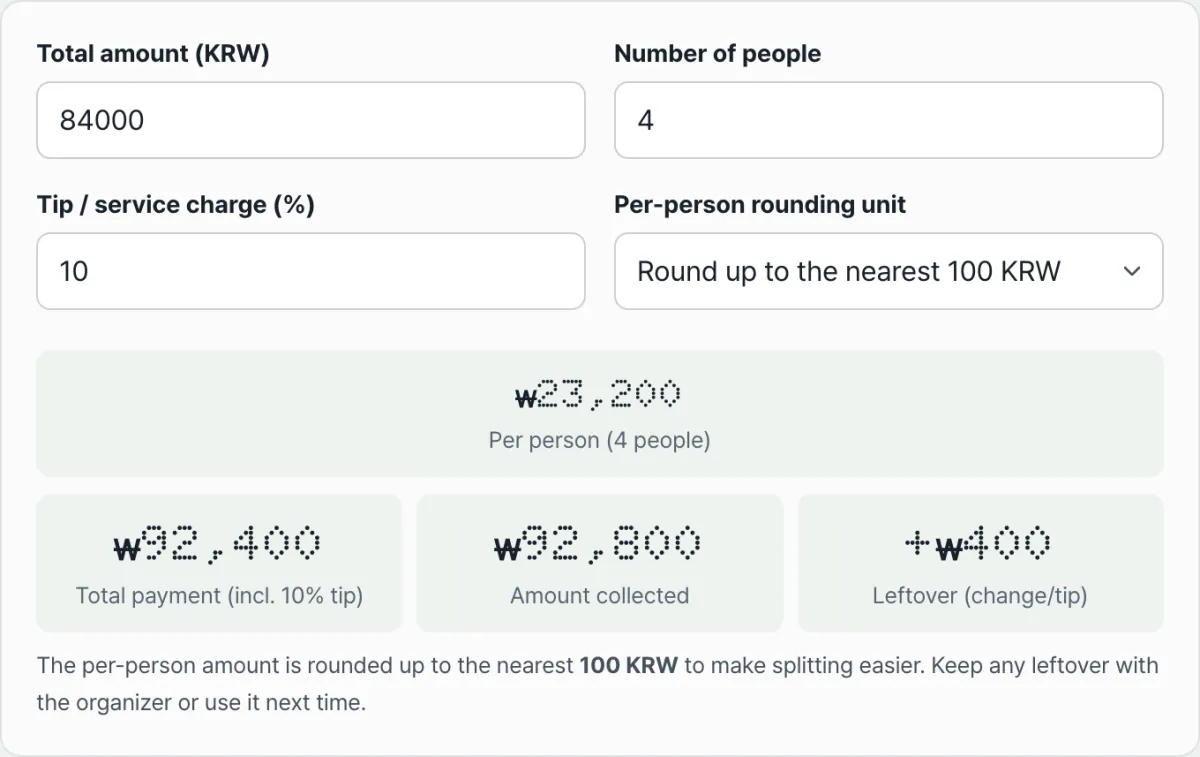
Check it with our tool.
Enter the total, the number of people, the tip, and the rounding unit, and you'll see the per-person amount and the leftover money right away. All calculations happen only in your browser.
Points That Are Easy to Misunderstand
A few things are easy to misread if you only look at the result.
- Why the per-person amount is always bigger than total ÷ headcount. Two things work together. One is that the tip is added to the total first, and the other is that the divided value gets rounded up. With a 0% tip and a 1-won rounding unit, the two numbers become the same.
- The rounding unit sets "in what unit you collect," not "how much you collect." A bigger unit makes bank transfers easier but tends to increase the leftover money. Set it to 1 won and there's no leftover, but you end up with an amount like 32,450 won that doesn't come out even.
- The tip is added to the total first and then divided — it's not added separately to each person's amount. Change the order (divide first, then add the tip per person) and rounding can shift the result slightly, so applying it at the total stage keeps the math consistent.
- The leftover money doesn't belong to anyone by rule. It just shows the difference by which rounding pushed the collected amount above the total payment. Whether the organizer holds it for the next gathering or hands it back on the spot is up to the group.
| Rounding unit | Per-person amount (based on the example above) | Range of leftover money |
|---|---|---|
| 1 won | 32,450 won (the value with no decimals) | 0 won |
| 10 won | 32,450 won | 0–9 won |
| 100 won | 32,500 won | 0–99 won |
| 1,000 won | 33,000 won | 0–999 won |
Recap
- The per-person amount is based on the total payment including tip, not the total alone.
- The divided value is rounded up to a rounding unit that's easy to transfer, and that sets what you actually collect.
- The extra collected from rounding shows up as leftover money, and the group decides how to handle it.
- Once you know the formula you can check it by hand or in a calculator app, and you only need four numbers: total, headcount, tip, and rounding unit.
- The amounts you enter are calculated in your browser only and never sent to a server.
Enter the total, the number of people, the tip, and the rounding unit, and you'll see the per-person amount and the leftover money right away. All calculations happen only in your browser.
Frequently Asked Questions
Why does the per-person amount come out a little higher than the total?
Because the result is rounded up to the rounding unit you chose (say, 100 won). The extra collected appears in the "leftover money" line, and you can hold it or put it toward the next gathering. Set the rounding unit to 1 won and the per-person amount is that value with no decimals.
How does the tip or service charge factor into the calculation?
The tip rate (%) you enter is added to the total first to make the "total payment," and that amount is divided by the number of people. It's not added separately to each person's share — it's applied once, at the total stage. If there's no tip, just leave it at 0%.
How should I choose a rounding unit?
Pick whichever unit makes bank transfers easy for your group. 1 won gives you the most exact value with no leftover, while 100 won or 1,000 won gives you simple amounts to transfer at the cost of a slightly bigger leftover. There's no single right answer — match what your group usually does.
Are the amounts I enter saved on a server?
No. The total, headcount, tip, and rounding unit are all calculated inside your browser, and no amount is ever sent to or stored on a server.
This article was adapted from our Korean original. Read the Korean original