
Stress Test Score: How PSS-10 Totals and 3 Levels Work
Contents
The stress level test uses the 10-item PSS-10 (Perceived Stress Scale). You answer each item on a 0–4 scale, reverse-score items 4, 5, 7, and 8, and add everything up to a total of 0–40. A total of 0–13 shows low stress, 14–26 shows moderate stress, and 27–40 shows high stress. These three ranges are commonly used reference ranges, not diagnostic criteria.
This article is for you if you've felt unusually on edge or unable to focus over the past month, but you can't tell how serious it is.
Here's the catch: each item is scored in a different direction, and if you don't know that, it's easy to read your score backward. So this article starts with how the calculation works, step by step.
Summary ① Answer 10 items on a 0–4 scale, then add up the scores to get a total between 0 and 40. ② Items 4, 5, 7, and 8 ask about positive states, so they are reverse-scored. Flip each answer with (4 − your answer) before adding it. ③ A total of 0–13 shows low stress, 14–26 shows moderate stress, and 27–40 shows high stress. You need to answer all 10 items to get a result.
Why It's Easy to Misjudge Your Score When You Estimate It Yourself
Most people who look up a stress self-assessment start because the past month felt especially hard. But once you start answering, some questions don't ask directly how stressed you felt. Instead, they ask the opposite, such as "how confident you felt handling problems" or "how often you felt things were going your way."
If you answer "very often" to one of these items, it doesn't mean your stress is high. It means your stress is lower. If you don't know this and treat it like every other item ("often = high score"), you'll guess the wrong result when you add up your total in your head.
How to Calculate Your Score by Hand
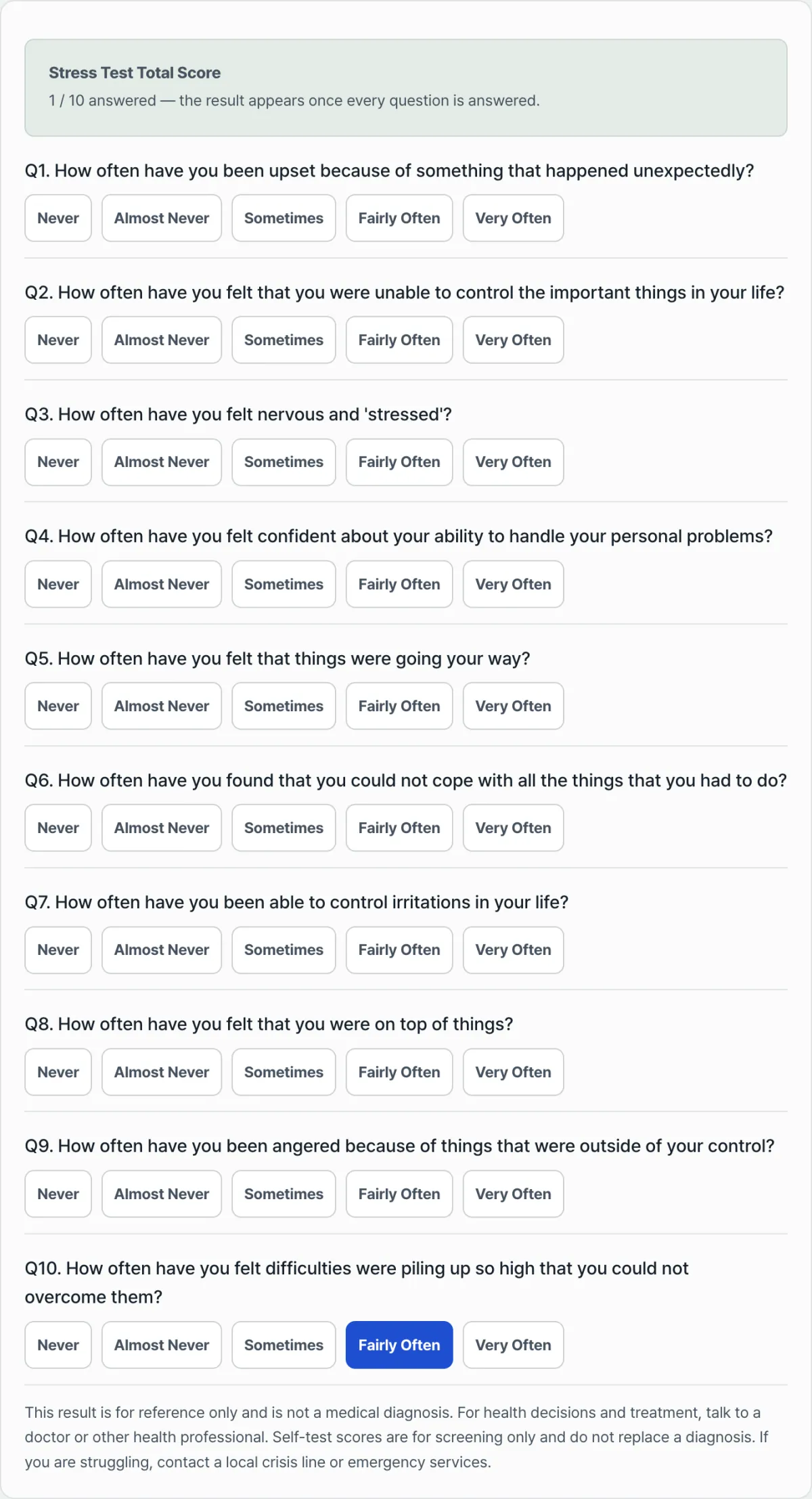
The PSS-10 has 10 items. For each one, you rate how often a situation came up during the past month, from 0 to 4 (never to very often). On paper, write down items 1 through 10, then decide what score you'd give each one.
Six of the 10 items ask directly about stress, such as feeling tense, irritated, or unable to cope. For these, you add your score as it is. If you answer "very often (4 points)," a full 4 points goes into your total.
The other four items (4, 5, 7, and 8) ask about positive states, such as "I handled problems with confidence" or "I felt things were going my way." These are reverse-scored. You don't use your answer as is. You subtract it from 4 and add that number. So if you answer "very often (4 points)," it counts as 0 points in your total.
Add up the scores for all 10 items and you get a total between 0 and 40. Compare that total to two cutoffs, 13 and 26, and it falls into one of three levels.
| Total score | Level |
|---|---|
| 0–13 | Low stress |
| 14–26 | Moderate stress |
| 27–40 | High stress |
The PSS-10 was developed by a team led by the American psychologist Sheldon Cohen. It originally has no official cutoff points. A higher score is read as more perceived stress. The three ranges split at 13 and 26 are widely used reference ranges, not diagnostic criteria.
You can do the math on paper, but checking the scoring direction for every item as you add in your head is tedious, and it's easy to slip on the reverse-scored items. Check it with our tool.
Answer 10 questions and get your total score and stress level right away. Your answers aren't sent to a server. They're processed only in your browser.
Common Mistakes When Reading Your Score
There are three mistakes people often make when estimating their total on their own.
| Common mistake | How it's actually calculated |
|---|---|
| Treating items 4, 5, 7, and 8 like the others, so "often" means a high score | These four items are flipped with (4 − your answer) before adding, so "very often" actually counts as 0 points |
| Thinking you'll get a result after answering just a few items | You need to answer all 10 items to see your total and level. Until then, you only see how many items you've answered |
| Taking the score from a single test as a medical diagnosis | It's a self-check reference based on the PSS-10 method. It's just a tally of your memory of the past month at one point in time, not a diagnosis |
Your total is only a tally of how you remember the past month at the moment you answered. If the same person answers again on a different day, the total can change depending on their memory and mood that day. So instead of drawing a firm conclusion from one result, you'll learn more by looking at how your scores change over time.
Summary
- Answer 10 items on a 0–4 scale. Six items are added as answered, and four are flipped with (4 − your answer) and then added, giving a total of 0–40.
- The reverse-scored items are 4, 5, 7, and 8. On these, "very often" counts as 0 points.
- A total of 0–13 shows low stress, 14–26 shows moderate stress, and 27–40 shows high stress. These are commonly used reference ranges.
- You get your result after answering all 10 items.
- The total is a reference measure tallied from your own answers at one point in time. It is not a medical diagnosis.
Answer 10 questions and get your total score and stress level right away. Your answers aren't sent to a server. They're processed only in your browser.
Frequently Asked Questions
Why does answering "often" lower my score on some items?
Items 4, 5, 7, and 8 ask about positive states, such as feeling confident you can handle problems or feeling that things are going your way. They are reverse-scored. Instead of adding your answer as is, the score subtracts it from 4 and adds that number. If you answer "very often (4 points)," it counts as 0 points in your total.
How are the 13 and 26 cutoffs used?
After reverse scoring, a total of 0–13 shows low stress, 14–26 shows moderate stress, and 27–40 shows high stress. The PSS-10 itself has no official cutoff points. These ranges are commonly used reference ranges.
When do I get my result?
You get your total and level after you answer all 10 items. Until then, you only see how many items you've answered, so check that you haven't skipped any.
Can this result tell me whether I need counseling?
The Stress Level Self-Test shows a total and a level based on the PSS-10 items. It's a self-check measure. It doesn't tell you whether you need counseling, and it doesn't diagnose anything. Whatever your score, if you feel you can't handle things on your own, you can talk to someone through a local mental health center, the mental health crisis line in Korea at 1577-0199, or the 24-hour suicide prevention hotline at 109.
This article was adapted from our Korean original. Read the Korean original