
Temperature Difference Converter: Celsius, Fahrenheit, Kelvin
Contents
You want to convert a temperature change — say, 10 degrees Celsius up or down — into Fahrenheit or Kelvin, and when you plug that number into an ordinary temperature converter, you get a strange result.
The calculator isn't broken. The formula for converting "the temperature at a specific moment" and the formula for converting "the size of a temperature change" are different by design. This post shows with math where that difference comes from, and how to convert just the temperature difference correctly.
Summary ① Converting a temperature difference (ΔT) differs from converting an absolute temperature in that the freezing-point offsets (+32, +273.15) cancel each other out during the calculation and disappear. ② For a Celsius → Fahrenheit difference you only multiply by 1.8 (=9/5), and for a Celsius → Kelvin difference the number stays exactly the same, 1:1. ③ If you apply the absolute temperature formula to a difference and add the offset, you get the wrong value.
When temperature differences and absolute temperatures get mixed up
In climate news you often see the sentence "the global average temperature has risen 1.5 degrees compared with pre-industrial times." English-language sources usually give the same figure alongside a Fahrenheit number.
Plugging the number 1.5 into an ordinary temperature converter creates a problem here. Most online converters are built to convert "a specific temperature of 1.5 degrees Celsius" to Fahrenheit, so they apply the absolute temperature formula 1.5×9/5+32 and return roughly 34.7°F.
But the sentence isn't talking about "a temperature of 1.5 degrees Celsius" itself — it's talking about "a change of 1.5 degrees Celsius."
The value English-language sources actually use alongside it is about 2.7°F, which is nothing like 34.7. If you don't separate temperature differences from absolute temperatures, this kind of gap keeps showing up.
How to work it out yourself, without a tool
You can derive the temperature difference conversion yourself starting from the absolute temperature formula. If the Celsius temperatures at two moments are C₁ and C₂, the Fahrenheit temperatures are:
F₁ = C₁ × 9/5 + 32
F₂ = C₂ × 9/5 + 32
Now take the difference between the two values (F₂ − F₁). The +32 that was added to both expressions cancels out and disappears in the subtraction.
F₂ − F₁ = (C₂ − C₁) × 9/5All that's left is ΔF = ΔC × 9/5 (=1.8). The freezing-point offset of 32 only sets "where the scale starts counting," and it automatically cancels the moment you take the difference between two temperatures.
Kelvin works the same way. Kelvin is defined as K = C + 273.15, so subtracting the two values cancels the 273.15 just the same.
ΔK = (C₂+273.15) − (C₁+273.15) = C₂ − C₁ = ΔCThat's why a Celsius difference and a Kelvin difference are always the same number. Kelvin just sets absolute zero (−273.15°C) as its starting point (0K); the size of one degree step is designed to match Celsius exactly.
In short, the order of calculation is:
- Decide the Celsius difference (ΔC) you want to convert. Example: 10 degrees
- If you need the Fahrenheit difference, calculate ΔC × 1.8 → 10 × 1.8 = 18°F
- If you need the Kelvin difference, use ΔC as is → 10K
- To go the other way, from a Fahrenheit difference to Celsius, calculate ΔF ÷ 1.8
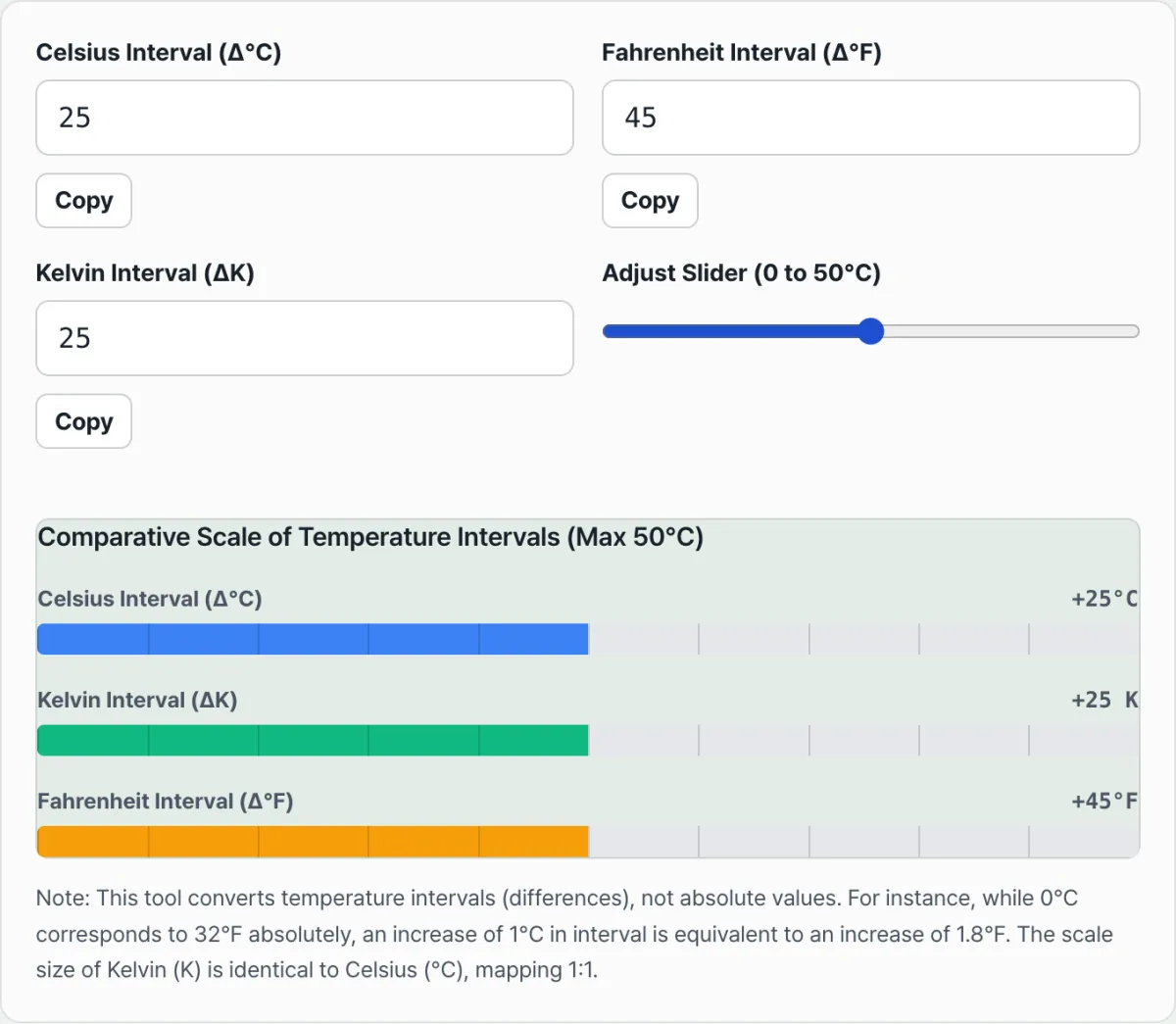
These four steps done by hand give you an exact value with no error. If multiplying and dividing by 9/5 every time is a hassle, check it with our free Temperature Difference Converter.
Convert temperature changes to Celsius, Fahrenheit, and Kelvin right away. Free, no install.
Where people usually get it wrong
Mistakes in temperature difference conversion almost all come from one pattern: dealing with a difference but still applying the absolute temperature formula and adding the offset.
| Situation | Wrong value | Correct value |
|---|---|---|
| 10-degree Celsius change → Fahrenheit | 10×9/5+32 = 50°F | 10×1.8 = 18°F |
| 1.5-degree Celsius rise → Fahrenheit | 1.5×9/5+32 = 34.7°F | 1.5×1.8 = 2.7°F |
| 20-degree Celsius change → Kelvin | 20+273.15 = 293.15K | 20K |
As the table shows, the value with the offset added (+32, +273.15) and the value with only the ratio applied are completely different numbers. They look like similar calculations, so it's tempting to pick either one, but only one of them is right.
The errors stand out most on the Fahrenheit side. The Fahrenheit scale is 1.8 times finer than Celsius, so a wrong offset and the correct value end up much further apart than they do with Kelvin.
Recap
- Temperature difference conversion is a different calculation from absolute temperature conversion. The freezing-point offset cancels out when you take the difference between two temperatures.
- To turn a Celsius difference into Fahrenheit, multiply by 1.8 (ΔF = ΔC×1.8); to turn a Fahrenheit difference into Celsius, divide by 1.8.
- A Celsius difference and a Kelvin difference are always the same number. Kelvin differs only in its starting point; the size of a degree is identical to Celsius.
- Applying the absolute temperature formula (+32, +273.15) to a difference gives the wrong value, so watch out for that.
Convert temperature changes to Celsius, Fahrenheit, and Kelvin right away. Free, no install.
Frequently Asked Questions
Why is the result different from an ordinary temperature converter?
An ordinary converter uses the formula for an absolute temperature at a specific moment (°F = °C×9/5+32), so it adds the freezing-point offset of 32.
A temperature difference conversion, on the other hand, cancels that offset out when it takes the difference between two temperatures, leaving only the pure ratio of ×1.8. That's why entering the same number 10 gives a different result.
Why are Celsius and Kelvin differences always the same?
Kelvin defines absolute zero (−273.15°C) as 0K, so it only shifts the starting point; the temperature span covered by one degree step is designed to be identical to Celsius.
When you take the difference between two moments, the shifted starting point (273.15) cancels out in the calculation, so a Celsius difference and a Kelvin difference are always equal, 1:1.
How do I convert a Fahrenheit difference to Celsius?
Divide the Fahrenheit difference by 1.8 (=9/5) to get the Celsius difference. For example, a change of 18 degrees Fahrenheit becomes 18÷1.8=10 degrees Celsius. No offset is added or subtracted in this calculation either.
Can the Temperature Difference Converter also convert an absolute temperature at a specific moment?
No. This tool is built to handle only the difference (ΔT) between two temperatures, so it doesn't apply the freezing-point offset.
To convert an actual temperature at a specific moment (for example, today's daytime high of 25 degrees), you need to apply the absolute temperature formula that includes the offset separately (°F = °C×9/5+32, K = °C+273.15).
This article was adapted from our Korean original. Read the Korean original