
Time Difference Calculator: GMT Offsets and Daylight Saving
Contents
When you're lining up video calls or phone calls with a city overseas, it's tempting to memorize "the time difference is X hours" once and assume it'll keep holding. It won't. If the other place observes daylight saving time (DST), the difference changes during the year. This post explains how to read GMT offsets, why time differences shift, and how to compare times live instead of recalculating every time.
Summary ① A time difference isn't a fixed number — it changes during the year depending on whether each place observes daylight saving time (DST). ② A GMT offset (a notation like +09:00) shows how many hours and minutes a place is ahead of or behind UTC. ③ For city pairs that straddle the International Date Line, not just the hours but the date itself can differ.
Why time difference math trips you up every time
Picture someone at a company in Korea who sets up a weekly video call with a partner in New York. The first time they schedule it, they work out that "Seoul is 14 hours ahead of New York," and from then on they just keep using that number.
The problem is that Korea doesn't observe daylight saving time, while the United States changes its clocks twice a year. When New York is on standard time (EST, UTC-05:00), the difference from Seoul is 14 hours. Once daylight saving time (EDT, UTC-04:00) kicks in, it shrinks to 13 hours.
So once the U.S. moves to daylight saving time, the "14 hours" you calculated at the start is no longer correct, and meetings end up happening an hour off without anyone noticing. That's why memorizing a time difference once and reusing it is risky.
How to read GMT offsets and calculate time differences yourself
The reference point for time difference math is UTC (Coordinated Universal Time). GMT (Greenwich Mean Time) is used in practice as the same reference, which is why notations like "+09:00" are commonly called GMT offsets.
The sign on the offset tells you the direction. + means the clock is ahead of UTC (east), and - means it's behind UTC (west). Seoul is UTC+09:00, nine hours ahead of UTC, and Los Angeles is UTC-08:00 on standard time, eight hours behind.
The difference between two cities is one city's current offset minus the other's. Comparing Seoul (+9) with Los Angeles on daylight saving time (-7) gives 9 - (-7) = 16 hours. When daylight saving time ends and Los Angeles returns to -8, it becomes 9 - (-8) = 17 hours.
Here's the order for doing it by hand.
- Check the current GMT offset for both cities you're comparing. What matters is the offset at that moment, not a fixed value.
- Subtract one offset from the other. That's your time difference in hours.
- If either offset includes 30- or 45-minute increments, carry those minutes through the calculation too.
- If the difference is large, check whether the date changes as well.
Step 1 is the one people skip most often. Offsets vary by region and by time of year within the same region, so reusing an old number gives you the wrong answer.
Instead of looking up these offsets by hand every time, you can let the browser's Internationalization (Intl) standard handle it. Browsers ship with data on time zones and daylight saving rules worldwide, so when you specify a time zone, they immediately return the offset and local time for that moment — including whether daylight saving time is currently in effect.
In other words, you don't have to check on your own whether New York is on daylight saving time right now. Give the browser the time zone name and it works out the correct offset for that moment. The catch is that comparing several cities at once means repeating that calculation for each one.
Check it with our free tool.
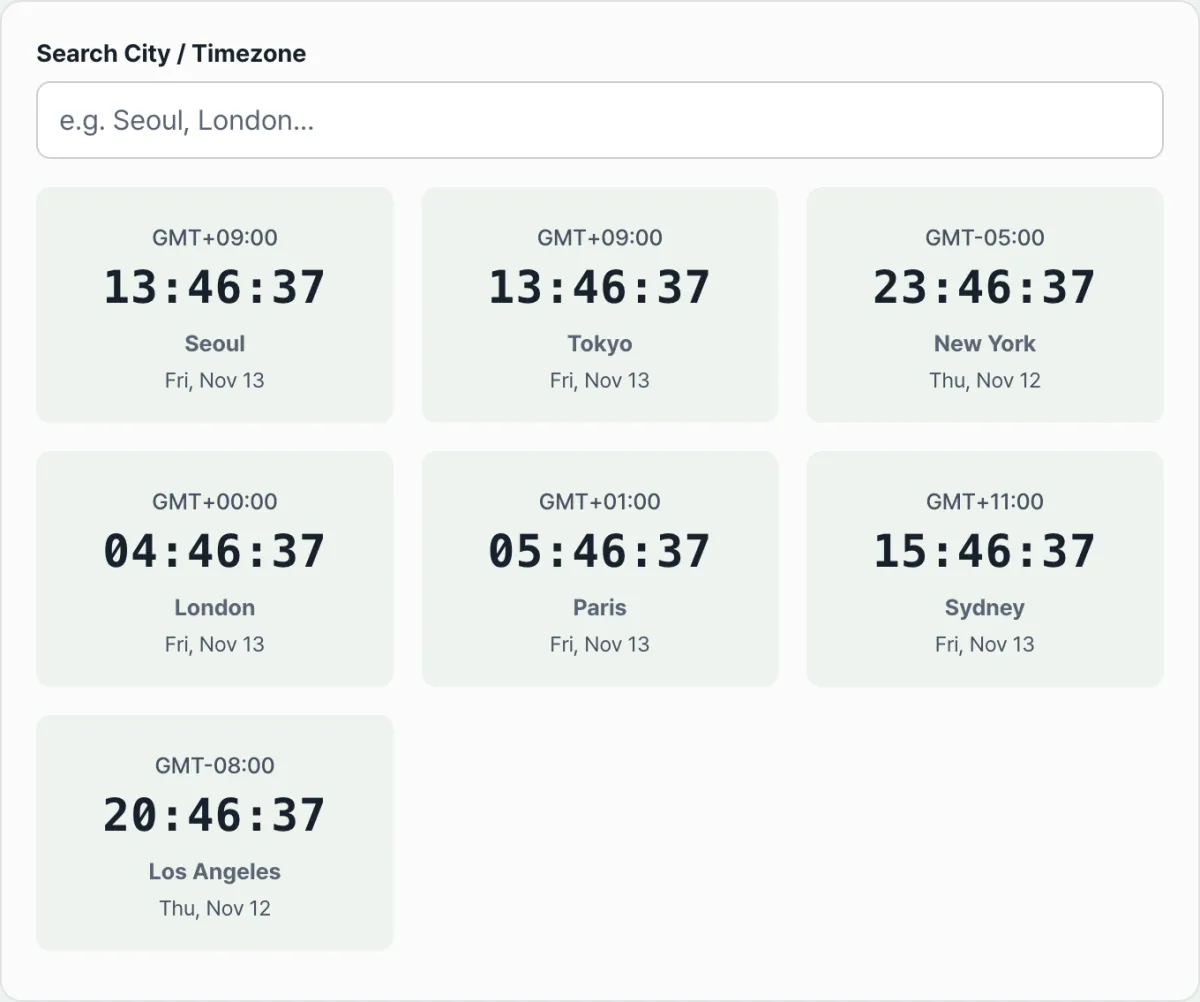
GMT offsets and current times for 7 cities, including Seoul, Tokyo, and New York, update live every second.
Where time difference calculations usually go wrong
A few mistakes come up again and again when people work out time differences.
Regional differences in when daylight saving starts and ends
Daylight saving time starts and ends on different dates in different places. The United States starts on the second Sunday in March and ends on the first Sunday in November, while the European Union starts on the last Sunday in March and ends on the last Sunday in October. Every year there's a stretch of a few weeks when the two regions are out of step going into and out of daylight saving time.
The Southern Hemisphere runs on the opposite schedule
In the Southern Hemisphere, daylight saving time falls at the opposite time of year. Most of Australia, including Sydney, observes daylight saving time from the first Sunday in October to the first Sunday in April the following year. When the Northern Hemisphere has summer, the Southern Hemisphere has winter, so Sydney's daylight saving period overlaps with Korea's winter.
Time zones with 30- and 45-minute offsets
Some time zones are offset by 30 or 45 minutes. Most are on the hour, but India (UTC+05:30), Nepal (UTC+05:45), Iran (UTC+03:30), and central Australia (UTC+09:30) are not. Once one of these places is involved, your result ends in a leftover number of minutes.
Crossing the International Date Line
For city pairs that straddle the International Date Line, the hour difference alone isn't enough. Cities with the date line between them, like Seoul and Los Angeles, are 16 to 17 hours apart, so it's common for Los Angeles to still be Monday afternoon while Seoul is already Tuesday morning. Get the time right but leave the date alone and your whole schedule lands on the wrong day.
| Situation | Why it's confusing |
|---|---|
| Daylight saving start and end dates don't match | Regions change at different times, so the same offset difference doesn't hold all year |
| Southern Hemisphere daylight saving | The timing is opposite to the Northern Hemisphere, so the "summer = daylight saving" instinct is wrong |
| 30- and 45-minute time zones | India, Nepal, Iran, and others aren't on the hour, so results end in leftover minutes |
| International Date Line | The gap is so large that the date itself moves a day forward or back |
The takeaway
- A time difference isn't a fixed number — it changes during the year depending on whether each place observes daylight saving time.
- The sign on a GMT offset shows the direction relative to UTC. + means ahead of UTC, and - means behind.
- Not every offset is a whole hour; some regions use 30- or 45-minute offsets, so your result can end in minutes.
- City pairs that are far apart can differ in date as well as time, so check both.
- The browser's Internationalization (Intl) standard applies daylight saving rules automatically, so when you're comparing several cities at once, a tool that shows them live is more accurate than calculating by hand.
GMT offsets and current times for 7 cities, including Seoul, Tokyo, and New York, update live every second.
Frequently asked questions
Why doesn't Korea observe daylight saving time?
Korea doesn't currently observe daylight saving time, so its standard time (KST, UTC+09:00) stays the same all year. It did run daylight saving time temporarily in the past, but that was discontinued, which means the time difference from Korea changes only based on whether the other place observes daylight saving time.
Are GMT and UTC the same thing?
In practice they're used almost interchangeably. UTC (Coordinated Universal Time) is the official atomic-clock-based standard, while GMT (Greenwich Mean Time) originally referred to solar time at the Greenwich Observatory. Time zone offsets use both terms, and there's no real difference between them.
How can I tell right away whether daylight saving time is in effect?
Look at the offset. For example, if New York shows UTC-05:00, it's on standard time (EST); if it shows UTC-04:00, daylight saving time (EDT) is in effect. A tool that displays each city's GMT offset in real time lets you see the current status at a glance.
Where exactly does the International Date Line run?
Roughly along the 180th meridian, but it zigzags in several places to follow national borders. It runs through the Pacific Ocean, so no single city sits on it, but when you compare cities on opposite sides (say, Seoul and Los Angeles), remember that the date can change even though that's separate from the time difference.
This article was adapted from our Korean original. Read the Korean original