
Time Difference Calculator: UTC Offsets and Date Changes
Contents
A time difference between two cities isn't something you can memorize as a single number. Standard time offsets vary by city in 30- and 45-minute steps, and even for the same pair of cities, the gap itself changes with the season depending on whether daylight saving time is in effect. This post is for anyone who needs to convert Seoul time into a colleague's or family member's local time accurately — and check whether the date rolls over to the next day.
Summary ① Time differences aren't always whole hours — 30- and 45-minute offsets really do exist, like India (UTC+5:30) and Nepal (UTC+5:45). ② Even for the same two cities, DST rules and the dates they start and end differ, so the gap changes with the season. ③ If you miss the "UTC+9" or "+1 day" labels on the conversion result, you can schedule a meeting on the wrong hour or the wrong date.
Why time differences are often miscalculated
When setting up a video call with an overseas branch, people often reuse a number they checked once before, like "New York is 14 hours behind Seoul." The problem is that this number doesn't stay fixed all year.
The US observes daylight saving time from the second Sunday in March to the first Sunday in November. During that period, New York moves one hour ahead, and the gap with Seoul shrinks from 14 hours to 13.
London works the same way. It's normally 9 hours behind Seoul, but between the last Sunday in March and the last Sunday in October, when the UK observes daylight saving time, the gap shrinks to 8 hours.
When DST start and end dates differ by country
There's one more thing. The US and the UK start and end daylight saving time on different dates. For about 2–3 weeks each spring and fall, only one of the two countries is on DST.
During that stretch, even the gap between New York and London shifts briefly from the usual 5 hours to 4. With just two cities, the gap changes by season — and even during specific weeks.
When the date slips by a day
There's a date problem too. If you schedule a morning meeting in Seoul, it's usually the previous afternoon or evening in Los Angeles. If you miss that and only say "10 a.m. tomorrow," the other person's calendar may show it on the wrong date.
How to calculate by hand without a tool
Converting times around the world is less arithmetic and more a matter of looking up data. If you know the exact name of each city's time zone and whether that region is on DST on the date in question, you can work it out by hand.
Here's the order.
- Find the city's time zone name. Seoul is Asia/Seoul, New York is America/New_York, London is Europe/London, and Tokyo is Asia/Tokyo — each has a city-level name (an IANA time zone name). This database, built into browsers and operating systems, also contains the DST start and end dates, which are updated every year.
- Check whether that region is on DST on the date you're converting. Seoul and Tokyo don't observe DST, so their offset stays fixed at UTC+9 year-round, but New York, London, and Los Angeles change offsets with the season.
- Subtract that region's offset from your reference time to get UTC. For example, 9 a.m. in Seoul is UTC+9, so subtract 9 hours and you get UTC 00:00.
- Add the target city's offset to the UTC time. Add New York's offset (UTC-5 in winter) to UTC 00:00 and you get 7 p.m. the day before; add London's (UTC+0 in winter) and you get 12 a.m. the same day.
- Compare the calendar dates in each city. In the example above, New York lands on a date one day earlier than Seoul, while London lands on the same date as Seoul.
Adding several cities to the clock app on your phone or computer uses the same principle. The catch is that this method is only accurate for "right now" — if the date you care about is in the near future, close to a DST change, you need to check separately whether DST applies that day.
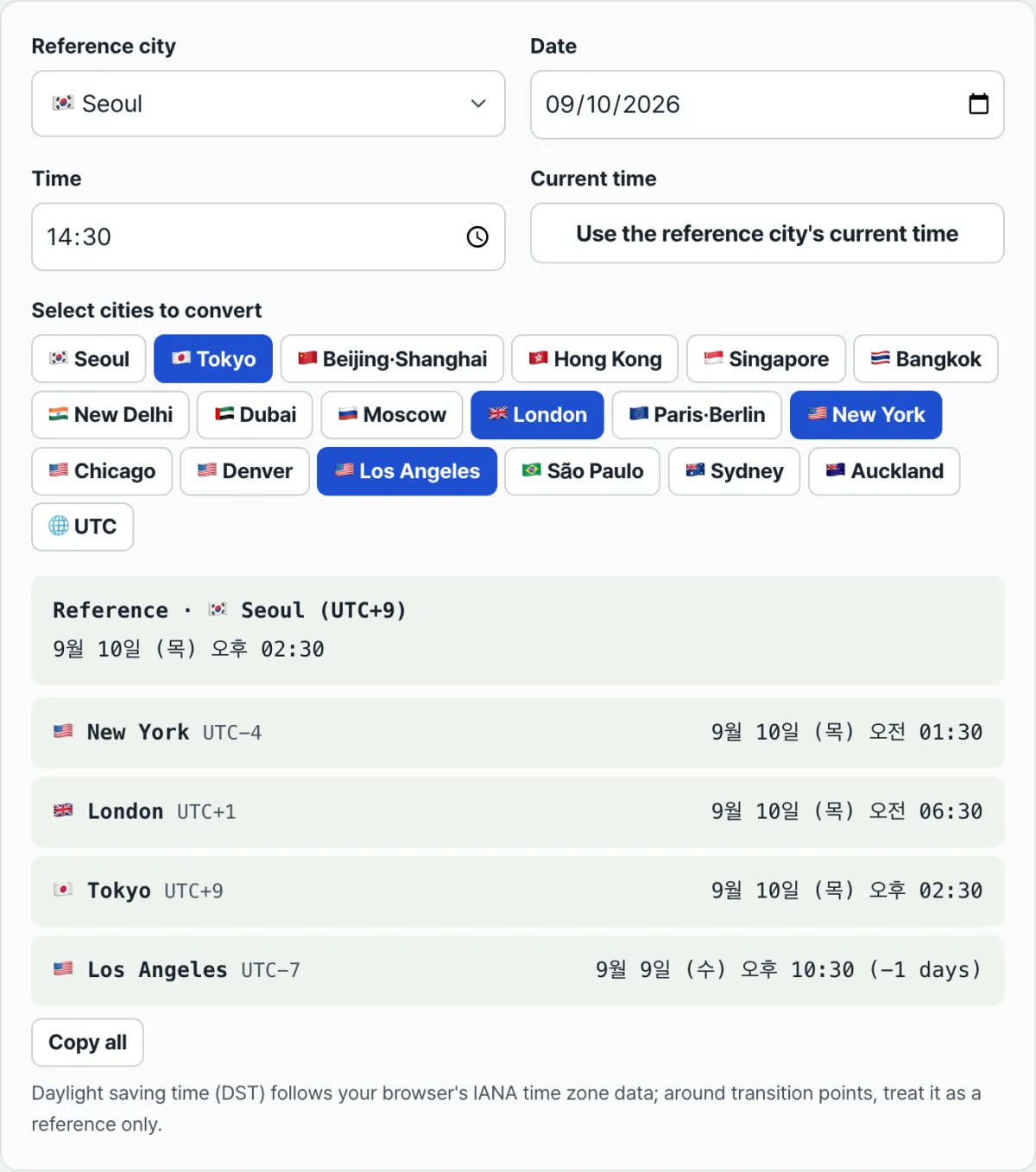
Instead of working through these five steps by hand every time, check with our free tool.
Free, no sign-up. Using your browser's built-in time zone data, convert a base city's time such as Seoul straight to the local time of any city you pick.
Common misreadings of conversion results
There are a few spots in the offsets and date labels a converter shows that people often misread.
| Misconception | Reality |
|---|---|
| Time differences are always whole hours | Some zones use 30- and 45-minute steps, like India (UTC+5:30), Nepal (UTC+5:45), and Adelaide, Australia (UTC+9:30) |
| "UTC+9" is a fixed value for that city | Cities that observe DST change offsets with the season (New York: UTC-5 in winter, UTC-4 in summer) |
| The "+1 day" label is extra information | It means the date has changed — key information, since it can put a meeting or deadline on the wrong day |
The "+1 day" or "-1 day" attached to a result compares the dates (which calendar day it is) in the two cities, not the times. The larger the gap and the more the pair crosses UTC midnight, the more often this label shows up.
For example, if you schedule a meeting at 11 p.m. in Seoul, Los Angeles is still in the morning of the previous day at that same moment. If you look only at the time and ignore the "-1 day" label, the other person may receive it as a schedule on a different day.
Summary
- A time difference is the difference between two cities' offsets, and some regions use 30- or 45-minute offsets (India UTC+5:30, Nepal UTC+5:45, and so on).
- Cities that observe DST change offsets with the season, so even the same two cities have a different gap in different seasons.
- The US and Europe start and end DST on different dates, so for about 2–3 weeks each spring and fall the gap differs from the usual number.
- Check the offset label like "UTC+9" and the "+1 day"/"-1 day" date label together to avoid scheduling something on the wrong day.
- The underlying logic is to look up the offset in each region's time zone data and convert to UTC — the same approach browsers and operating systems share.
Free, no sign-up. Using your browser's built-in time zone data, convert a base city's time such as Seoul straight to the local time of any city you pick.
Frequently asked questions
Does it account for daylight saving time (DST) automatically?
Yes. Offsets are calculated for the date you enter based on the time zone database built into your browser, so cities whose gap changes between summer and winter are handled automatically.
Can I use it to line up a meeting time across several cities?
Set your own time zone as the reference city and pick the cities you want to compare. It shows what time that same moment is in each place, plus whether the date rolls over to another day. It's useful for coordinating overseas video calls or deadlines.
Are there cases where the result is ambiguous?
Around the moment DST starts or ends, there can be a one-hour window that doesn't exist locally or that repeats twice. Treat times in that range as a reference, and if the schedule matters, double-check the actual local time with the other person.
Why do 30- and 45-minute time zones exist?
Because each country set its standard time at a non-whole-hour offset based on its geographic position or policy decisions. Well-known examples are India (UTC+5:30), Nepal (UTC+5:45), and parts of Australia (UTC+9:30).
This article was adapted from our Korean original. Read the Korean original