
Karvonen Formula: Calculate Target Heart Rate Zones From HRR
Contents
- Why target heart rate math gets confusing
- How to do the math by hand: the Karvonen formula in three steps
- How it differs from the simple %HRmax method
- Why the timing of your resting heart rate measurement changes the result
- Common mistake: mixing up %HRmax and %HRR zones
- The bottom line
- Frequently asked questions
If you calculate your target heart rate with the simple "60–70% of max heart rate" method, it ignores your resting heart rate — which varies from person to person — so you get a different number than the Karvonen formula gives you.
Both methods use the same "60–70%" phrasing, but they calculate 60–70% of different things. This article walks through the Karvonen formula's three-step process — HRmax, HRR, target heart rate — with the actual numbers filled in.
Summary ① The Karvonen formula runs in this order: HRmax = 220 − age → HRR = HRmax − resting heart rate → target heart rate = HRR × intensity% + resting heart rate. ② The simple %HRmax method doesn't use resting heart rate, so at the same intensity% its math produces a lower number than the Karvonen formula. ③ When you measure your resting heart rate changes your heart rate reserve (HRR), and that shifts all four intensity zones together.
Why target heart rate math gets confusing
You read that you should keep your workout at "60–70% of max heart rate," so you do the math yourself — and the formula differs from source to source. Some sources calculate from age alone. Others also ask for your resting heart rate.
Two people the same age can run two different calculators and get different results, because each formula defines the "60–70% zone" as a different actual bpm range.
The Karvonen formula is one of the formulas behind that gap. It adds a second variable — resting heart rate — so it lands somewhere different from the age-only method.
How to do the math by hand: the Karvonen formula in three steps
The Karvonen formula takes three steps. You can follow them in order without a calculator.
Step 1 — Find your max heart rate (HRmax). HRmax = 220 - age. If you're 30, HRmax = 220 - 30 = 190.
Step 2 — Find your heart rate reserve (HRR). HRR = HRmax - resting heart rate. If your resting heart rate is 70bpm, HRR = 190 - 70 = 120.
Step 3 — Find your target heart rate for each intensity. Target heart rate = HRR × (intensity% ÷ 100) + resting heart rate. Intensity is split into four zones: 50–60%, 60–70%, 70–80%, and 80–90%.
Results at all five points
Using the same example (age 30, resting heart rate 70bpm), here are all five points calculated out.
| Intensity | Calculation | Target heart rate |
|---|---|---|
| 50% | 120×0.50+70 | 130bpm |
| 60% | 120×0.60+70 | 142bpm |
| 70% | 120×0.70+70 | 154bpm |
| 80% | 120×0.80+70 | 166bpm |
| 90% | 120×0.90+70 | 178bpm |
Connect each pair of neighboring values and you get four intensity zones: 50–60% is 130–142bpm, 60–70% is 142–154bpm, 70–80% is 154–166bpm, and 80–90% is 166–178bpm.
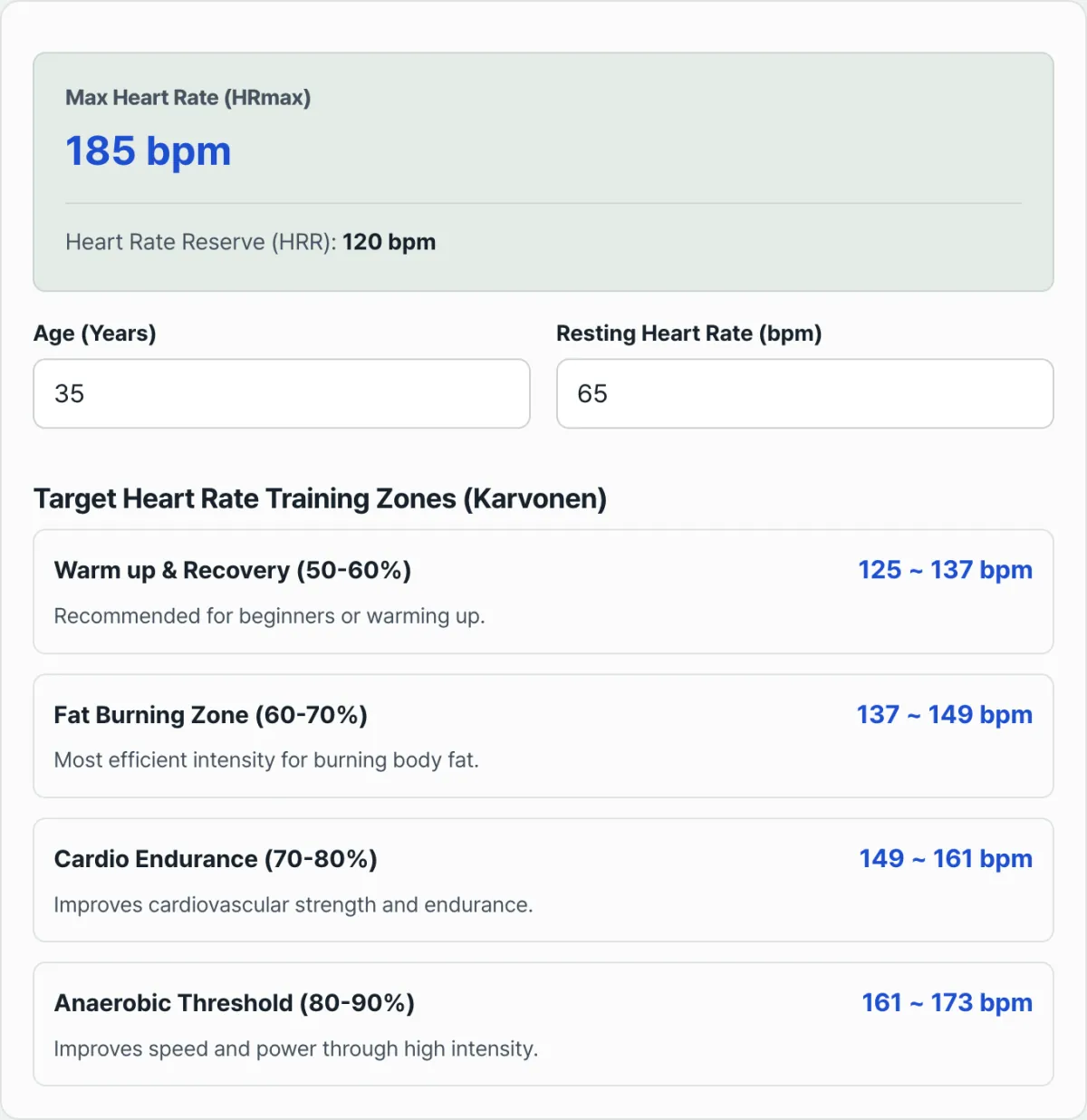
Rerunning this math every time you change your age or resting heart rate gets tedious. Try our free Target Heart Rate Calculator (Karvonen Formula).
Enter your age and resting heart rate and it calculates right in your browser. Your inputs are not sent to a server.
How it differs from the simple %HRmax method
The simple method calculates target heart rate = HRmax × intensity%. It doesn't use resting heart rate at all.
Applying the simple method to the same example (age 30, HRmax 190) gives this.
| Intensity | Karvonen formula (HRR-based) | Simple method (HRmax-based) |
|---|---|---|
| 50% | 130bpm | 95bpm |
| 60% | 142bpm | 114bpm |
| 70% | 154bpm | 133bpm |
| 80% | 166bpm | 152bpm |
| 90% | 178bpm | 171bpm |
How far apart the two methods land
The same "60–70% intensity" is 142–154bpm with the Karvonen formula and 114–133bpm with the simple method.
That's a 28bpm difference at the bottom of the zone and 21bpm at the top, and it comes directly from whether resting heart rate (70bpm) is part of the equation.
Which of the two better matches your actual fitness depends on your individual cardiovascular capacity, so this article doesn't make that call. Structurally, though, the lower your resting heart rate, the smaller the gap between the two methods.
Why the timing of your resting heart rate measurement changes the result
You can rewrite the three-step formula as target heart rate = HRmax×intensity% + resting heart rate×(1-intensity%). It's the same equation, just expanded.
In that form, resting heart rate gets multiplied by (1-intensity%). The lower the intensity, the larger that multiplier; the higher the intensity, the smaller it gets.
Take the same age (30) and enter a resting heart rate of 85bpm instead of 70bpm (a measurement that came out 15bpm high). Here's the difference.
| Intensity | Resting 70bpm | Resting 85bpm | Difference |
|---|---|---|---|
| 50% | 130bpm | 137.5bpm | +7.5bpm |
| 90% | 178bpm | 179.5bpm | +1.5bpm |
Error from measurement timing
The error is the same 15bpm in both cases, yet it moves the 50% zone by 7.5bpm and the 90% zone by only 1.5bpm. That's the structure of the math: lower intensity zones are more sensitive to your resting heart rate reading.
Your resting heart rate is generally lowest and steadiest right after you wake up, measured before you get out of bed. Measure during activity or after coffee and it tends to read higher.
Common mistake: mixing up %HRmax and %HRR zones
The most common mix-up is seeing "60–70% intensity" and never asking whether that's 60–70% of HRmax or 60–70% of HRR.
Say you pulled "60–70% zone" numbers from one source, then checked a calculator running the Karvonen formula (HRR-based). The two numbers came from different equations, so you can't compare them directly.
As the tables above show, the same 60–70% comes out roughly 20–30bpm apart between the two methods.
%HRmax vs. %HRR: what to check
| What to check | Simple %HRmax | Karvonen %HRR |
|---|---|---|
| Uses resting heart rate | No | Yes |
| Base value | HRmax only | HRR (HRmax - resting heart rate) |
| Result at the same intensity% | Relatively lower | Relatively higher |
When you look at a source or a calculator, don't stop at the "%" — check what that % gets multiplied by (HRmax or HRR) so you're comparing on the same basis.
The bottom line
- The Karvonen formula runs in this order: HRmax = 220 - age → HRR = HRmax - resting heart rate → target heart rate = HRR × intensity% + resting heart rate.
- The simple %HRmax method doesn't use resting heart rate, so at the same intensity% it gives a lower number than the Karvonen formula.
- Resting heart rate enters the result multiplied by (1-intensity%), so in lower intensity zones the timing of your measurement matters more.
- When you see "intensity %," check whether it's based on HRmax or HRR so you don't compare two different methods by accident.
Enter your age and resting heart rate and it calculates right in your browser. Your inputs are not sent to a server.
Frequently asked questions
Is the Karvonen formula more accurate than the simple age-based method?
The two methods use different variables. The Karvonen formula uses two — age and resting heart rate. The simple method uses one, age.
Which one comes closer to your actual fitness depends on your individual cardiovascular capacity, so this article doesn't recommend one over the other.
When should I measure my resting heart rate?
Generally, the reading right after you wake up, before you get out of bed, is the lowest and steadiest of the day. Measure during activity or after coffee and it tends to come out higher, which can shift your whole set of results.
When someone says "target heart rate 60–70%," is that %HRmax or %HRR?
You can't tell from the phrasing alone, because sources use different formulas. Check the equation itself — is it HRmax × intensity%, or (HRmax - resting heart rate) × intensity% + resting heart rate? That tells you which basis you're on.
Do results update right away if I change my age or resting heart rate in the calculator?
Yes. There's no calculate button — max heart rate, heart rate reserve, and all four intensity zones recalculate the moment you change an input. Everything runs in your browser, so your inputs are never sent to a server.
This article was adapted from our Korean original. Read the Korean original