
Widmark Formula: How to Calculate BAC Step by Step
Contents
The Widmark formula estimates blood alcohol content (BAC) from how much you drank, the alcohol percentage, your body weight and sex, and the time since your last drink. This post is for anyone who wants to know how the number on the calculator screen is produced. It walks through the math in order: alcohol mass, the Widmark factor (r), the hourly elimination rate, and the BAC thresholds in South Korea's Road Traffic Act.
The short version: the Widmark Formula BAC Calculator uses the average Widmark factor (0.68 for men, 0.55 for women) for its estimate. It also shows a lowest-to-highest range using the full factor range (0.52–0.86 for men, 0.47–0.64 for women). The result is judged against South Korea's Road Traffic Act limits: 0.03% or higher is the license suspension range, and 0.08% or higher is the license revocation range.
Summary ① Alcohol mass (g) = total volume of drink (mL) × alcohol percentage (%) × alcohol density (0.7894) ② The Widmark factor r uses the average of 0.68 for men and 0.55 for women. The range that varies from person to person (0.52–0.86 for men, 0.47–0.64 for women) is calculated too. ③ Subtract elapsed hours × 0.015% per hour from the peak BAC, then compare the result with the Road Traffic Act thresholds (0.03%, 0.08%, 0.2%) ④ The result is only an estimate. It is never a reason to think it's OK to drive.
Why You Should Know How the Calculation Works
You enter your weight, sex, and drinks into an online BAC calculator. Two people who had the same number of drinks can still get different numbers. It's hard to tell whether one result is wrong or whether that's just how the math works.
That confusion comes from not knowing the calculation itself. The Widmark formula combines five inputs in a fixed order: sex, body weight, type of drink, number of drinks, and time elapsed. Once you know the order, you can see right away why results differ.
How to Calculate It by Hand
The Widmark formula works in four steps. Follow them in order and you'll get the same result by hand that a calculator gives you.
Step 1: Find the Alcohol Mass
First, multiply the standard serving size for your drink (soju, beer, makgeolli, or liquor) by the number of drinks. That gives you the total volume (mL). Then factor in the alcohol percentage to get the weight of the alcohol you actually consumed (g).
Alcohol mass (g) = total volume (mL) × (alcohol percentage / 100) × 0.7894
0.7894 is the density of alcohol (ethanol). For the same volume, a higher alcohol percentage or more drinks means a larger alcohol mass.
Step 2: Apply the Widmark Factor (r) to Get Peak BAC
Peak BAC (%) = (alcohol mass × 0.7 ÷ (body weight × r)) × 0.1
0.7 is the assumed share of the alcohol you drink that your body absorbs. r is the Widmark factor (body distribution coefficient). In Widmark's research it varied from person to person: 0.52–0.86 for men (average 0.68) and 0.47–0.64 for women (average 0.55). South Korean investigations and court proceedings also use these ranges. The calculator gives its estimate using the average, and it also shows a lowest-to-highest estimate using the two ends of the range. Because r is in the denominator, a smaller r gives a higher BAC.
An earlier version of this calculator used only the largest value in each range (0.86 for men, 0.64 for women), which gives the lowest BAC. It now uses the average instead.
For example, say the alcohol mass is 60 g. For a 70 kg man (r = 0.68), the peak BAC is 60 × 0.7 ÷ (70 × 0.68) × 0.1 = about 0.088%. Using the full r range (0.52–0.86) gives about 0.070–0.115%.
A woman with the same weight and the same intake (r = 0.55) comes out to about 0.109% (range about 0.094–0.128%). Even with the same weight and the same amount of alcohol, the value of r can change which category the result falls into.
Step 3: Subtract the Alcohol Your Body Has Eliminated
Current BAC (%) = peak BAC − (0.015 × hours elapsed)
0.015% per hour is the average rate at which BAC falls. In reality it varies by person, from roughly 0.008% to 0.03% per hour. If the result drops below 0, it is treated as 0.
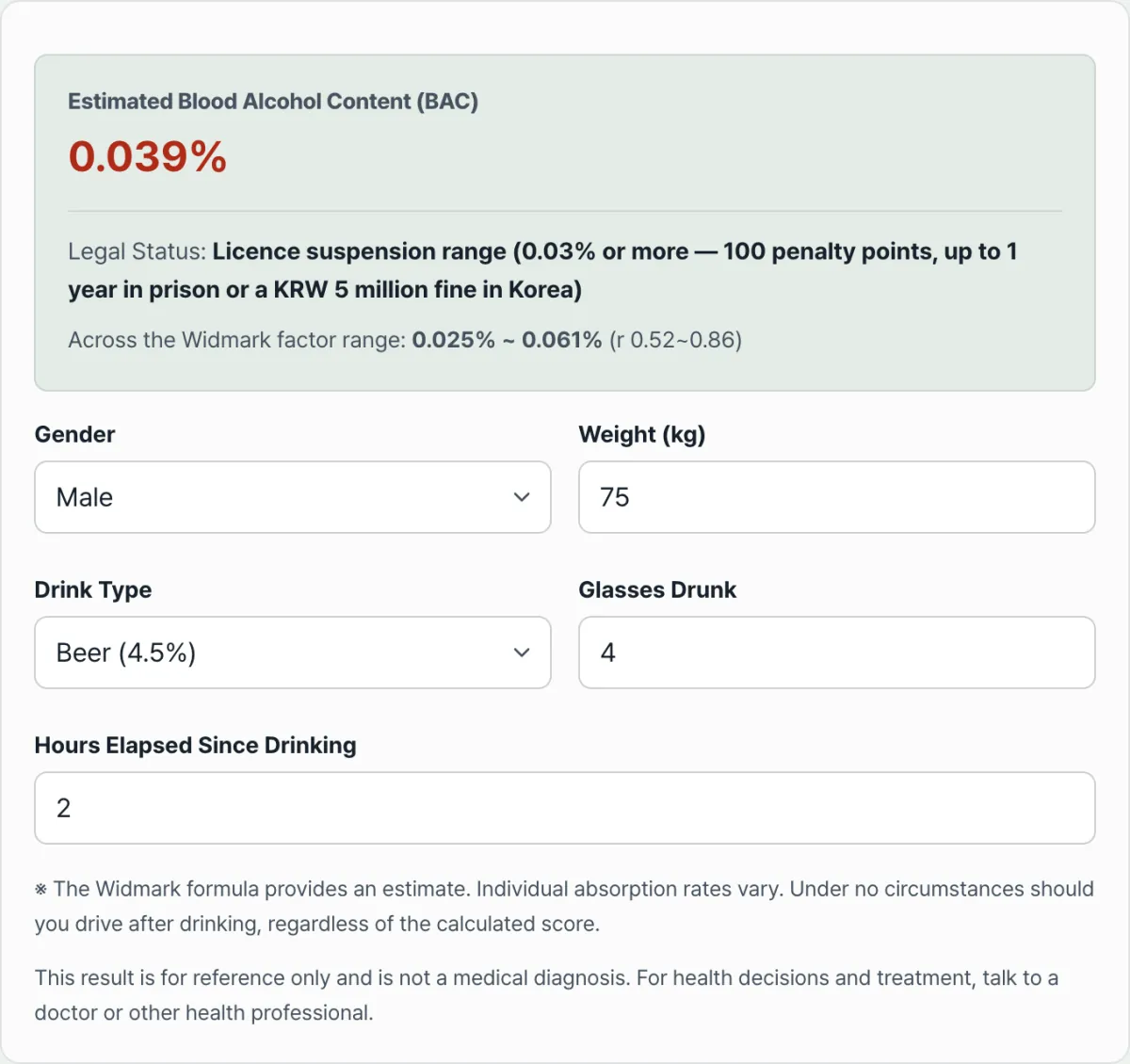
Continuing the man's example (peak BAC 0.088%): after 2 hours, it's 0.088 − 0.03 = 0.058%. After 4 hours, it's 0.088 − 0.06 = 0.028%.
Step 4: Compare the Result with the Two Threshold Lines
Compare the calculated current BAC with the Road Traffic Act thresholds and sort it into one of the categories below.
| BAC | Administrative penalty | Criminal penalty (Road Traffic Act, Article 148-2) |
|---|---|---|
| 0.03% or higher, under 0.08% | License suspension (100 demerit points) | Up to 1 year in prison or a fine of up to 5 million won |
| 0.08% or higher, under 0.2% | License revocation | 1–2 years in prison or a fine of 5–10 million won |
| 0.2% or higher | License revocation | 2–5 years in prison or a fine of 10–20 million won |
If the result is under 0.03%, the calculator only says "Estimated below the enforcement limit." That does not mean it's OK to drive. The standard for driving under the influence (0.03%) is in Article 44, Paragraph 4 of the Road Traffic Act. The standards for license revocation and suspension are in Appendix 28 of the Act's Enforcement Rule. A repeat offense within 10 years is punished more severely.
Back to the example: at 2 hours (0.058%), the man is in the license suspension range. At 4 hours (0.028%), he is estimated to be below the enforcement limit. But using the highest estimate from the r range (0.115%), he is still at 0.055% after 4 hours, which is in the suspension range. That's why you shouldn't feel safe looking at the average alone.
Working out five inputs by hand every time is tedious. Check it with our Widmark Formula BAC Calculator.
Enter your sex, body weight, drink type, number of drinks, and time elapsed, and the Widmark Formula BAC Calculator instantly estimates your blood alcohol content. All calculations run in your browser only.
Common Points of Confusion
When you work through the Widmark formula by hand, a few misunderstandings come up often.
| Common misunderstanding | How the calculation actually works |
|---|---|
| Same number of drinks means the same result | Each type of drink has a different standard serving size and alcohol percentage, so the same number of drinks can give a different alcohol mass |
| r is a single fixed value for each sex | It varies from person to person (0.52–0.86 for men, 0.47–0.64 for women), and that difference alone can change the category |
| Elimination speed is adjusted for each person | This calculator applies 0.015% per hour (the average) to every input |
| The number keeps dropping below zero | Once the calculated value falls below 0, it stops and stays at 0 |
As the table shows, the Widmark formula doesn't account for your actual metabolism or body differences. It uses fixed averages: 0.7 for absorption and 0.015% for elimination. That's why the same inputs can still give a result that differs from a measured BAC.
Summary
Here is the Widmark calculation in five steps:
- Find the total volume (mL) from the type of drink and the number of drinks
- Find the alcohol mass (g): total volume × alcohol percentage × 0.7894
- Find the peak BAC: alcohol mass × 0.7 (absorption rate) ÷ (body weight × Widmark factor r), then multiply by 0.1 (averages: 0.68 for men, 0.55 for women)
- Find the current BAC: subtract elapsed hours × 0.015% from the peak BAC (if it's below 0, use 0)
- Compare the current BAC with the Road Traffic Act thresholds (0.03%, 0.08%, 0.2%)
Every step is a fixed formula, so you can do it by hand. But if you want to change the five inputs and compare how the result shifts, it's faster to enter them in the calculator.
Enter your sex, body weight, drink type, number of drinks, and time elapsed, and the Widmark Formula BAC Calculator instantly estimates your blood alcohol content. All calculations run in your browser only.
Frequently Asked Questions
Who created the Widmark formula?
Swedish forensic scientist Erik Widmark introduced it in the 1930s. It estimates blood alcohol concentration from the amount of alcohol consumed, body weight, and differences in body water distribution between the sexes. It is still widely used as a reference formula for gauging drinking-related numbers.
Is the calculated result the same as a real breathalyzer reading?
Not necessarily. The calculation uses fixed average values, such as an absorption rate of 0.7 and an elimination rate of 0.015% per hour. Your actual metabolism and body makeup can make a measured result differ from the estimate.
Why are the results different for men and women at the same weight?
It comes down to the Widmark factor (r). It reflects differences in body water percentage, and the formula uses an average of 0.68 for men and 0.55 for women. Because r is in the denominator, a lower r value (women) produces a higher result, even when weight and the amount of alcohol are the same.
What does it mean that BAC drops by 0.015% per hour?
It is a fixed elimination rate. The formula multiplies the elapsed time by 0.015% per hour and subtracts that amount directly from the peak BAC. Actual elimination speed varies from person to person (roughly 0.008 to 0.03% per hour), but the formula applies the same average value to every input.
Is it OK to drive if my result is under 0.03%?
No. The calculated value is only an estimate, and your actual BAC could be higher. If you have been drinking, don't drive, no matter what the number says.
Sources
- Road Traffic Act of Korea, Article 44 (Prohibition of Driving While Intoxicated) and Article 148-2 (Penalties), Korea Ministry of Government Legislation, National Law Information Center https://www.law.go.kr/%EB%B2%95%EB%A0%B9/%EB%8F%84%EB%A1%9C%EA%B5%90%ED%86%B5%EB%B2%95 (effective 2026-10-13, accessed 2026-11-17)
- Enforcement Rule of the Road Traffic Act, Appendix 28 (Standards for Revocation and Suspension of Driver's Licenses), National Law Information Center https://www.law.go.kr/%EB%B2%95%EB%A0%B9/%EB%8F%84%EB%A1%9C%EA%B5%90%ED%86%B5%EB%B2%95%EC%8B%9C%ED%96%89%EA%B7%9C%EC%B9%99 (accessed 2026-11-17)
This article was adapted from our Korean original. Read the Korean original