
Loan Amortization Schedule: How Each Payment Is Calculated
Contents
The repayment method you choose — equal total payments, equal principal, or interest-only until maturity — changes how much you pay each month and how much interest you pay in total, even when the principal and interest rate are the same. Once you know the order in which the payment-by-payment schedule in your contract is calculated, you can check the bank's numbers yourself instead of just trusting the table they give you.
This post explains how each of the three repayment methods splits principal and interest in every payment, and in what order the math runs.
Summary ① Interest in every payment is always starting balance × monthly rate. As the balance falls, the interest falls too. ② With equal total payments, you pay the same amount every month. With equal principal, your payment shrinks each month. With interest-only until maturity, you pay only interest until the final payment. ③ Under the same terms, total interest is lowest with equal principal and highest with interest-only until maturity.
Why each repayment method produces a different schedule
All three methods use the same interest formula each month. Interest for the month = starting balance × monthly rate. What changes is how much principal you repay each month.
- Equal total payments: The combined principal and interest (the monthly payment) stays fixed from start to finish. As the balance falls, interest makes up a smaller share and principal a larger share.
- Equal principal: The principal you repay each month is fixed (loan principal ÷ number of payments). The balance drops quickly, so interest drops quickly too, and your monthly payment gets a little smaller every month.
- Interest-only until maturity: You pay no principal at all until the final payment — only interest. The balance never falls, so the monthly interest stays the same, and in the last payment you pay the entire principal plus that month's interest in one go.
How to calculate interest and principal for each payment yourself
Take equal total payments as an example. Using the loan principal (P), the monthly rate (i = annual rate ÷ 100 ÷ 12), and the total number of payments (n), the monthly payment (A) is:
A = P × i × (1+i)^n ÷ [(1+i)^n − 1]
Once A is set, repeat these three steps for each payment to fill in the table.
- Interest this payment = starting balance × i
- Principal this payment = A − interest this payment
- New balance = starting balance − principal this payment
For example, on a ₩12,000,000 loan at 6% a year (0.5% a month) repaid over 12 months with equal total payments, the monthly payment A is about ₩1,032,797. Repeating the three steps above gives you this.
| Payment | Starting balance | Monthly payment | Interest this payment | Principal this payment | New balance |
|---|---|---|---|---|---|
| Payment 1 | ₩12,000,000 | ₩1,032,797 | ₩60,000 | ₩972,797 | ₩11,027,203 |
| Payment 2 | ₩11,027,203 | ₩1,032,797 | ₩55,136 | ₩977,661 | ₩10,049,542 |
| Payment 3 | ₩10,049,542 | ₩1,032,797 | ₩50,248 | ₩982,549 | ₩9,066,992 |
| ... | ... | ... | ... | ... | ... |
| Payment 12 | ₩1,027,659 | ₩1,032,797 | ₩5,138 | ₩1,027,659 | ₩0 |
The final payment (payment 12) is the exception. Up to that point you just repeat the three steps, but if you keep doing the math by hand rounded to the nearest won, a few won can still be left over in payment 12. So in the final payment you skip step 2 (monthly payment − interest this payment) and apply the entire starting balance as the principal payment, bringing the balance to exactly ₩0. Equal principal and interest-only until maturity work the same way for step 1 (calculating interest). Only step 2 (how you set the principal payment) is different.
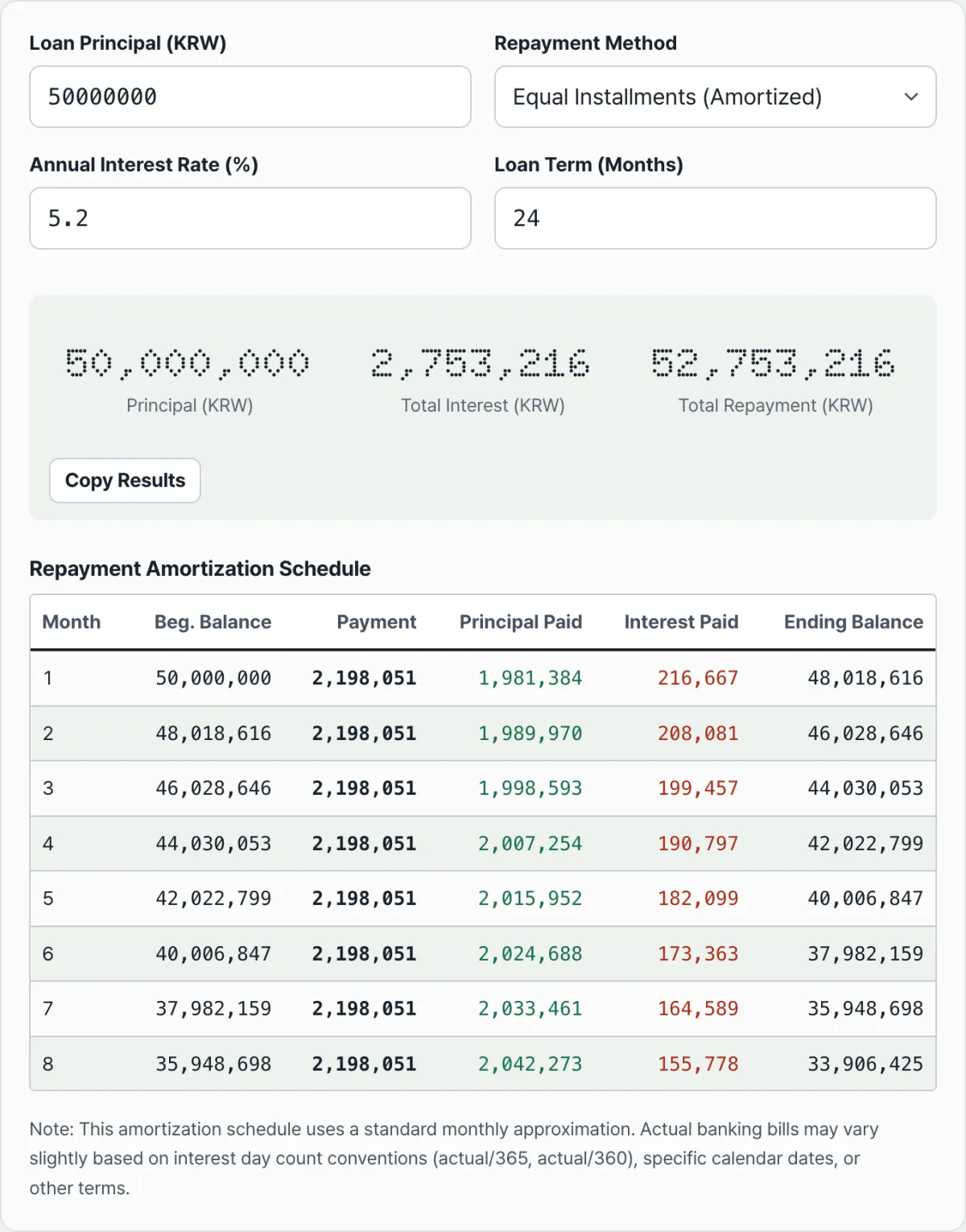
If you'd rather not repeat the math by hand. Our free Loan Amortization Schedule Generator asks only for the principal, annual rate, term, and repayment method, then calculates the whole payment-by-payment table for you.
Enter the loan amount, annual rate, term, and repayment method to see a table of principal, interest, and total interest paid for every payment.
How the three repayment methods differ in the table
With the same principal, the same interest rate, and the same term, switching the repayment method changes things like this.
| Method | What you pay each month | How fast principal falls | Total interest |
|---|---|---|---|
| Equal total payments | Always the same | Faster as the payments go on | More than equal principal, less than interest-only |
| Equal principal | Falls as the payments go on | Always the same | Lowest of the three |
| Interest-only until maturity | The same until the final payment (interest only) | Zero until the final payment | Highest of the three |
Why total interest differs by method is simple. Interest is charged on the balance at that moment every time, so the faster a method repays principal, the faster the balance that interest is charged on shrinks — and the lower the total interest across all payments.
Common sticking points
| Situation | Why |
|---|---|
| The result is a few won off from what the bank actually charges | Banks use daily proration based on the actual days elapsed, while this calculation treats each month as a single unit — it's a monthly approximation |
| I made a prepayment and the table no longer matches | The table reflects only the original terms, before contract changes such as prepayments or payment holidays |
| I only changed the repayment method and the total interest changed | Even with the same loan principal, rate, and term, changing the method changes how fast principal is repaid each period, so total interest changes too. Your loan terms didn't change — the calculation method did |
The bottom line
- Interest in every payment is always calculated as starting balance × monthly rate.
- With equal total payments, the amount you pay each month is fixed. With equal principal, the principal you repay each month is fixed. With interest-only until maturity, you pay only interest until the final payment.
- Under the same terms, total interest grows in this order: equal principal < equal total payments < interest-only until maturity.
- What the bank actually charges can differ slightly from this table because of daily proration and similar factors.
Enter the loan amount, annual rate, term, and repayment method to see a table of principal, interest, and total interest paid for every payment.
Frequently asked questions
Which repayment method has the lowest total interest?
Looking at total interest alone, equal principal is the lowest. Because the principal you repay each month is fixed, the balance drops faster, so the amount that interest is charged on shrinks faster. The catch is that your payments in the first few months are higher than with equal total payments. Each method has a different payment size and pattern, so it's most accurate to compare total interest and month-by-month payments side by side in a table.
Why does the calculator's result differ from what my bank charges?
This calculation approximates the annual rate with a monthly rate, dividing it by 12. Actual financial institutions also factor in the number of days used in the interest calculation (including whether holidays count), the exact payment dates, and contract terms such as prepayment fees, so results can differ by a few won.
This article was adapted from our Korean original. Read the Korean original