
How fast is Mach 1 in km/h? m/s conversion formulas
Contents
The speed of sound — Mach 1 — is 343 m/s in dry air at 20°C (68°F). Converted to an hourly rate, that's about 1,234.8 km/h.
This post lays out two things: Mach is not a vague "how many times faster" feeling but simple division by a reference value of 343 m/s, and the five units — m/s, km/h, mph, knots, and Mach — are tied together by different multipliers.
It's for anyone who wants to take a speed from the news, like a KTX train's top speed or a typhoon's wind speed, and convert it into another unit themselves.
Summary ① Mach 1 (the speed of sound) is 343 m/s in dry air at 20°C, about 1,234.8 km/h. ② Multiply m/s by 3.6 to get km/h, by 2.236936 to get mph, and by 1.943844 to get knots. ③ Mach isn't a multiplier — it's m/s divided by 343. And knots are based on the nautical mile (1,852 m), so they don't match km/h.
Why It Gets Confusing - Five Units Split the Same Speed
The news uses units inconsistently for the same "speed." Korea's weather service advisories report peak gust speeds in m/s, road signs use km/h, and aviation stories bring in Mach or knots.
Numbers alone don't tell you much. "Peak gust of 40 m/s" doesn't immediately register as how hard that wind feels on the road, and "Mach 2" doesn't instantly say exactly how many times faster than an airliner that is.
The real problem is that the five units don't all scale the same way. The 3.6 multiplier from m/s to km/h and the 2.236936 multiplier to mph are different numbers, and Mach is division, not multiplication. So eyeballing it goes wrong a lot.
How to Do the Math Yourself Without a Tool
Four multiplication and division formulas cover every conversion. The base unit is m/s (distance traveled per second), and the other four units come from it.
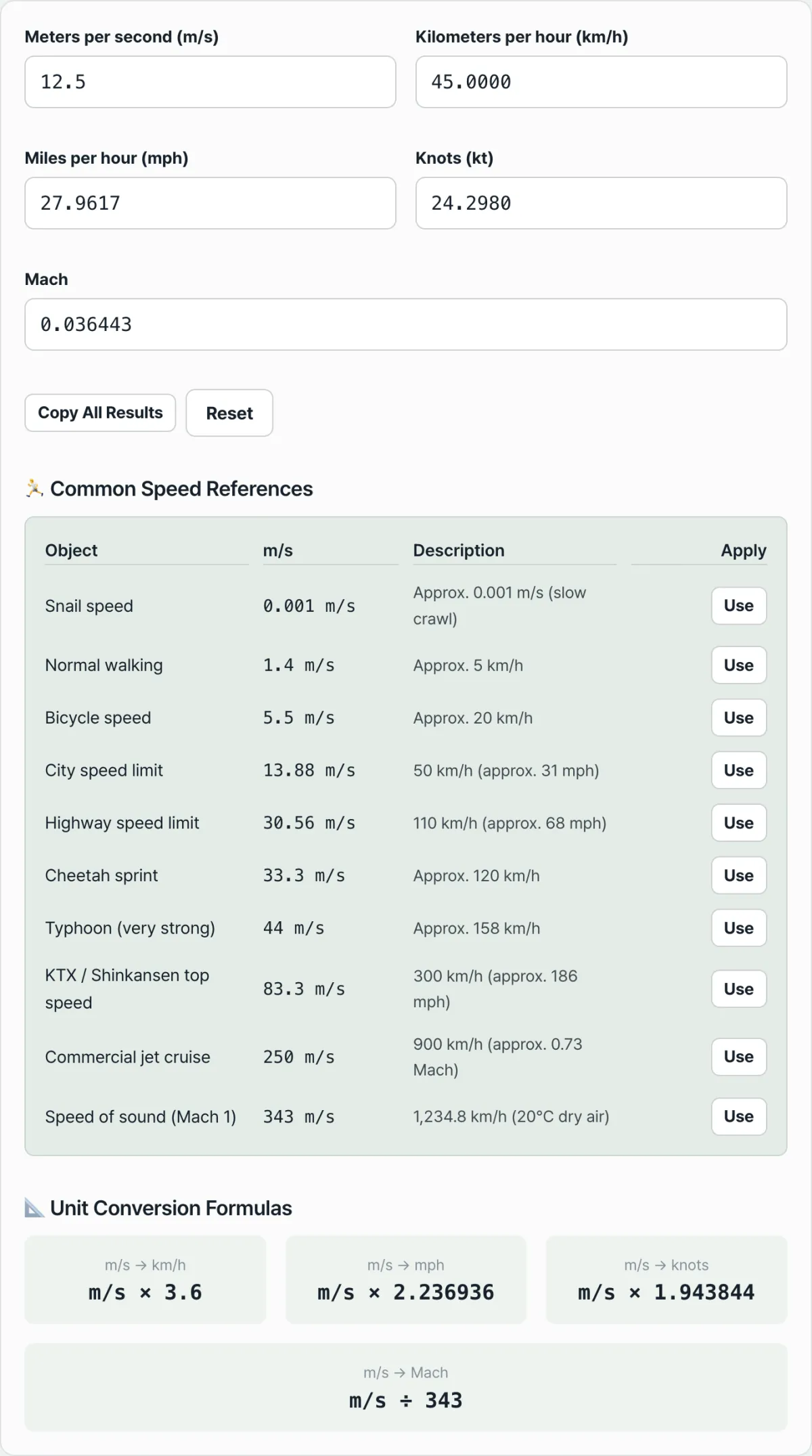
- km/h = m/s × 3.6
- mph = m/s × 2.236936
- knots = m/s × 1.943844
- Mach = m/s ÷ 343 (speed of sound in dry air at 20°C)
Going the other way, from a unit like km/h, first divide by 3.6 to get back to m/s, then apply the formulas above.
Example 1 — Converting the KTX top speed of 300 km/h into other units
- To m/s: 300 ÷ 3.6 ≈ 83.33 m/s
- To mph: 83.33 × 2.236936 ≈ 186.4 mph
- To knots: 83.33 × 1.943844 ≈ 162.0 knots
- To Mach: 83.33 ÷ 343 ≈ 0.243 (about 24% of the speed of sound)
Example 2 — Converting a typhoon advisory's peak gust of 40 m/s into an hourly rate
40 × 3.6 = 144 km/h. When a weather service advisory gives you m/s, this one multiplication puts it into the hourly speed you're used to.
The same method gives you the speed of sound in real-world terms. 343 × 3.6 = 1,234.8 km/h, 343 × 2.236936 ≈ 767.3 mph, and 343 × 1.943844 ≈ 666.7 knots.
Check it with our free tool.
Enter one m/s value and get km/h, mph, knots, and Mach at the same time. Free to use, with no install or sign-up.
Where People Get Mixed Up
| Unit | 1 unit = how many m/s | Basis | Where it's used |
|---|---|---|---|
| km/h | about 0.2778 m/s | 1 km = 1,000 m | Road signs, everyday news |
| mph | about 0.44704 m/s | 1 mile = 1,609.344 m | Roads in the US and UK |
| knots | about 0.514444 m/s | 1 nautical mile = 1,852 m | Aviation and marine navigation |
| Mach 1 | 343 m/s | Speed of sound (dry air at 20°C) | Aircraft, supersonic flight |
Knots and km/h look close in number, so people mix them up constantly. 1 knot is about 1.852 km/h — a bit more than 1 mph (about 1.609 km/h). If a boat's speed is "20 knots," that's not 20 km/h; it's about 37 km/h.
Mach works differently from the other four. km/h, mph, and knots are linear conversions: you multiply m/s by a fixed factor. Mach is a division by a physical reference value, 343.
This calculator treats 343 m/s — the speed of sound in dry air at 20°C — as Mach 1. The real speed of sound changes with temperature and altitude, so under different conditions the same speed can give you a different Mach number.
The Short Version
- Mach 1 (the speed of sound) is 343 m/s in dry air at 20°C, about 1,234.8 km/h.
- km/h is m/s × 3.6, mph is m/s × 2.236936, and knots is m/s × 1.943844.
- Mach isn't a multiplier — it's m/s divided by 343, and the real speed of sound varies with temperature and altitude.
- Knots are based on the nautical mile (1,852 m), so the same number means a bigger speed than it would in km/h.
- All five units come from m/s, so if you know one value you can get the rest with the formulas.
Enter one m/s value and get km/h, mph, knots, and Mach at the same time. Free to use, with no install or sign-up.
Frequently Asked Questions
Is the speed of sound (Mach 1) always 1,234.8 km/h?
Under the reference conditions (dry air at 20°C), it's 343 m/s, or about 1,234.8 km/h. The real speed of sound changes with temperature and altitude, so under other conditions it can differ from that figure. This calculator uses the dry-air-at-20°C value.
Why do knots exist as a separate unit?
A knot is the speed of traveling one nautical mile (1,852 m) per hour, and it's mainly used in aircraft and ship navigation. 1 knot is about 1.852 km/h, so the same number means a bigger speed than it would in km/h.
How do I convert a KTX or highway speed into mph?
First divide the km/h value by 3.6 to get m/s, then multiply that by 2.236936 to get mph. For example, the KTX top speed of 300 km/h is about 186.4 mph.
Is Mach 2 exactly twice as fast as Mach 1?
Under the same reference (343 m/s), yes. Mach is just actual speed divided by 343, so Mach 2 is 686 m/s and Mach 1 is 343 m/s — exactly double. But if the reference speed of sound itself changes with temperature and altitude, that comparison shifts along with it.
This article was adapted from our Korean original. Read the Korean original